
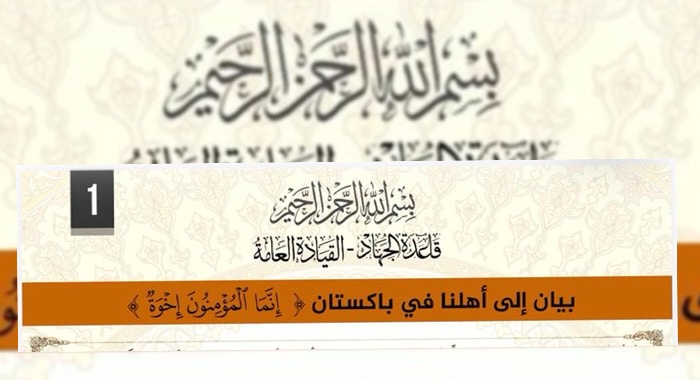
A statement attributed to Al-Qaeda’s General Command has reportedly issued a sharply worded message directed at Pakistan’s civil and military leadership, marking a significant escalation in the group’s rhetorical posture, according to regional monitoring sources.
The statement, which is circulating across open-source platforms, adopts a highly confrontational tone and aligns with historical patterns of extremist messaging previously directed at Pakistan. Analysts note that the language and structure are consistent with propaganda formats used by the group in earlier phases of regional conflict narratives.
According to the content of the statement, Al-Qaeda declares its support for the Taliban “to the best of its ability and energy” against Pakistan’s state institutions. Security observers interpret this as an explicit attempt to reinforce ideological alignment narratives and signal solidarity between militant actors operating in the region.
The statement further frames Pakistan’s civil and military leadership within a broader ideological critique, referencing contemporary geopolitical alignments and drawing comparisons to earlier post-9/11 strategic developments. Analysts suggest such framing is intended to revive historical narratives that have previously been used to justify anti-state messaging.
Security experts caution that statements of this nature often serve multiple strategic purposes, including psychological influence, narrative amplification, and attempts to exploit perceived political or institutional fault lines. They emphasize that extremist organizations frequently use media statements to project influence beyond their actual operational capabilities.
The emergence of this communication has renewed attention on the broader regional security environment, where militant groups continue to use Afghanistan-linked and transnational narratives to shape ideological discourse and expand propaganda reach.



