
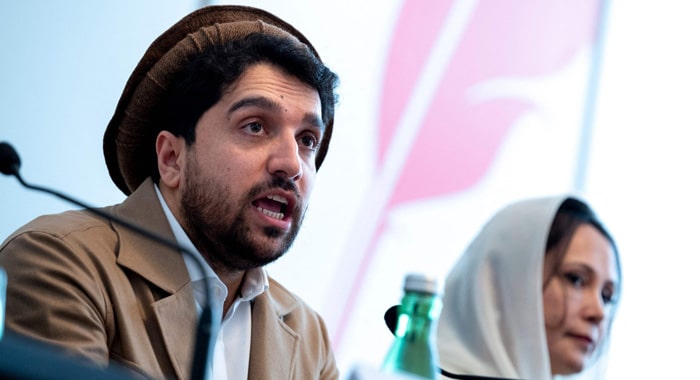
Ahmad Massoud, leader of the National Resistance Front (NRF), has called for sustained civic, intellectual, and field-based efforts to challenge what he described as the “illegitimate rule of the Taliban,” stating that the current situation in Afghanistan cannot continue indefinitely.
Speaking at an online event marking April 28 the date in 1992 when mujahideen forces entered Kabul following the fall of the government of Mohammad Najibullah Massoud described the ongoing political order in Afghanistan as unsustainable and lacking both domestic and international legitimacy.
He characterized the current administration in Afghanistan as a “despotic group,” adding that no system built on repression or exclusion can endure. According to Massoud, the suppression of women, youth, and political freedoms reflects a governance structure that does not represent the future of the Afghan people.
Massoud further stated that the continuation of present conditions is not in the interest of Muslims and expressed confidence that change in Afghanistan is inevitable in the near future.
Emphasizing the importance of legitimacy in governance, he said that no political system can survive without recognition both internally and externally. He reiterated that sustainable governance requires broad-based acceptance and participation.
In his remarks, Massoud also indirectly accused the Taliban of contributing to ethnic divisions within Afghanistan. He contrasted the Afghan situation with Iran, describing it as a more ethnically diverse society that has, according to him, achieved a shared political understanding of national identity and cohesion.
He referred to historical examples of unity in Iran, stating that despite external pressure, its population has maintained collective solidarity in the face of challenges.
Massoud also addressed recent commemorations related to his father, Ahmad Shah Massoud, stating that some individuals, whom he referred to as “Pakol-wearers,” attempted to misuse his father’s legacy in a manner he described as provocative and disrespectful.
In his speech, he further asserted that the Taliban do not represent the Pashtun ethnic group as a whole. He emphasized that, in his view, “responsible and educated Pashtuns” bear an important role in recognizing that the Taliban’s governance model does not align with national unity. He also stated that Pashtuns have suffered significant losses over the past two decades.
The NRF leader concluded by underscoring his belief that Afghanistan’s future must be built on inclusivity, legitimacy, and unity among all ethnic groups, rejecting what he described as divisive governance practices.
The virtual event brought together supporters and participants from various regions to reflect on historical and political developments in Afghanistan and to discuss the country’s future trajectory.



