
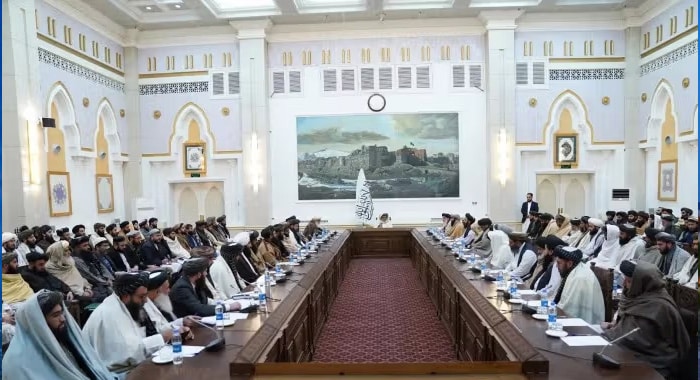
A comprehensive new dataset compiled by an Australia-based research institution has mapped more than 1,200 Taliban leaders and officials, revealing a concentrated pattern of international sanctions targeting the group’s senior leadership and underscoring its continued isolation within the global system.
The Middle East Institute reports that it has collected, verified, and analyzed detailed profiles of over 1,200 individuals associated with the Taliban structure. Of these, only 67 individuals—approximately 5.7 percent—are currently subject to formal international sanctions, though these include a significant proportion of the group’s top leadership.
According to the findings, sanctions are heavily concentrated at cabinet level, with between 13 and 14 of the Taliban’s 33 ministers listed under United Nations sanctions, based on updates issued by the UN Security Council’s 1988 Sanctions Committee in March and April 2026.
Those designated include several of the Taliban’s most senior officials, such as Prime Minister Mohammad Hassan Akhund, Deputy Prime Minister for Economic Affairs Abdul Ghani Baradar, Deputy Prime Minister for Administrative Affairs Abdul Salam Hanafi, Interior Minister Sirajuddin Haqqani, and Foreign Minister Amir Khan Muttaqi, alongside ministers responsible for key governance portfolios including energy, economy, justice, mines, and transport.
The United Nations sanctions framework rooted in Security Council resolutions 1267 (1999) and 1988 (2011)—imposes asset freezes, travel bans, and arms embargoes on individuals and entities deemed to pose risks to international peace, stability, and security in Afghanistan.
Current UN listings include 135 individuals and five entities linked to the Taliban, with periodic updates reflecting ongoing assessments by the sanctions committee. Recent revisions have adjusted entries for 26 Taliban-linked officials in recent months.
The European Union and the United Kingdom largely align their sanctions regimes with the UN framework, maintaining coordinated restrictive measures including asset freezes and travel restrictions. The EU similarly maintains listings covering 135 individuals and five entities.
The United States enforces a significantly broader sanctions regime, designating the Taliban under its Specially Designated Global Terrorist (SDGT) programme and classifying the Haqqani network as a Foreign Terrorist Organization (FTO). Reports indicate that more than half of the Taliban cabinet is subject to U.S. terrorism-related sanctions, which include financial isolation measures and restrictions on international transactions.
Additional countries, including Canada, Australia, France, and other European states, have imposed supplementary sanctions citing human rights concerns and security-related risks. In December 2025, Australia sanctioned four senior Taliban officials over alleged violations of women’s rights and broader human rights concerns, while Canada has implemented parallel human rights-focused restrictive measures alongside UN-aligned sanctions.
Analysts say the concentration of sanctions among senior leadership reflects sustained international concerns regarding governance, security conditions, and compliance with global norms, while also highlighting the complexity of enforcing coordinated pressure mechanisms across multiple jurisdictions.
The findings contribute to ongoing international assessments of the Taliban’s political structure, accountability frameworks, and the long-term implications of sustained sanctions regimes on Afghanistan’s governance environment.



