
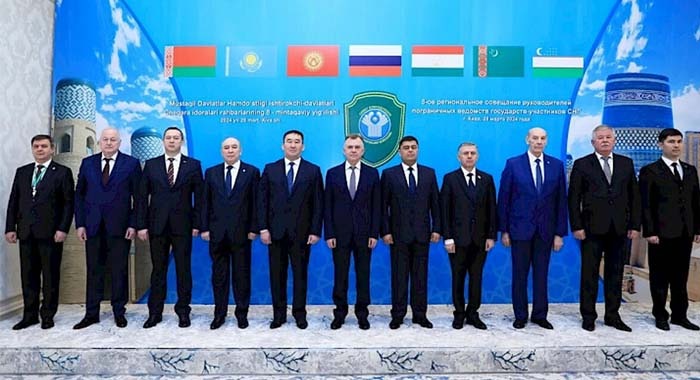
The ninth regional meeting of border chiefs from Commonwealth of Independent States (CIS) member countries was held in Guliston on Wednesday, bringing together senior security officials to discuss evolving border security challenges, with a particular focus on risks emanating from instability in Afghanistan.
The meeting convened representatives from Tajikistan, Uzbekistan, Kazakhstan, Kyrgyzstan, Belarus, and Russia, along with delegations from the Commonwealth of Independent States and the Collective Security Treaty Organization.
According to participants, discussions centered on the growing security implications of Afghanistan’s internal instability and its potential spillover effects on Central Asian border regions. Officials expressed concern that evolving conditions in Afghanistan could increase cross-border threats, including the movement of militant groups and illicit activities across sensitive frontier zones.
Member states reviewed ongoing national and coordinated measures aimed at countering cross-border security risks. Emphasis was placed on improving intelligence-sharing mechanisms, strengthening surveillance capabilities, and enhancing operational coordination among border security agencies.
The meeting also highlighted a CIS-led programme for reinforcing external borders for the 2026–2030 period, described as a key strategic framework for aligning member states’ border security policies. Participants noted that the initiative is intended to modernize border infrastructure and improve collective preparedness against emerging transnational threats.
Officials further reported that a set of coordinated measures aimed at maintaining long-term stability along external borders was developed during the proceedings. These measures are expected to support enhanced regional resilience and more structured cooperation among participating states.
The CIS, formed in 1991 following the dissolution of the Soviet Union, continues to serve as a platform for political, economic, and security coordination among its member states, including Azerbaijan, Armenia, Uzbekistan, Belarus, Tajikistan, Russia, Kyrgyzstan, Kazakhstan, and Moldova.
Officials reiterated longstanding concerns among member states regarding the potential for militant activity and instability in Afghanistan to influence security conditions across Central Asia. They stressed the importance of sustained cooperation to mitigate shared risks and maintain stability across external borders.
The meeting concluded with a renewed commitment to strengthening regional collaboration and advancing joint security frameworks aimed at addressing evolving transnational threats.



