
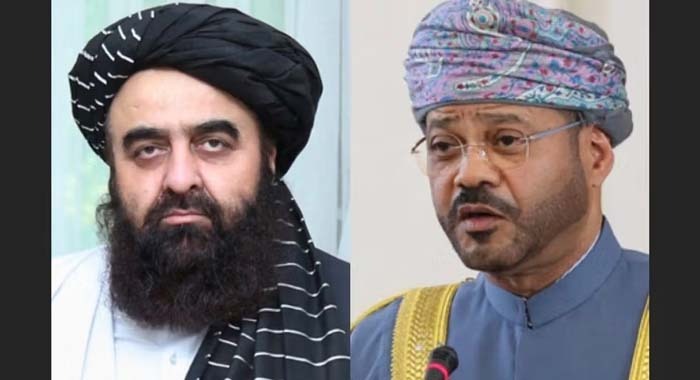
The acting foreign minister of the Taliban administration, Amir Khan Muttaqi, discussed tensions with Pakistan during a phone call with the foreign minister of Oman, Badr Al Busaidi, according to a statement issued by the Taliban foreign ministry.
The ministry said Muttaqi outlined the Taliban administration’s position regarding what it described as Pakistan’s attacks and the responses taken by the Afghan side, which it characterized as defensive measures.
According to the statement, the two sides also discussed bilateral relations and broader regional developments during the call.
In a message posted on social media on Wednesday, the Taliban foreign ministry said both diplomats expressed concern over recent developments in the Middle East and condemned what they described as attacks by the United States and Israel against Iran, warning that the conflict could expand further across the region.
The statement added that Muttaqi and Al Busaidi emphasized the importance of diplomacy as the primary means of resolving regional tensions.
Questions Over Diplomatic Priorities
The discussion of Pakistan-related tensions with a Gulf country such as Oman has raised questions among observers about the Taliban administration’s diplomatic priorities.
Pakistan remains Afghanistan’s immediate neighbor and one of the countries most directly affected by cross-border security developments.
For years, Islamabad has consistently raised concerns over the presence of militant groups operating from Afghan territory, particularly the Tehreek-e-Taliban Pakistan, which Pakistan says has carried out numerous attacks inside the country.
Pakistani officials have repeatedly urged the Taliban administration to prevent Afghan soil from being used for attacks against neighboring states.
The same concern has also been echoed by other regional actors, including China and Russia, both of which have emphasized the need for Afghanistan to ensure that militant groups do not threaten regional stability.
International forums have voiced similar expectations. Bodies such as the United Nations and the European Union have repeatedly stressed that Afghan territory should not serve as a base for militant activities targeting other countries.
Calls with Regional Powers
In recent days, Muttaqi has held discussions with representatives of several countries regarding tensions with Pakistan, including officials from China, Russia and Qatar.
The diplomatic outreach comes amid heightened tensions between Kabul and Islamabad following a series of cross-border security incidents and military responses.
Earlier, speaking to foreign diplomats in Kabul, Muttaqi said the Taliban administration was facing what he described as an “imposed war,” claiming that Afghan authorities had acted cautiously in what he termed defensive operations.
However, observers note that while the Taliban leadership has increasingly discussed the issue with foreign diplomats and international partners, the core concern repeatedly raised by Pakistan and other regional actors remains unresolved: the continued presence and activities of militant groups operating from Afghan territory.
Analysts say that unless this central issue is addressed through direct and sustained engagement between Kabul and Islamabad, diplomatic discussions with distant partners are unlikely to ease the tensions that continue to shape relations between the two neighboring countries.



