(Shamim Shahid)
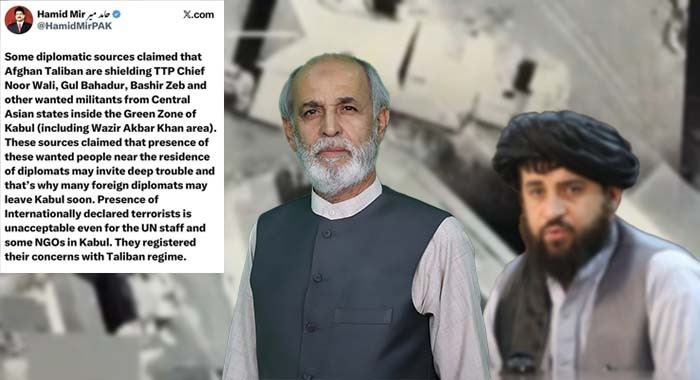
In recent weeks, reports have emerged that the Afghan Taliban have placed the head of the Tehrik‑i‑Taliban Pakistan (TTP), Mufti Noor Wali Mehsud, along with senior commanders Hafiz Gul Bahadur and Bashir Zaib, in what is being described as a “green zone” in Kabul a secure, protected area typically reserved for diplomats and officials. The developments have alarmed security analysts across South and Central Asia, and raised urgent questions about the future of Pakistan‑Afghanistan relations, regional counter‑terrorism cooperation, and the broader implications for global peace and security.
To many in Pakistan, Afghanistan and beyond, this is not just another chapter in the long saga of militancy and conflict it is a potential turning point with far‑reaching consequences. What does it mean when leaders of a proscribed terrorist organization are sheltered, protected and perhaps even nurtured under the watch of another state actor? Are foreign powers willing to intervene? Could this embolden extremist networks instead of containing them? And perhaps most critically what happens if diplomatic tensions escalate between Afghanistan and Pakistan, igniting wider instability in an already volatile region?
These are not hypothetical concerns. They are real and present dangers that demand sober reflection, hard answers and strategic clarity.
To understand why this situation is so dangerous, one must first grasp the history that feeds it. The Tehrik‑i‑Taliban Pakistan emerged in the mid‑2000s as a coalition of militant groups opposed to the Pakistani state, seeking to impose their own rigid interpretation of Islam across Pakistani territory. Over time, they have carried out countless suicide bombings, targeted assassinations, and insurgent operations killing thousands of civilians, soldiers and law enforcement personnel.
For Pakistan, the TTP is not just a foreign entity; it is a domestic threat that has caused profound human suffering and destabilized entire regions. Islamabad has repeatedly designated the group as a terrorist organization and has pursued military and legal measures to dismantle its network. Yet despite persistent operations and negotiated surrenders over the years, the group has shown resilience often regenerating strength in borderlands, tribal districts and safe havens across Afghanistan.
Meanwhile, Afghanistan’s own internal dynamics decades of war, shifting political leadership, and the return of the Taliban as the de facto government in 2021 have created conditions in which groups like the TTP can operate with degrees of impunity previously unseen. This is partly due to ideology, partly due to shared ethnic and tribal ties, but also due to strategic calculations by Afghan leadership.
So when Mullah Yaqoub, identified as a senior figure among the Afghan Taliban leadership, recently stated that the group can “fight Pakistan for 10 years,” it should not be dismissed as mere rhetoric. Rather, it reflects a worldview that frames Pakistan not as a neighbor to be engaged with diplomatically but as an adversary in an ongoing ideological struggle.
Some observers interpreted his comments as “passionate imagination.” But whether imagination or intention, the statement was revealing: it clarified that, at least among some elements of the Afghan leadership, there remains a belief that Islamabad’s attempts to designate and combat the TTP are illegitimate, unnecessary or perhaps even hostile.
The diplomatic implications of the Afghan Taliban housing TTP leaders are profound. Reports suggest that Mehsud and Bahadur have been hosted in a secured area, with controlled movements, rotating vehicles and guarded routes — a calculated effort to ensure their safety and operational secrecy. This arrangement sends several messages at once:
-
Protection over Prosecution: Instead of surrendering these individuals to justice whether through international legal mechanisms or direct negotiation with Pakistan they are being sheltered.
-
A Symbol of Legitimacy: Placing them in a “green zone” associated with diplomatic immunity carries a psychological weight. It suggests they are not merely fugitives, but persons of importance with some form of formal protection.
-
Potential for Relocation: There is discussion in policy circles about the possibility of these leaders being relocated with the assistance of foreign governments, via passports, medical visas or ambassadorial channels to Western or Gulf nations purportedly for “treatment” or “humanitarian reasons.”
Such movements might seem feasible to those orchestrating them, but in reality they would be blatant violations of international law and UN Security Council resolutions. Both the United States and the United Nations have placed the TTP on terrorist designation lists. Providing them sovereign protection or facilitating their relocation abroad would directly contravene these rulings. Countries that choose to offer asylum under these circumstances would find themselves in breach of the global counter‑terrorism framework.
Some might point to past instances such as conflicts in the 1990s where combatants were permitted safe passage or where cross‑border movements were tolerated as part of geopolitical expediency. But the post‑9/11 security architecture is no longer the Wild West of yesteryear. The world has developed norms, sanctions regimes and cooperative mechanisms precisely to prevent terrorists from moving freely across borders and establishing new bases of operation.
There are already troubling precedents. Elements of al‑Qaeda have been targeted within Kabul itself, and even senior figures like Khalil Haqqani linked to destabilizing operations have been hit by drone strikes or other counter‑terrorism measures. The fact that such targeting has occurred inside Afghanistan underscores the dual reality: extremist figures are present, and they are seen as threats even by those who once tolerated them.
A key question many observers are now asking is: Could foreign countries be willing to offer shelter to these figures?
Diplomatically, some states might be inclined to provide safe passage under the guise of medical treatment, refugee status, or diplomatic protection. This has historical analogues insurgent leaders and political dissidents have sometimes been allowed entry to Western or Gulf countries for plausible reasons, only to remain politically active abroad.
But if it were revealed whether in secret or overtly that such relocation took place for leaders of a terrorist organization actively plotting cross‑border violence, the blowback would be immense. Not only would it undermine the legitimacy of global counter‑terrorism norms, it would elevate the credibility of accusations that some countries tacitly support militant groups for their own strategic interests.
Some analysts have suggested that support for the TTP from foreign states has diminished over the years. Yet the hosting of these commanders in Kabul and the ambiguity surrounding their status suggests that support has not disappeared entirely. Rather it may have shifted from explicit sponsorship to implicit tolerance. The fact that local Afghan governance structures are willing to issue documents, assert protective authority, and facilitate mobility only deepens the concern.
Under such circumstances, these leaders are not simply refugees. They are operational hubs with networks, contacts and historical ties to extremist factions across the region. If relocated or allowed to operate freely abroad, they could reconnect with militant cells in Pakistan, Central Asia, the Middle East, and beyond. The idea that terrorists can simply be “sent away” under diplomatic cover betrays a dangerous misunderstanding of how extremist networks function.
The security implications for Pakistan are obvious and severe. But the risks extend much further:
-
Threat to Regional Stability: Central Asian countries like Tajikistan and Uzbekistan have already expressed concern about spillover violence and refugee flows linked to militant movements in Afghanistan. An emboldened TTP presence would further heighten these anxieties.
-
Terrorism as a Transnational Threat: When extremist leaders find sanctuary whether in embassies, protected zones, or foreign capitals — the likelihood of transnational recruitment, planning and financing operations increases significantly.
-
Undermining Counter‑Terrorism Partnerships: Pakistan, China, the United States, and many others have attempted to build cooperative strategies to limit extremist resurgence. If any state appears to shield or accommodate terrorist leadership, trust erodes, and cooperation falters.
International institutions have already voiced their objections. The United Nations and major non‑governmental organizations have formally signaled that harboring such individuals is unacceptable. Yet their statements may ring hollow without accountable enforcement mechanisms. If objections are raised but no consequences follow, the entire system of global counter‑terrorism governance is weakened.
The recent statements attributed to Mullah Yaqoub claiming the ability to engage in conflict with Pakistan for “10 years” reflect more than bravado. They reveal a worldview grounded in perpetual struggle rather than peaceful coexistence.
Pakistan’s formal designation of the TTP as a terrorist group is rooted in decades of violence and loss. To dismiss that designation as “passionate imagination” is not just a semantic contradiction it is a refusal to acknowledge the very real suffering that terrorism has caused. It also reveals how ideological frameworks can distort strategic calculations.
Critics might argue that Yaqoub’s rhetoric is posturing aimed more at internal audiences than at Islamabad. Yet rhetoric can become reality when policy and protection mechanisms align with it. When leaders publicly affirm a willingness to “fight” for decades, they are laying down psychological precedents that feed recruitment, justify violence and embolden extremist fighters.
Pakistan’s security challenges cannot be resolved through rhetoric alone. A comprehensive, cooperative and sustained approach domestically and internationally is necessary. All security institutions must be unified in approach, share intelligence, and act cohesively to disrupt violent networks. Decades of piecemeal strategies have failed to eradicate militancy precisely because they lacked unity and resolve.
Tensions between Pakistan and Afghanistan have already manifested at diplomatic and political levels. Recent clashes in international meetings including between Afghanistan and Qatar reflect deeper fissures and competing agendas. Qatar has attempted mediation and peace initiatives, China has offered facilitation, and other regional powers have weighed in. Yet these efforts have repeatedly faltered.
Why? Because peace cannot be brokered from the outside if the primary actors lack the will to compromise. Pakistan seeks recognition of threats within its territory. Afghanistan, under the Taliban, appears unwilling to sever ties with groups it views as ideological kindred spirits. External powers can mediate handshake agreements, but without internal alignment, such treaties remain fragile and hollow.
The consequences of continued stagnation are grave. Without genuine progress, hostility could escalate diplomatically, economically, and potentially militarily. Pakistan may feel compelled to take defensive measures to safeguard its borders and citizens. Afghanistan, already isolated and embattled, may further retreat into ideological nationalism. The result would be more instability across a region that has already endured too much.
We must not understate the gravity of the moment. The positioning of TTP leaders in secure Afghan zones is not a localized issue. It is a symptom of a larger structural failure one rooted in unresolved conflict, ideological persistence, and the absence of a workable peace framework.
Pakistan’s security concerns must be taken seriously. Afghanistan’s internal politics cannot be ignored. And the international community must recognize that terrorism, once incubated, rarely remains contained. If the world allows protected safe havens to become operational hubs for militant networks, the blowback will ripple across continents.
Diplomacy, accountability, and robust counter‑terrorism cooperation are paramount. So is political will from Islamabad, Kabul, regional powers, and international institutions alike. If these leaders are simply relocated, re‑documented and absorbed into foreign societies under diplomatic or humanitarian cover, it will not neutralize the threat it will export it. History has already demonstrated that terrorism thrives in shadows and safe harbors. We ignore this reality at our collective peril.