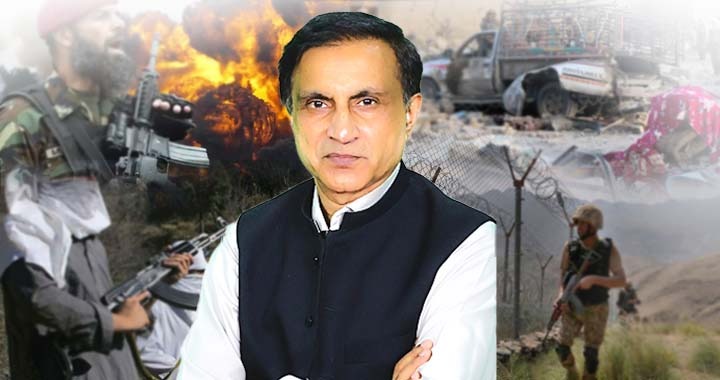
We were briefed by military leadership the other day and were told these security and regional issues in detail. Afghanistan, the militant’s safe havens there and the ongoing conflict situation, developments in the Middle East, and the impact of attacks originating from hostile militant networks were all part of the discussion. Internal security matters of Pakistan, the situation in Khyber Pakhtunkhwa, and the Afghan migrant crisis were also reviewed during the two-and-a-half-hour meeting. We also asked questions regarding Bagram.
The military leadership appeared highly confident. Their body language was composed, strong, and professionally assured. I observed that level of confidence for the first time. They expressed the view that Pakistan did not go to Afghanistan with any intention of conquest. The objective was only to target check posts and locations from where attacks were being launched against Pakistan.
Bagram was highlighted because weapons, ammunition, and drones were reportedly stored there. The drones being used against Pakistan were also mentioned. Therefore, Pakistan targeted locations where such military equipment and hostile infrastructure were believed to exist. It was made very clear that Pakistan had not attacked the Afghan people or the Afghan state.
Whenever incidents occurred inside Pakistan, we repeatedly informed Afghanistan and our international partners by presenting evidence of militant activity. That is why the international community did not question Pakistan’s actions, because evidence was placed before the world.
The operation on the 21st targeted Taliban positions inside Afghanistan. It was not directed against civilians or the Afghan population. The objective was to strike hostile elements hiding in those areas.
After that, militants attacked 53 Pakistani check posts on the 26th and 27th, targeting our army personnel. We had to respond, and our response was defensive in nature.
Security officials clearly stated that Taliban check posts and leadership elements exist in Afghanistan. Since these groups continue attacking Pakistan and martyring innocent civilians, Pakistan will respond. The message was simple: if militants martyr one Pakistani, we may respond with stronger force to eliminate terrorist threats.
There are only two options. Either the Afghan authorities take action themselves against these groups, or they cooperate by handing over individuals responsible for terrorism against Pakistan.
I also asked whether diplomatic contacts have been made with the Afghan government. I was told that conversations have taken place, but Pakistan’s strategic objective remains unchanged. This is not a war; it is a counterterrorism operation against TTP networks.
The operation will continue. If anyone thinks Pakistan will stop after a few strikes, they are mistaken. Military actions will continue until strategic objectives are achieved.
Pakistan has no intention of changing the Afghan system or interfering in Afghanistan’s political structure. Whatever governance model Afghanistan chooses is their internal matter.
However, Pakistan’s demand is simple: Afghan soil should not be used against Pakistan or any other country for terrorism.
Historically, Afghans sometimes claim victories over major powers such as Russia and the United States, but I believe the Afghan situation is more complex than such simplified narratives.
Pakistan’s policy is straightforward. Counterterrorism operations will continue in self-defense.
Pakistan has demanded that individuals responsible for terrorism inside the country, including those involved in attacks on soldiers, civilians, and places of worship, should be handed over for justice.
Multiple diplomatic attempts were made through Turkey, Qatar, the United Arab Emirates, Saudi Arabia, China, and Iran, but no permanent solution has emerged.
Pakistan will not retreat from its security position.
The Afghan government is currently under economic pressure and international constraints. Some trade activities through Iran are continuing, but internal stability remains a concern.
Pakistan maintains that its military should not be compared with other regional militaries. Our armed forces are professional, technologically advanced, and fully capable of defending national security.
As a nuclear-capable state, Pakistan’s deterrence capability plays an important role in maintaining regional stability. People should not be unnecessarily worried about external threats.
Pakistan believes that militant organizations such as TTP and similar groups operate across multiple networks. These groups function in proxy-style conflict environments where external actors may indirectly support non-state armed elements.
Regarding Afghanistan, there are differences between the Kabul and Kandahar positions. Pakistan’s demand remains that militant groups targeting Pakistan must be controlled.
If Afghan authorities claim sovereignty, then controlling militant networks should also be their responsibility.
Pakistan has no conflict with the Afghan people. The issue is terrorism originating from militant networks.
If Afghan authorities believe they cannot control these groups, then Pakistan expects either effective action or cooperation.
The Afghan interim system has continued for about five years. When they came to power, they promised that elections would be held, but no electoral process has taken place. There is no democratic transition framework.
In my view, it is a system where a single group is exercising control over the country, and that group is governing as it wishes.