
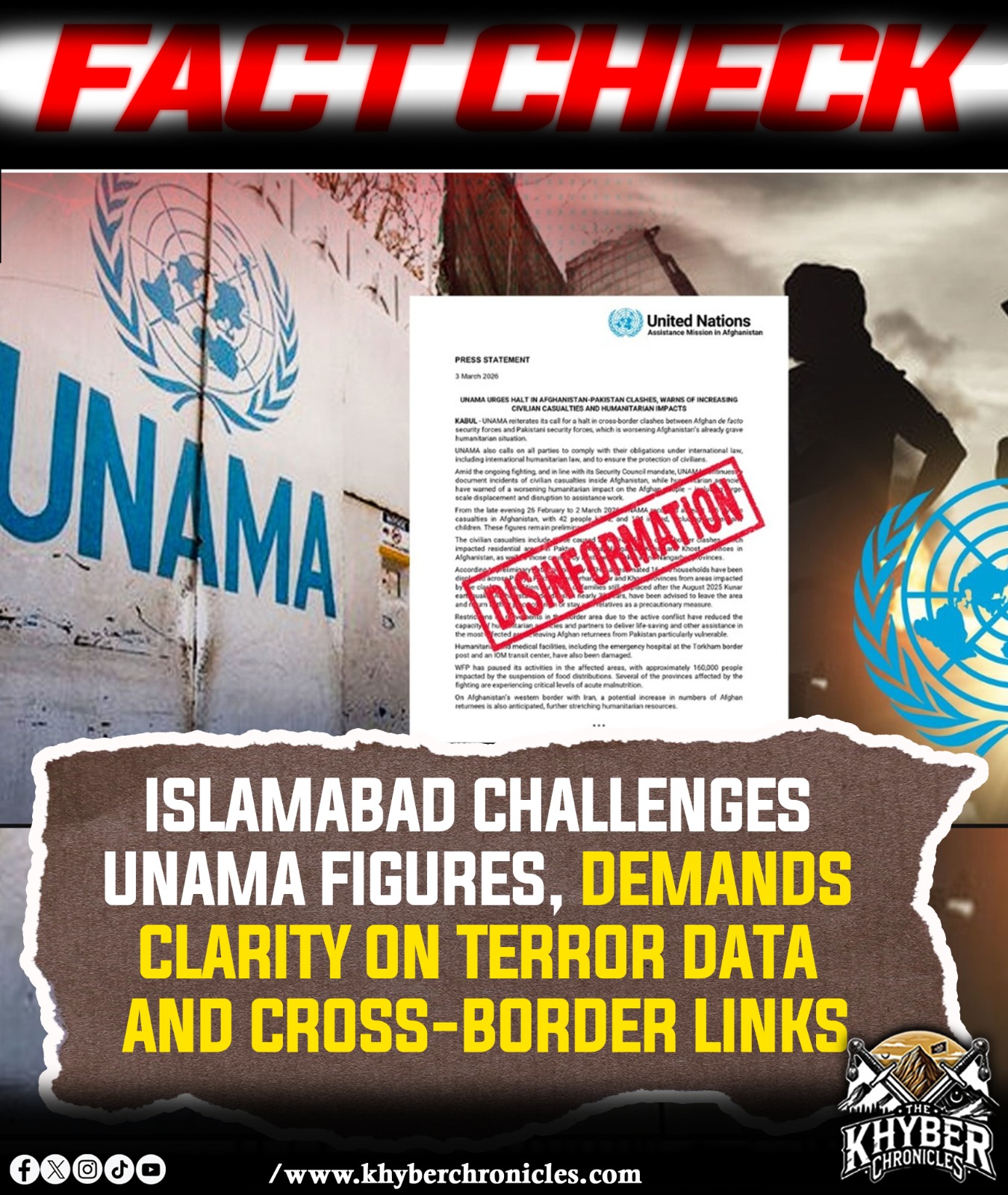
Political and diplomatic circles in Pakistan have voiced strong reservations over the latest report issued by the United Nations Assistance Mission in Afghanistan, questioning both the data presented and the methodology behind it.
Security experts and foreign policy observers argue that while the figures cited in the report are concerning, the process through which they were gathered, verified and contextualized must be made public to ensure transparency and credibility.
The UN mission’s report refers to 42 fatalities, 104 injuries, the displacement of 16,400 households and the impact on 160,000 individuals. However, Pakistani analysts contend that without identifying the actors responsible and without presenting a fuller security context, the report offers only a partial view of a far more complex regional situation.
According to these observers, no humanitarian assessment in the region can be detached from the broader security environment. They argue that the report does not sufficiently account for the activities of banned militant outfits such as the Tehreek-e-Taliban Pakistan, Daesh and other armed groups that have carried out attacks against Pakistan from Afghan soil.
Citing a recent report by the UN Security Council’s monitoring team, analysts note that allegations have been raised regarding the presence of approximately 6,000 TTP fighters operating in Afghanistan, with claims that they enjoy varying levels of facilitation. International assessments have referenced more than 600 militant attacks in the recent period, several of which are said to be linked to cross-border infiltration.
Border provinces including Kunar, Nangarhar, Khost and Paktika have been highlighted in security discussions as areas where training infrastructure and logistical support networks may exist, heightening Islamabad’s concerns.
Global data trends further complicate the picture. According to figures attributed to the Institute for Economics and Peace, Pakistan recorded 1,081 terrorism-related deaths in 2026, marking a 45 percent increase compared to the previous year. Of these, 482 attacks and 558 civilian fatalities were attributed to the banned TTP, accounting for roughly 52 percent of total deaths.
Similarly, statistics released by the Pakistan Institute for Peace Studies indicate that 521 terrorist attacks in 2026 resulted in 852 fatalities, compared to 699 attacks and 1,034 deaths in 2025. Analysts maintain that a significant number of these incidents involved groups operating from or linked to Afghan territory.
Observers argue that reporting humanitarian consequences without explicitly acknowledging the role of armed groups and their facilitators risks presenting an incomplete narrative. They emphasize that Pakistan has endured decades of cross-border militancy while simultaneously hosting between four and six million Afghan refugees over the years, absorbing substantial economic and social costs.
Political stakeholders in Islamabad are calling on UNAMA to publicly clarify the evidentiary basis and verification mechanisms underpinning its report and to raise the issue of alleged militant safe havens at international forums.
Pakistan has repeatedly informed the United Nations and the Security Council about what it describes as emerging terrorism threats emanating from Afghanistan, reiterating that it reserves the right to defend its citizens and territory through intelligence-based operations.
So far, UNAMA has not issued a formal response to the concerns raised in Pakistan. Diplomatic sources suggest the matter may see further discussion in the coming days as regional security tensions continue to shape international engagement.



