
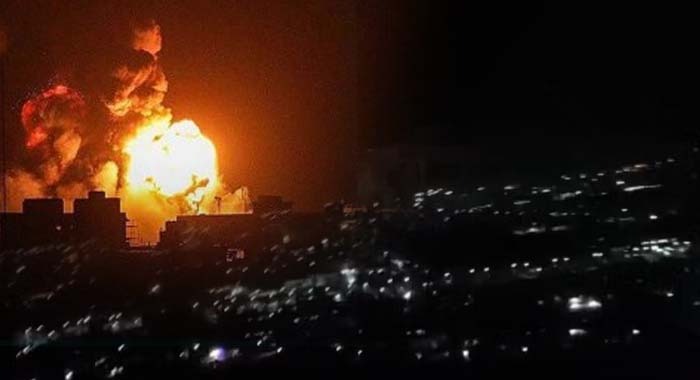
Residents of Kabul reported the sound of fighter aircraft over the capital on Sunday evening, March 30, followed by heavy gunfire in parts of the city. The incident occurred against the backdrop of escalating cross-border tensions between the Taliban administration and Pakistan.
Inayatullah Khwarizmi, spokesman for the Taliban Ministry of Defence, confirmed that Taliban forces had opened fire on what he described as “Pakistani aircraft.” He urged residents not to panic and stated that the situation was under control.
While operational details remain unclear, the reported engagement marks a sensitive development, as aerial signaling carries heightened escalation risks in already volatile frontier dynamics.
The Most Striking Development: Internal Political Crackdown During External Tension
Simultaneously, the Taliban’s Ministry of Information and Culture announced the suspension of Rah-e-Farda TV, a broadcaster affiliated with Mohammad Mohaqiq, leader of the People’s Islamic Unity Party of Afghanistan. Authorities confirmed the confiscation of the outlet’s property, citing Mohaqiq’s recent public criticism of the Taliban in relation to the ongoing conflict with Pakistan.
Mohaqiq stated that the clashes do not represent a war between the Afghan and Pakistani people, but rather “a confrontation between Pakistan and the ruling regime in Kabul.” He further accused the Taliban of pursuing policies that have inadvertently drawn ordinary Afghans into a broader conflict.
In response, Khabib Ghufran, spokesman for the Ministry of Information and Culture, accused Mohaqiq of acting “at the instigation of the enemy” and attempting to undermine national unity through what he termed baseless statements. Authorities justified the suspension of the broadcaster as necessary to preserve internal stability.
Strategic Implications for Terror and Counterterror Dynamics
The dual developments, reported aerial engagement and internal media suppression, suggest that the Taliban leadership is managing both external security pressure and internal political dissent simultaneously.
From a counterterror and regional security perspective, such moments are critical. Cross-border confrontation risks escalation along already fragile frontier zones, while internal political consolidation measures may reflect leadership concerns about cohesion during external pressure.
For Pakistan, any intensification of aerial or cross-border engagement raises the risk of retaliatory or dispersed militant activity along sensitive sectors of the Pakistan–Afghanistan frontier. Historically, militant networks have exploited periods of bilateral tension to recalibrate operational movement.
The suspension of a media outlet linked to a prominent political figure also signals tightening information control during conflict conditions; a pattern often associated with attempts to centralize narrative authority in wartime environments.
The situation in Kabul underscores a broader dynamic: external confrontation and internal political management are unfolding in parallel. How the Taliban balance security posture, domestic control, and cross-border signaling in the coming days will determine whether tensions remain contained or evolve into a wider security crisis affecting the region’s fragile counterterror equilibrium.



