
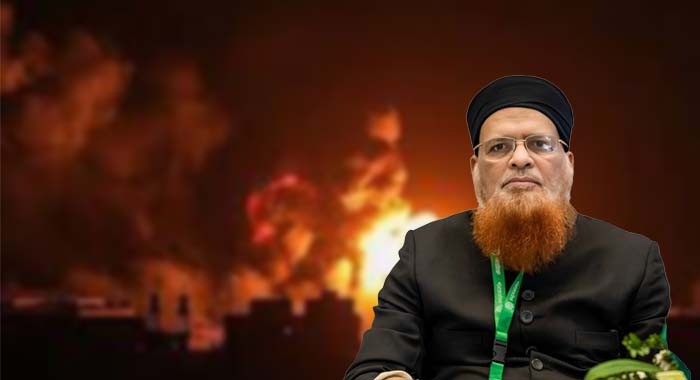
Mufti Taqi Usmani, the esteemed Grand Mufti of Pakistan, has publicly condemned armed action against the state of Pakistan, declaring it as open rebellion, unlawful, and forbidden in Islam. In a strongly worded statement, Mufti Usmani expressed his disapproval of ongoing militant activities, particularly those linked to the Tehrik-i-Taliban Pakistan (TTP), and urged the leadership of Afghanistan to take responsibility for the militants operating from its territory.
Mufti Usmani emphasized that Pakistan has made repeated diplomatic efforts to address the issue of cross-border terrorism emanating from Afghanistan. Pakistan has sent numerous delegations of respected Deobandi scholars to engage with Afghan leadership and to urge them to take action against TTP militants, who are given refuge in Afghan territory. In one prominent instance, Mufti Usmani himself, accompanied by a delegation of over fifty scholars, traveled to Afghanistan for direct talks to de-escalate tensions and advocate for peace.
He further pointed out that Pakistan’s repeated calls for peaceful resolution and intervention by international actors, including Qatar, Turkey, and Saudi Arabia, demonstrate the country’s commitment to dialogue rather than conflict. “If Pakistan truly wanted to engage in attacks, why would it repeatedly send scholars or involve neutral parties? The fact remains that Pakistan has sought peaceful solutions while condemning violence,” said Mufti Usmani.
The Grand Mufti reiterated that Pakistan has never sought to harm innocent civilians in Afghanistan or to escalate violence. “We have never had any intention of causing harm to the Afghan people, nor do we seek any unjust demands. What we do seek is for the Taliban, specifically TTP, to cease their attacks on Pakistan. It is not a difficult ask for these militants to stop carrying out suicide bombings and attacks on our soil,” he explained.
Mufti Usmani also addressed the accusations that Pakistan was responsible for instigating violence, reminding the international community that Pakistan has always refrained from such acts. “Had we wanted to carry out attacks, we would not have taken the diplomatic route, nor would we have sent our religious scholars to mediate. We have always called for peace.”
The Mufti raised concerns about the hypocrisy of the TTP’s rhetoric. “While they claim to fight for Islam, they are waging war against their own neighboring state, Pakistan, which has consistently supported peaceful engagement and sought to protect its citizens. Meanwhile, the TTP remains silent on the ongoing conflict in Kashmir, where Muslims are suffering, but instead, they use derogatory language against Kashmiri Mujahideen.”
Mufti Usmani pointed out that the TTP’s actions raise questions about its true allegiances. “This contradiction reveals the real players behind this violence,” he said, emphasizing that the TTP is merely a pawn in a larger geopolitical game.
Mufti Usmani’s statement is a call for responsible leadership in the region, urging Afghanistan’s leadership to take responsibility for the militant groups operating within its borders and to prevent them from using Afghan soil to launch attacks on Pakistan. He also stressed that Pakistan’s commitment to regional peace and stability is unwavering, as the country has continually sought to de-escalate tensions and find peaceful solutions through dialogue and diplomacy.
“The time has come for Afghan leadership to act decisively and take responsibility for these militants,” Mufti Usmani concluded. “Until then, Pakistan will continue to defend its sovereignty and the safety of its citizens.”



