
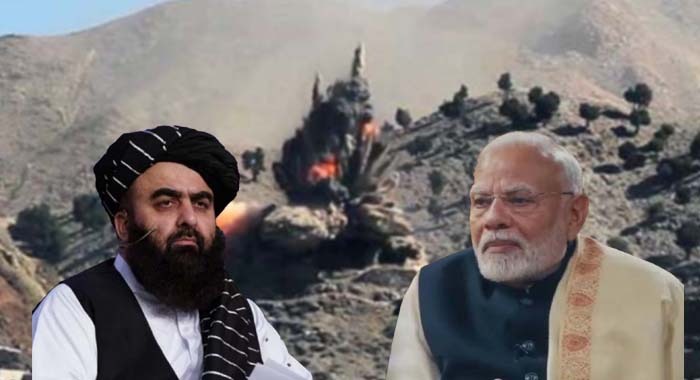
Pakistan’s recent airstrikes against terrorist hideouts inside Afghanistan have once again underscored the Afghan Taliban’s failure to control extremist groups operating from their territory, while highlighting India’s predictable attempts to politicize regional security. Contrary to Taliban propaganda and the narrative pushed by their sympathizers, no Muslim-majority or Arab country has condemned Pakistan’s operations, reflecting a broader regional understanding of Pakistan’s legitimate right to defend itself against cross-border terrorism.
India, which has consistently harbored and supported militant networks targeting Pakistan, unsurprisingly criticized the airstrikes a predictable reaction given that several of its proxies were affected. The criticism exposes India’s long-standing strategy of using Afghanistan as a platform for destabilizing Pakistan, while turning a blind eye to the suffering of Afghan civilians caused by the Taliban’s inability or unwillingness to control terrorist sanctuaries.
The Afghan Taliban, far from protecting Afghan society, continue to provide a safe haven for groups like the Tehreek-e-Taliban Pakistan and the Balochistan Liberation Army, allowing them to carry out attacks against Pakistan and destabilize the region. Their apologists attempt to frame Pakistan’s defensive measures as “aggression,” but this rhetoric fails to hide the truth: it is the Taliban’s inaction and complicity that threaten peace and security.
Large segments of Afghan society, including ethnic Tajiks, Uzbeks, and Hazaras, have welcomed Pakistan’s strikes. The National Resistance Front of Afghanistan, led by Ahmad Massoud, publicly praised Pakistan’s operations and called for further action against militant hideouts. This demonstrates that ordinary Afghans recognize the Taliban’s role in fostering violence and support efforts to dismantle terrorist infrastructure — not the regime in Kabul.
Pakistan’s actions are further validated by the Russian Ministry of Foreign Affairs, which recently reported that 20,000–23,000 militants, including foreign fighters, continue to operate from Afghanistan, posing threats to regional and global stability. The Taliban’s failure to address this growing threat highlights their inability to govern responsibly and underscores their role as protectors of militancy rather than the Afghan people.
Pakistan’s airstrikes were precise, targeted, and directed solely against terrorist infrastructure. They are a lawful act of self-defense under international law, aimed at neutralizing groups that have repeatedly attacked Pakistani civilians, schools, mosques, and security forces. The operations were not directed against Afghanistan or its people, contrary to Taliban propaganda.
The Afghan Taliban’s apologists and India’s attempts to politicize Pakistan’s defensive response are both transparent and hypocritical. The real threat to regional peace is the Taliban’s protection of militant sanctuaries and India’s history of supporting proxies to destabilize Pakistan.
Pakistan remains committed to defending its citizens and securing regional stability. Sustainable peace can only be achieved when Afghanistan’s ruling regime confronts the terrorist networks within its territory rather than sheltering them, and when countries like India stop exploiting militancy as a political tool.



