
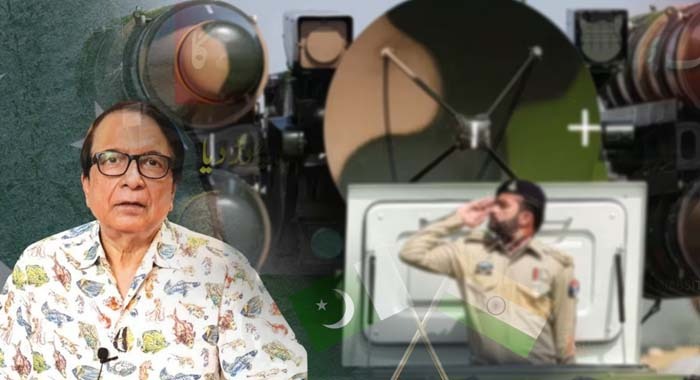
Renowned Indian defense and geopolitical analyst, Praveen Sawhney, has highlighted Pakistan’s decisive defensive capabilities and modern warfare proficiency, emphasizing that any violation of the country’s sovereignty would be met with an effective response. In his detailed analysis, Sawhney stressed that the assumption that Pakistan would refrain from retaliation is contradicted by both historical precedent and ground realities.
According to the analyst, the ceasefire line established in 1949 after the first Indo-Pak war has largely endured, demonstrating that India has historically been unable to achieve decisive superiority along Pakistan’s western front. Despite the conflicts of 1965 and 1971, this military line remained intact, later formally recognized as the Line of Control (LoC).
Referencing the 2019 Balakot incident, Sawhney noted that India undertook a non-traditional aerial operation for the first time. However, Pakistan responded the following day with Operation Swift Retort, executing a precise and limited counterstrike in which an Indian aircraft was downed, and pilot Abhinandan Varthaman was captured and later released. The analyst emphasized that contrary to Indian claims, there is no verified international evidence that any Pakistani F-16 aircraft were lost, with U.S. officials confirming that all Pakistani F-16s remained operational and secure.
Sawhney further highlighted a significant geopolitical shift in the region following August 5, 2019, when China openly supported Pakistan’s sovereignty and territorial integrity. Subsequent Pakistan-China air exercises reached advanced levels, strengthening military coordination and enhancing operational effectiveness in later actions.
The analyst also emphasized Pakistan’s modern multi-domain warfare capabilities, including the use of long-range precision missiles, which have introduced a new operational paradigm in the region and shifted the strategic balance of power.
Looking ahead, Sawhney stated that any potential future conflict between India and Pakistan would not necessarily be prolonged but could be short, precise, and decisive, with Pakistan’s air power expected to play a central role. He concluded that Pakistan’s integrated defense strategy, modernized air force, and missile capabilities make it a formidable force, underscoring the risks for any actor considering violation of its sovereignty.



