
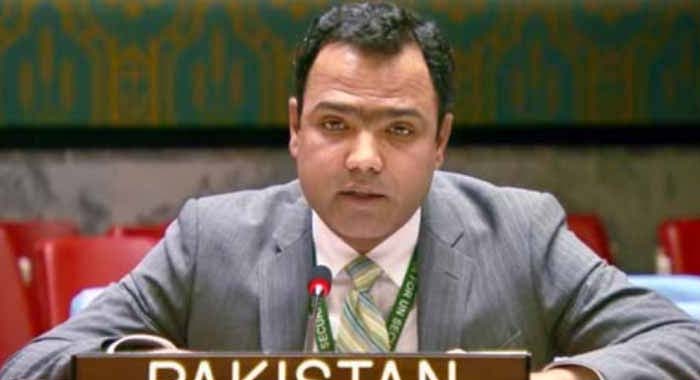
Pakistan’s Consul at the United Nations, Gul Qaiser Sarwani, has reaffirmed that Jammu and Kashmir is an internationally recognised disputed territory and not an integral part of India, while strongly rejecting remarks made by the Indian representative and highlighting long-standing violations of international law, unresolved commitments on the right to self-determination, and concerns over cross-border terrorism during a debate at the United Nations.
Responding to the Indian delegate, Gul Qaiser Sarwani stated that despite the passage of more than eight decades, the promise made to the people of Jammu and Kashmir regarding their right to self-determination remains unfulfilled. He underlined that the dispute continues to be on the agenda of the United Nations and must be resolved in accordance with relevant UN Security Council resolutions and the wishes of the Kashmiri people.
The Pakistani consul further accused India of supporting and financing militant groups operating in the region, including Tehreek-e-Taliban Pakistan (TTP), Fitna al-Khawarij and the Balochistan Liberation Army (BLA). He said India was actively engaged in sponsoring cross-border terrorism, adding that New Delhi’s activities were not limited to the region but extended to acts of violence and targeted killings in various countries, including in North America.
Highlighting India’s conduct towards Pakistan, Sarwani said that India had repeatedly resorted to acts of aggression, which constituted clear violations of international law and the United Nations Charter. He stressed that such actions undermined regional peace and stability and ran counter to the principles the international community was expected to uphold. The Pakistani representative once again called on India to immediately cease state-sponsored terrorism and adhere to its international obligations.
Addressing India’s recent statements regarding the Indus Waters Treaty, Sarwani rejected them as a deliberate distortion of facts and a misinterpretation of a binding international agreement. He emphasized that the treaty did not contain any provision allowing for its unilateral suspension or amendment, warning that any such attempt would amount to a serious breach of international commitments.
Reiterating Pakistan’s position, the consul urged the international community to take note of India’s actions and rhetoric, and to play its role in ensuring respect for international law, the sanctity of treaties, and the peaceful resolution of disputes, including the long-standing issue of Jammu and Kashmir.



