
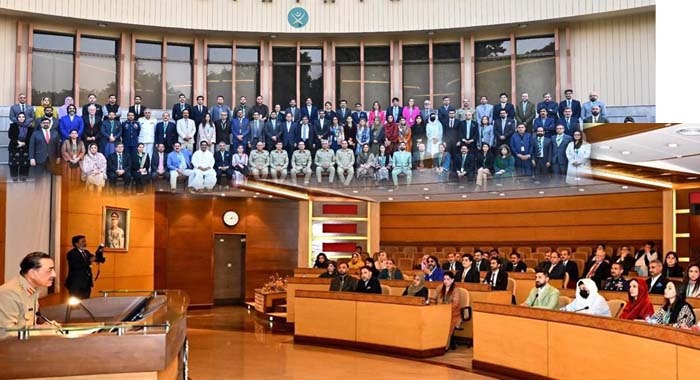
Participants of the National Security Workshop–27 (NSW–27) visited General Headquarters (GHQ) today for a detailed briefing on Pakistan’s regional and internal security environment. During the interactive session, Field Marshal Syed Asim Munir, NI (M), HJ, Chief of Army Staff (COAS), emphasized the fluid regional dynamics shaped by intensified geopolitical competition, cross-border terrorism, and hybrid threats. He highlighted that despite complex challenges, including externally supported militancy and information-centric warfare, Pakistan’s Armed Forces, intelligence agencies, and law-enforcement institutions continue to operate with unwavering professionalism and resolve to safeguard national security.
The COAS underlined Pakistan’s stature as a country of consequence, noting that the professionalism and dedication displayed by the Armed Forces during Marka-e-Haq have enhanced the nation’s global standing. “Our greatest strength lies in national unity, and together we shall defeat the nefarious designs of our foes, Insha’Allah,” he stated.
Delegates were briefed on ongoing national efforts to curb illegal activities, including smuggling, narcotics trafficking, and organised crime, which adversely affect security. Updates were also shared on strengthened border controls and the repatriation of illegal foreigners to ensure internal stability and protect national interests.
Reiterating the Army’s commitment, the COAS affirmed that Pakistan’s territorial integrity, security, and the protection of every citizen remain paramount and will not be compromised under any circumstances. He further stressed that coordinated national efforts and synergy among institutions are essential for lasting peace, stability, and prosperity.
NSW–27, the flagship programme of the National Defence University (NDU), brings together parliamentarians, senior civil and military officials, and representatives from academia and civil society to enhance understanding of national security priorities.



