(Shamim Shahid)
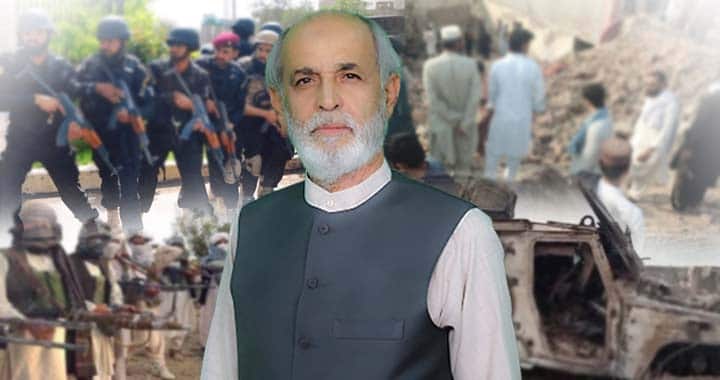
The recent tragedy in Bannu is not merely another entry in Pakistan’s long and painful ledger of militancy-related violence. It is, instead, a stark reminder of the deteriorating security environment in the country’s northwestern belt, the widening trust deficit between the state and its citizens, and the growing disconnect between political leadership and ground realities. The killing of 15 police officers in a single incident, along with the presence of 29 other police personnel at the station and damage to infrastructure, reflects a grim truth: the state is still struggling to assert effective control in regions where militant networks continue to adapt, regroup, and strike with alarming confidence.
While responsibility for the attack has been claimed by elements associated with the Tehrik-e-Taliban Pakistan (TTP), what matters more than the claim itself is the pattern it reflects—fragmented militant structures, shifting operational identities, and an increasingly complex insurgency that is no longer confined to traditional organizational boundaries. These groups have evolved into loosely connected cells capable of coordinated violence, often exploiting geographical terrain, local grievances, and governance gaps.
The Bannu incident has reignited an old but unresolved debate in Pakistan: who is accountable for the protection of civilians and security personnel in conflict-prone regions? More importantly, why does the state continue to appear reactive rather than preventive?
Perhaps the most controversial dimension of the aftermath has been the public perception of leadership absence. In moments of collective tragedy, symbolism matters as much as policy. The absence of top political leadership, including federal and provincial heads, at key mourning gatherings has fueled anger among local communities and law enforcement ranks alike. In societies facing persistent insecurity, state presence—physical and symbolic—at sites of grief is not a ceremonial choice but a political necessity.
The resentment expressed by citizens in Bannu reflects a deeper frustration that has been accumulating over years: a sense that security sacrifices are disproportionately borne by frontline personnel and civilians, while political ownership remains distant. This perceived gap between decision-makers and those affected on the ground continues to widen mistrust.
At the same time, law enforcement agencies find themselves trapped in an increasingly difficult operational environment. Officers are expected to execute counterterrorism operations under intense pressure, often without sufficient intelligence integration, political consensus, or long-term institutional backing.
The security situation in Bannu and surrounding districts cannot be understood without acknowledging the evolving nature of militant groups operating in the region. The TTP and its associated factions have undergone significant fragmentation in recent years. Rather than a single centralized entity, the landscape now consists of multiple small groups that collaborate tactically while maintaining operational independence.
This decentralization complicates counterterrorism efforts. It allows militant actors to evade tracking, shift identities, and exploit weak enforcement zones. The result is a persistent cycle of attacks followed by temporary military responses, without achieving long-term stabilization.
It is also evident that militant groups continue to exploit cross-border dynamics, particularly the unstable security environment in Afghanistan. The porous nature of the Pakistan-Afghanistan border region has long been a factor in insurgent mobility, recruitment, and logistical support. Despite repeated diplomatic engagements, this structural issue remains unresolved.
Following the Bannu incident, reports of public anger, protests, and the targeting of local peace committees highlight another layer of instability. When communities begin to question or reject local peace structures, it signals a breakdown in trust not only in the state but also in intermediary governance mechanisms.
The burning of offices associated with peace committees and public demands for their dissolution reflect a dangerous erosion of local conflict-resolution frameworks. In the absence of trusted institutions, communities often swing between reliance on state force and complete disillusionment with it.
This creates a vacuum that militant actors are quick to exploit.
Against this backdrop of violence and mistrust, reports of a peace conference involving stakeholders from Afghanistan and Pakistan in Switzerland have drawn attention. However, the absence of official confirmation from Pakistani authorities raises questions about the transparency, scope, and effectiveness of such engagements.
Previous rounds of dialogue in international settings including meetings in Istanbul and other regional forums—have produced limited tangible outcomes. While participation from diplomats, journalists, and former officials reflects an interest in continued dialogue, the absence of binding agreements or enforceable mechanisms undermines their impact.
The central challenge remains unchanged: how to translate international discussions into actionable commitments on the ground.
Afghanistan’s role remains particularly critical. The international community continues to express concern over the presence of multiple militant networks operating from Afghan territory. Neighboring countries, including Pakistan and Central Asian states, have repeatedly raised concerns about cross-border security threats. However, without coordinated enforcement and mutual trust, these concerns persist unresolved.
Recent remarks by former Afghan President Hamid Karzai, criticizing Pakistan’s approach to Afghanistan, reflect ongoing diplomatic tensions. His statements underscore a broader narrative dispute between Kabul and Islamabad regarding sovereignty, interference, and security responsibility.
Such exchanges highlight a long-standing problem in regional diplomacy: the absence of a shared security framework. Instead of collaborative counterterrorism strategies, relations are often shaped by mutual suspicion and blame attribution.
In this environment, even well-intentioned peace initiatives struggle to gain traction.
Beyond militancy and diplomacy lies a more fundamental issue: governance fragmentation within Pakistan itself. The security crisis in Bannu, as in other regions of Khyber Pakhtunkhwa and Balochistan, reflects institutional disconnects between civil administration, law enforcement, and political leadership.
Security operations are frequently driven by agencies with limited coordination with elected representatives. While this may provide tactical efficiency, it often results in strategic incoherence. Without political ownership, security successes remain temporary, and failures become politically explosive.
Moreover, local populations are rarely included in meaningful consultation processes. This exclusion fuels resentment and reduces cooperation with state institutions.
At the center of this crisis are the individuals who pay the highest price—police officers, civilians, and families caught in cycles of violence. The loss of 15 officers in Bannu is not just a statistic; it represents institutional sacrifice without adequate systemic reinforcement.
Accountability, in this context, must extend beyond identifying perpetrators. It must include evaluating operational preparedness, intelligence failures, policy gaps, and administrative negligence. Without such introspection, repeated tragedies will continue to be framed as isolated incidents rather than symptoms of a broader structural failure.
Pakistan stands at a critical juncture. The convergence of militant resurgence, regional instability, governance fragmentation, and diplomatic stagnation has created a complex security environment that cannot be addressed through force alone.
The Bannu tragedy should serve as a wake-up call—not only for security institutions but also for political leadership and regional stakeholders. Military operations, while necessary, are insufficient without parallel investments in governance reform, political inclusion, and cross-border diplomatic engagement.
Similarly, international peace dialogues must move beyond symbolic gatherings and toward enforceable frameworks that address root causes rather than symptoms.
If the current trajectory continues unchecked, incidents like Bannu will not remain exceptions they will become the norm. And in such a scenario, the cost will be borne not by abstract institutions, but by the very citizens whose protection defines the legitimacy of the state itself.
The time for reactive responses has passed. What is required now is a coordinated, transparent, and politically owned strategy that recognizes the complexity of the challenge and the urgency of addressing it.