
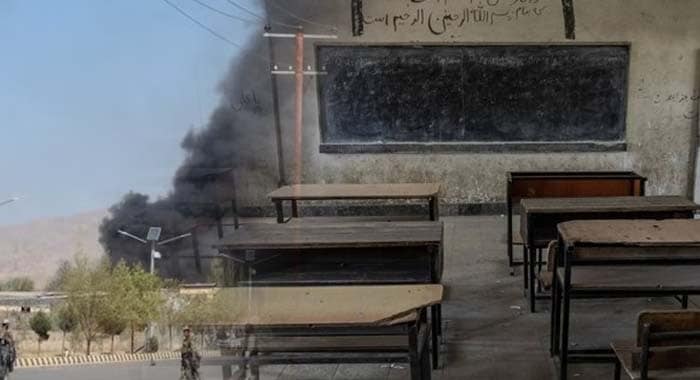
Following weeks of intense cross-border fighting between the Taliban and Pakistan, education for Afghan children in border regions has come to a near standstill, deepening an already fragile humanitarian situation. In several frontier villages, including Barikot in the Nari district of Kunar, formal schooling has effectively collapsed, leaving children without access to structured learning.
Local accounts from the area indicate that a school in Barikot was completely destroyed during artillery exchanges, bringing educational activity to a halt. Residents in the region have attributed the destruction to cross-border firing, while the collapse of infrastructure has left hundreds of children without classrooms, teachers, or learning materials.
The situation raises a fundamental question that cannot be ignored: who bears primary responsibility for the repeated breakdown of civilian infrastructure and the paralysis of essential public services in these border regions? Regional development projects, educational continuity, and humanitarian stability continue to suffer in cycles of conflict, yet accountability remains consistently avoided by the governing authorities on the Afghan side.
The Taliban, who currently administer these areas, have been unable to ensure protection of civilian infrastructure or continuity of basic services. This failure comes at a time when Afghanistan remains the only country in the region where girls’ education beyond a certain level has been systematically banned under official restrictions imposed by the ruling authorities. The closure of schools for girls and the broader restriction on women’s education have already created a long-term generational crisis, even before the recent escalation in border violence.
At the same time, displacement has surged sharply. According to humanitarian coordination estimates, tens of thousands of people have been forced to leave their homes due to continued instability along the Pakistan–Afghanistan frontier. A significant proportion of those displaced are from Kunar, where entire communities along the river belt have been uprooted.
Displaced families are now living in temporary shelters under harsh conditions. Many reports walking long distances, often over an hour or more, simply to access safe drinking water. Basic sanitation remains a serious concern, particularly for women and children, with limited or no proper facilities available in temporary camps.
Local Taliban administrative representatives in Kunar acknowledge that existing schools in nearby districts, including the provincial center, lack the capacity to absorb displaced students. Efforts are reportedly underway to relocate affected families to previously established camps, originally set up for earthquake-affected populations, but these facilities are already overstretched.
Humanitarian conditions inside the camps remain extremely difficult. Families describe overcrowded tents and inadequate sanitation, with women facing particularly severe challenges due to the absence of proper facilities. The disruption has added another layer of hardship to communities already affected by years of instability and restricted mobility.
Educators in the affected border areas have expressed deep concern over the prolonged closure of schools. Nearly two hundred children who were previously enrolled in primary education have been left without any continuation of learning. Teachers warn that prolonged disruption risks permanently ending educational access for many of these children.
This situation again raises the central question of responsibility. When schools are destroyed, when displacement escalates, and when children are deprived of education, the issue is not only about immediate conflict but also about governance and policy decisions that have systematically weakened civilian infrastructure and educational access.
Pakistan has repeatedly expressed that it does not seek instability along the border and has no interest in depriving Afghan children, boys or girls, of education or basic services. However, the persistent collapse of civilian systems inside Afghanistan, combined with restrictions already imposed on education—especially for girls—has created a vacuum in which entire communities continue to suffer.
At the core of this crisis lies a broader structural question: who is responsible for halting regional development, disrupting educational continuity, and turning border communities into zones of recurring humanitarian distress? Increasingly, the pattern points to governance failures and policy choices within Afghanistan’s ruling system, which has already imposed severe restrictions on education and continues to struggle to protect civilian life and infrastructure during conflict.
Until these structural issues are addressed, border communities will remain trapped between conflict, displacement, and deprivation, with children bearing the longest and most damaging consequences.



