
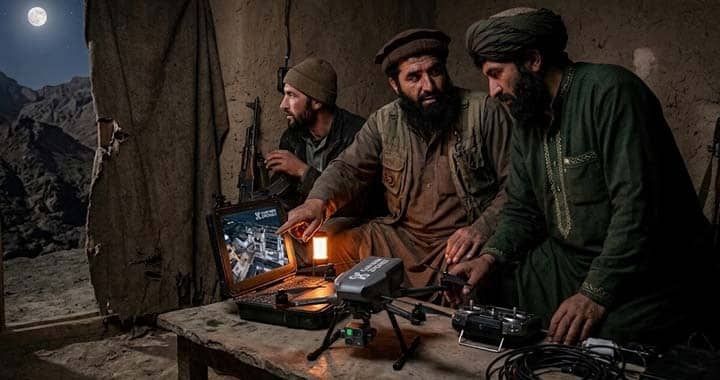
The growing use of weaponized commercial drones by militant groups in Khyber Pakhtunkhwa (KP) is emerging as a significant new dimension of Pakistan’s counterterrorism challenge, raising serious questions over the sources of the technology, the networks facilitating its acquisition and the environment in which militant groups are developing the capability to conduct drone-enabled attacks.
In recent years, quadcopters have increasingly featured in militant attacks across the province. According to figures cited by KP Police, security forces faced at least 405 quadcopter attacks during the previous year, while police reportedly foiled 341 attempted attacks during the first six months of the current year.
The human cost has been severe. In July, a drone attack on a house in Bajaur reportedly killed three members of the same family, including five-year-old Muneeba.
The increasing sophistication and frequency of such attacks indicate that drones are no longer simply commercial or surveillance devices. For militant organizations, they have become a relatively inexpensive means of conducting reconnaissance, delivering explosives and threatening security personnel from a distance.
Former Punjab Inspector General of Police Aamir Zulfiqar Khan, who also served in KP’s Counter Terrorism Department, has described the development as a fundamentally new challenge for Pakistan’s law-enforcement agencies.
While Pakistani police and security forces possess extensive experience in conventional counterterrorism operations, the proliferation of weaponized drones introduces a different operational environment—one requiring specialized detection, electronic warfare, intelligence, air-defence and forensic capabilities.
The central questions are therefore becoming increasingly important: Where are these drones being sourced, who finances their procurement, who modifies them, and how are militant operators acquiring the technical expertise required to weaponize them?
Available research and assessments increasingly point toward networks operating from Afghanistan.
Research cited in the available material indicates that the Tehreek-e-Taliban Pakistan (TTP) has acquired commercial drones in Afghan cities, including Kabul, and has developed the technical capacity to modify them for militant purposes. Studies have suggested that the process involves recruiting technicians and technically trained individuals capable of adapting commercially available quadcopters for weapons delivery.
The conversion of a commercial drone into a weaponized platform can require specialized knowledge, including the adaptation of explosive-release mechanisms, modification of components and the ability to operate effectively in environments where electronic countermeasures are being employed.
A June analysis published by South Asian Voices reportedly assessed that the TTP was unlikely to have developed such capabilities entirely in isolation. Researchers associated with Singapore’s S. Rajaratnam School of International Studies have likewise examined the development of drone capabilities within Afghanistan and reported possible links between Taliban technical programmes, facilities previously used by international forces and the capabilities subsequently available to groups including the TTP.
These assessments require continued independent verification, but collectively they raise significant questions about the extent to which Afghanistan has become an enabling environment for militant drone development.
The issue extends beyond technology to the broader relationship between the Afghan Taliban and the TTP. A recent United Nations Security Council monitoring report, as cited in the supplied material, assessed that Taliban authorities have continued to provide support or a permissive environment to the TTP and linked this relationship to the continued threat posed by the group to Pakistan. The report reportedly documented the relocation of approximately 2,000 TTP members and their families away from the border areas.
Former Pakistan Special Representative for Afghanistan Ambassador Asif Durrani has also described repeated engagements with Taliban authorities concerning the presence of TTP personnel in Afghanistan. According to Durrani, Afghan authorities had previously indicated that TTP cadres could be relocated away from the Pakistan-Afghanistan border, including proposals involving financial assistance from Pakistan. However, he said that despite repeated assurances, an effective arrangement was never implemented.
The continued attacks along Pakistan’s western border have consequently reinforced Islamabad’s concerns that commitments made by Kabul have not translated into sustained action against the TTP.
The security picture becomes more complicated when the activities of other militant organizations are considered.
On September 18, a suicide bombing reportedly targeted a mosque at the Old Police Lines in Kohat during Friday prayers, followed by an assault on the compound. At least 23 people were reported killed, including 17 police personnel. The attack was claimed by Ittehadul Mujahideen, an alliance associated with Afghanistan-based militant commander Hafiz Gul Bahadur and reported to operate in close proximity to the TTP.
Following the incident, Pakistan reportedly conducted strikes against militant positions across the border on September 21. According to the supplied account, two days later Afghan Taliban authorities launched eight drones toward areas including Torkham and Kohat.
Pakistan’s air-defence systems reportedly intercepted the drones, with two brought down through electronic jamming approximately seven kilometres from Kohat. The episode added another layer to an already complex security confrontation, particularly because the infrastructure, technical expertise and geographic space allegedly being used by militant organizations overlap with areas under Taliban control.
The wreckage of downed drones could provide an important opportunity for investigators. Security and intelligence agencies can potentially examine recovered platforms for serial numbers, components, communication systems, navigation equipment, manufacturing origins and other forensic indicators.
Former IGP Aamir Zulfiqar Khan has emphasized the importance of following the entire supply chain from financiers and facilitators to suppliers and operators. Even where the physical drone is commercially manufactured, the network behind its procurement, financing, modification and deployment may leave an intelligence trail. Such forensic investigation could help determine whether individual attacks represent isolated acts of militant innovation or form part of a broader organized procurement and technology-transfer network.
The supplied material also raises allegations concerning India’s alleged involvement in militant activity originating from Afghan territory. Ambassador Asif Durrani has characterized relations between India and the Taliban as driven by mutual interests and has argued that Afghan territory has historically been used by hostile actors seeking to pressure Pakistan.
The material further cites a Pakistani intelligence assessment alleging financial commitments involving Indian intelligence officials and Taliban intelligence representatives for activities connected to the Balochistan Liberation Army (BLA) and TTP. These allegations have not been independently established in the material provided, and India has denied such claims.
Similarly, former Afghan intelligence chief Ahmad Zia Saraj has reportedly referred to information suggesting Indian financial support for Taliban drone development while acknowledging the absence of documented proof establishing direct Indian government involvement. Given the seriousness of these allegations, Pakistan’s case would be strengthened by publicly presenting verifiable evidence, including documentary, forensic and intelligence findings, rather than relying solely on assertions.
The growing drone threat also exposes a broader institutional requirement. The scale and sophistication of drone activity mean that countering it cannot remain the responsibility of individual police units or provincial governments alone.
A comprehensive national counter-drone strategy would require coordination among federal and provincial authorities, intelligence agencies, law-enforcement organizations and the armed forces.
Such a strategy could encompass: Integrated drone detection and tracking systems. Electronic countermeasures and jamming capabilities. Rapid-response procedures for suspected drone incursions. Forensic examination of recovered drone platforms. Intelligence-led disruption of procurement and financing networks. Monitoring of commercial drone supply chains. Specialized training for police and counterterrorism personnel. Greater coordination between federal and provincial security institutions.
The objective should not merely be to intercept drones after they enter Pakistani airspace, but to identify and disrupt the networks responsible for financing, acquiring, modifying, transporting and operating them. Every intercepted drone potentially represents more than a neutralized threat. Its components may contain information capable of revealing the broader network behind an attack. Serial numbers, manufacturing patterns, electronic components, flight-control systems, communication equipment and modification techniques can potentially provide investigators with leads extending from the operator to the supplier and, ultimately, to the financier.
A systematic national forensic database of recovered militant drones could therefore become an important counterterrorism tool. Pakistan now possesses physical evidence from several drone incidents. The priority should be to exploit that evidence comprehensively and establish, wherever possible, the origin and complete chain of procurement.
The emergence of weaponized drones demonstrates how quickly militant organizations can adapt commercially available technology for asymmetric warfare. The challenge is particularly serious for police stations, border posts, military positions and civilian communities that may have limited protection against low-cost aerial threats.
For KP, where communities have already endured years of terrorism, the appearance of weaponized quadcopters represents another layer of insecurity. The response therefore requires more than additional physical barriers or isolated interceptions. It requires an integrated approach combining intelligence, technology, air defence, electronic warfare, law enforcement and international diplomacy.
The evidence and assessments cited in the available material raise serious questions about the ecosystem enabling militant drone warfare from Afghan territory. While individual claims require independent verification, the broader trend is clear: commercial drone technology is increasingly being adapted for terrorist purposes, and the threat is evolving faster than traditional counterterrorism mechanisms.
Pakistan’s immediate priority must be to protect its citizens and security personnel while systematically tracing every available piece of evidence. The country should identify the source of the drones, map the procurement and financing networks, establish the technical pathways through which militants acquire weaponization expertise and present verifiable findings to the international community.
For years, the presence of the TTP in Afghanistan has remained a central point of contention between Islamabad and Kabul. The emergence of increasingly sophisticated drone attacks adds a new and potentially consequential dimension to that dispute.
The drone threat is therefore not simply about an aircraft in the sky. It is about the network behind it—the financier, facilitator, supplier, technician and operator. Identifying that network may prove critical to determining how militant groups are acquiring a capability that is rapidly changing the security landscape of Khyber Pakhtunkhwa.



