
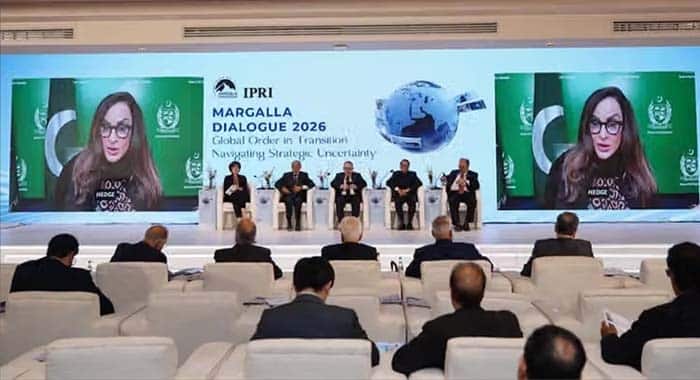
Pakistan’s security concerns, cross-border terrorism and the need for a sustainable regional approach to Afghanistan dominated discussions at the Margalla Dialogue in Islamabad, where Pakistani politicians, diplomats and regional experts exchanged views on the deteriorating relationship between the two neighboring countries.
While some participants called for reviewing Islamabad’s approach to Afghanistan and expanding regional economic cooperation, others emphasized that Pakistan could not compromise its national security in the face of persistent terrorist threats emanating from Afghan soil.
The dialogue, hosted by the Islamabad Policy Research Institute (IPRI) on Tuesday, brought into focus the challenge of balancing historical, cultural and economic ties with Afghanistan against Pakistan’s legitimate security concerns, particularly the presence of banned Tehreek-e-Taliban Pakistan (TTP) and other armed groups in Afghanistan.
Mushahid Hussain Calls for Reviewing Afghanistan Policy
Former senator Mushahid Hussain called for a review of Pakistan’s Afghanistan policy, cautioning against decisions that could push Kabul closer to New Delhi.
He argued that Pakistan and Afghanistan shared historical ties and that hasty policy decisions, border closures and the repatriation of Afghan students could further strain relations between the two countries.
According to Hussain, such measures were not in Pakistan’s interest or conducive to regional peace. He maintained that counterterrorism efforts should be distinguished from relations between the people of the two countries.
Hussain also highlighted the sharp decline in bilateral trade, claiming that Pakistan’s trade volume with Afghanistan had fallen from $2.3 billion in 2024 to just $7 million this year.
Describing the current tensions as temporary, he expressed optimism that the two countries would eventually overcome their differences.
He proposed a broader regional approach to counterterrorism, involving China, Russia, Turkey, Iran and several Arab countries, arguing that collective engagement could help address the challenges facing the region.
Sherry Rehman Highlights Pakistan’s Security Imperatives
Senator Sherry Rehman, however, placed particular emphasis on Pakistan’s security concerns, pointing to terrorist attacks, border clashes, trade disruptions and growing mistrust as major factors behind the deterioration in bilateral relations.
She accused the Afghan Taliban of harboring and tolerating a significant number of TTP fighters and members of other armed groups, stressing that Pakistan could not remain indifferent to threats and attacks originating from Afghan territory.
Although the Taliban deny these allegations, Rehman maintained that Pakistan’s security concerns required meaningful and verifiable commitments against terrorism.
She called for effective border monitoring, measurable progress in counterterrorism efforts and sustained diplomatic engagement to address the challenges.
Rehman also acknowledged the economic and humanitarian consequences of border closures, noting that restrictions had affected families and business communities on both sides while undermining Afghanistan’s potential role as a trade and transit link between South Asia and Central Asia.
Referring to regional connectivity initiatives, she cited the CASA-1000 electricity transmission project and the Turkmenistan-Afghanistan-Pakistan-India (TAPI) gas pipeline as examples of opportunities for economic cooperation.
She argued that Pakistan should continue exploring trade, transit and economic partnerships while addressing its security concerns.
Asif Durrani Identifies Key Priorities in Engagement with Taliban
Pakistan’s former special representative for Afghanistan, Asif Durrani, identified resolving outstanding disputes with the Afghan Taliban, particularly those involving terrorism and transit trade, as one of Islamabad’s three major priorities.
Discussing regional connectivity and competing economic interests, he referred to India’s investment in Iran’s Chabahar Port and the China-Pakistan Economic Corridor (CPEC).
Durrani argued that Pakistan should not view economic gains from one connectivity project as a loss for another, emphasizing that different regional trade and transit routes could complement rather than undermine one another.
He highlighted Pakistan’s strategic geographical position, saying the country could benefit economically by facilitating energy transfers to South Asia, expanding trade routes towards West Asia and providing Central Asian states access to warm waters.
Turkey Offers Continued Mediation Between Pakistan and Taliban
Professor Ismail Numan Tulsi of Turkey’s Ibn Haldun University discussed Ankara’s diplomatic efforts to reduce tensions between Pakistan and the Afghan Taliban.
He said talks held in Istanbul on October 30, 2025, had resulted in an agreement to extend the ceasefire and establish a mechanism for monitoring its implementation.
Following the suspension of negotiations, Turkey had encouraged the Pakistani delegation to give dialogue another opportunity, he added.
Tulsi further said Ankara had urged both sides to return to the negotiating table after tensions escalated again in February.
He emphasized that Turkey would continue its mediation efforts, noting that instability in Afghanistan would complicate regional connectivity between South Asia, West Asia and Central Asia.
The discussions at the Margalla Dialogue highlighted the competing considerations shaping Pakistan’s engagement with Afghanistan, particularly the need to preserve regional economic opportunities without compromising national security.
While diplomatic engagement and regional connectivity remain important elements of Islamabad’s approach, the persistent threat posed by terrorist groups operating from Afghan territory remains a central challenge to restoring trust and stability between the two countries.



