
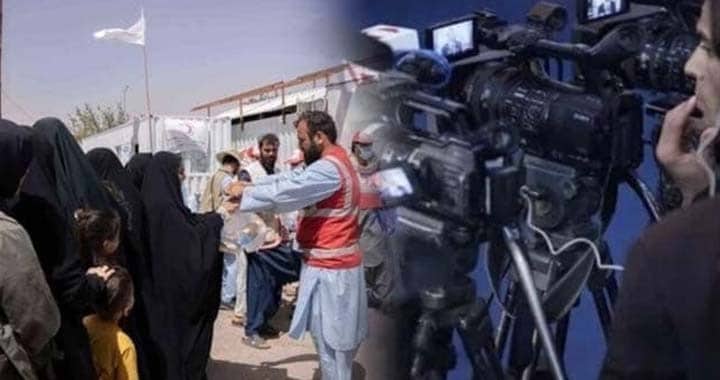
A Taliban intelligence unit has been accused of orchestrating a systematic campaign of intimidation, arbitrary arrests and torture against Afghan journalists, while also monitoring media outlets and coordinating online propaganda to suppress criticism of the regime.
A detailed investigation by Reporters Without Borders (RSF) identifies Directorate 015, operating under the Taliban’s General Directorate of Intelligence (GDI), as a central instrument of the crackdown. The unit reportedly monitors television and radio broadcasts, summons journalists over critical coverage, raids media offices and seizes equipment.
Since the Taliban returned to power in August 2021, at least 74 journalists have been arrested and detained for periods ranging from one week to two years, according to RSF. The investigation documents accounts of physical torture, threats, forced confessions and intimidation extending beyond Afghanistan’s borders.
One journalist, identified by the pseudonym Farhad, told RSF that he was taken to a GDI office in Kabul after his arrest, with a black bag placed over his head. Interrogators accused him of spying and spreading propaganda against the Islamic Emirate of Afghanistan. His phone and computer were searched before he was beaten and subjected to further interrogation.
Farhad said he was later transferred to Directorate 015, where he spent two weeks in solitary confinement. He described repeated beatings to his back and feet, as well as the use of a stun gun. Interrogators also pressured him to provide information about other journalists.
The unit reportedly maintains agents at its headquarters in Kabul and across Afghanistan’s provinces, monitoring media content and identifying material considered objectionable by the Taliban authorities. Its operations unit, sometimes working alongside the Ministry for the Promotion of Virtue and the Prevention of Vice, has reportedly conducted raids on media organizations, including a raid on TOLOnews in May 2026 and an operation targeting the offices of the Afghanistan Journalists Organisations and Media Federation in July 2025.
Journalists Threatened into Silence
The investigation describes a media environment in which journalists face pressure to avoid reporting on subjects such as women’s rights, security incidents and poverty.
A journalist identified as Ahmad told RSF that restrictions began with bans on certain television programmes and the exclusion of women journalists. Broadcasters were also required to pledge that they would not air mixed-gender programmes or interview people expressing views opposed to the Taliban regime.
Ahmad said he was repeatedly summoned to Directorate 015 over reports that authorities considered objectionable. He eventually fled Afghanistan after concluding that continuing his work had become too dangerous.
Another journalist, Abdul, described being instructed not to cover women’s rights, security incidents or poverty, and to invite only individuals approved by the Taliban authorities.
RSF said it had documented more than 20 national directives and an expanding number of provincial decrees aimed at restricting press freedom. Audio messages reviewed by the organization also allegedly contain Directorate 015 agents warning journalists against giving airtime to people who question Taliban policies.
The agents reportedly directed broadcasters to invite analysts from a Taliban-approved list containing around 50 names and demanded that media organizations produce reports and interviews on subjects selected by the authorities.
Threats have also reportedly continued against journalists living in exile, with some receiving messages warning that they would be found regardless of where they sought refuge.
Torture, Mock Execution and Imprisonment
Ahmad recounted being forcibly taken to Directorate 015, where he was accused of spying and beaten so severely that he lost consciousness. He was subsequently transferred to another GDI unit.
According to RSF, Directorate 015 does not operate its own prison, and journalists detained by the unit are generally transferred to GDI Directorates 40 or 90.
During his detention, Ahmad said he was allowed to see his family only twice and was subjected to a mock execution. He recalled being taken to a hill in the early hours of the morning, where an interrogator held a gun to his head and threatened to kill him.
He was eventually tried and sentenced to imprisonment for propaganda against the regime. After spending several months in Bagram prison, where he described being kept in shackles and subjected to physical punishment, he was released and fled Afghanistan.
Responding to RSF’s questions, Taliban spokesperson Hamdullah Fitrat said the relevant authorities, including Directorate 015, operated in accordance with the law and that no one was subjected to arbitrary treatment or arrest.
However, RSF said the response contradicted the numerous cases of repression and press freedom violations documented by the organization and other rights groups.
Intelligence Unit Accused of Running Online Propaganda Network
The investigation also links Directorate 015 to the Taliban’s efforts to shape public opinion through coordinated social media activity.
According to information obtained by RSF, a dedicated unit monitors online content, while another is responsible for propaganda, disinformation campaigns and efforts to influence public opinion. The directorate also reportedly operates a video production studio where forced confessions by detainees are recorded.
In September 2026, several media outlets published documents purportedly originating from the GDI. One document outlined an influence and propaganda programme with a projected budget of 70.7 million Afghanis, equivalent to more than $1 million.
The documents also referred to nearly 1,500 social media accounts allegedly used to promote the Taliban regime, discredit opponents and circulate narratives favorable to the Islamic Emirate.
RSF said its analysis of posts published in August 2026 by accounts identified in the documents found consistently pro-Taliban content. Several profiles reportedly shared identical or closely similar messages within minutes of one another, while some presented themselves as women or claimed to be from Panjshir, a historic center of resistance to the Taliban.
The findings echo an earlier investigation by the independent outlet 8AM Media, which identified synchronized posts and the use of fabricated female identities to promote pro-Taliban narratives.
The investigation portrays a system in which pressure on journalists, restrictions on independent reporting and coordinated online messaging operate as interconnected parts of the Taliban’s information-control strategy.



