
Tirah, or the rest of the province as well, did not descend into crisis overnight, nor did it become a theatre of security action by coincidence. Its geography, porous terrain, and long-neglected governance turned it into one of the most entrenched militant sanctuaries in the region. Over time, the area evolved into a convergence point for terrorism, organized crime, narcotics trafficking, and cross-border facilitation, with established linkages to Afghan Taliban and drug networks.
This was not merely a militant presence. It was a terror–crime ecosystem, one that gradually acquired political cover, producing one of the most dangerous hybrids Pakistan has faced: a terrorism–crime–politics nexus operating openly inside a civilian population.
Why Intelligence-Based Operations Were Inevitable
Security forces had been conducting sustained intelligence-based operations in Tirah for years. These operations delivered results, but a major constraint persisted. Militants deliberately embedded themselves within populated areas, turning civilian settlements into human shields. Collateral damage was not an abstract concern, it was a real and constant risk.
To prevent civilian casualties, the local administration, in coordination with tribal elders, initiated multiple jirgas. These were not cosmetic consultations. They were prolonged, serious engagements aimed at identifying a solution that would dismantle militant infrastructure without sacrificing innocent lives.
Local elders were given three full months to propose an alternative. During this period, they attempted direct engagement with the Khawarij elements entrenched in Tirah, urging them to vacate the area voluntarily. The objective was clear: avoid civilian harm during inevitable counterterror operations.
The militants refused, categorically.
Evacuation Was a Local Decision, Not a Military Demand
Only after militant defiance did the tribal elders approach the local government with a different proposal. They offered to temporarily relocate themselves so that security forces could operate without civilian constraints and eliminate militant hideouts completely.
This point is critical and non-negotiable.
The Pakistan Army never demanded evacuation. Evacuation was proposed, debated, and ultimately selected by the jirga itself as the least harmful option.
Following district-level consultations, the matter moved to the provincial tier. On December 26, 2025, jirga representatives formally conveyed their decision to the provincial government and expressed readiness to relocate. The choice was theirs. The state facilitated it.
Provincial Government Failure, By Design
Based on this decision, the provincial government approved Rs4 billion for the relocation and relief of Tirah’s population. That funding was not symbolic. It was sufficient, if managed honestly, to ensure dignified displacement, structured assistance, and minimal hardship.
What followed was not incompetence alone. It was deliberate mismanagement.
Funds were mishandled. Coordination collapsed. Relief mechanisms failed. The process descended into chaos, and the suffering of Tirah’s poorest residents deepened, not because evacuation was wrong, but because governance was weaponised.
This failure was then cynically repackaged.
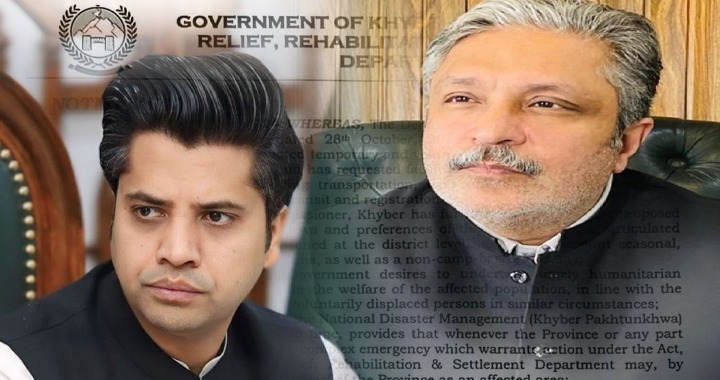
Instead of owning its administrative collapse, the PTI-led KP government launched a calculated propaganda campaign, shifting blame onto the federal government and the Pakistan Army. Evacuation was falsely portrayed as a forced military order. A locally chosen security measure was reframed as a manufactured humanitarian crisis.
Facts the Propaganda Cannot Erase
The record is unambiguous.
From the Bagh Maidan area, 19,000 families were identified for relocation. To date, 65 percent have moved. 35 percent remain, by choice, primarily due to agricultural considerations such as crop harvesting.
No timeline was imposed by security forces. None.
There has never been an agenda for a large-scale kinetic operation in Tirah. The strategy has always remained intelligence-based operations, a method proven repeatedly to be effective and precise.
In 2025 alone, 75,175 IBOs were conducted nationwide, resulting in the elimination of 2,597 terrorists. These numbers are not claims, they are outcomes.
Surveillance and strike capabilities have expanded significantly, allowing for greater precision and reduced collateral risk. Past experience has taught the state that large-scale operations generate humanitarian disasters and prolonged displacement. That lesson has not been forgotten.
No extraordinary troop buildup has occurred in Tirah. No indicators of a conventional operation exist. Even the region’s harsh climatic conditions argue against such a course.
The Real Objective in Tirah
Operations in Tirah are structured under the Bagh Joint Action Plan (BJAP), a comprehensive model combining kinetic action with non-kinetic measures. The objective is not just militant elimination, but long-term stability through development, law enforcement presence, economic revival, and the safe return of displaced families.
This is a stabilisation strategy, not a scorched-earth doctrine.
PTI’s Malign Narrative Exposed
The political crime–terror nexus has always opposed counterterror operations for one reason: they disrupt revenue streams, patronage networks, and ideological leverage.
The PTI government in KP, after failing administratively, chose alignment with this obstructionist logic. Public suffering was converted into a political weapon. National security was deliberately recast as a fake humanitarian tragedy. Displacement was used as emotional blackmail to discredit state institutions.
State-hostile social media networks, aided by external facilitators, amplified distorted narratives to conceal governance failure and protect illicit interests.
This was not dissent. It was active sabotage of counterterror efforts.
The Bottom Line
Tirah is not a story of military overreach. It is a story of militants cornered, local elders choosing safety, and a provincial government exploiting misery for politics.
Counterterror pressure is tightening. That is why militants are fleeing, propaganda is intensifying, and political cover is being tested.
The facts stand firm.
And no amount of manufactured outrage can erase them.



