
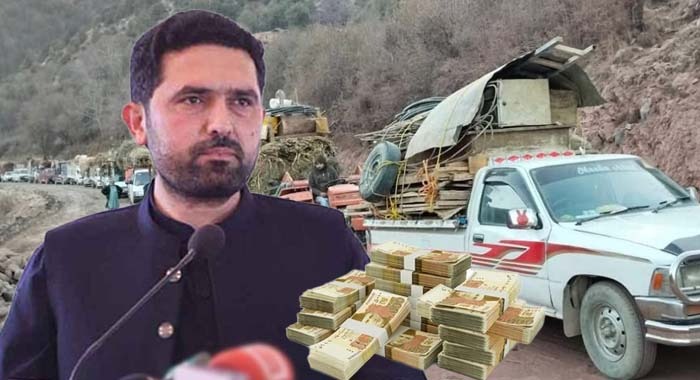
The release of Rs4 billion for Tirah Valley within less than two days was not an administrative achievement. It was a stress test. And Pakistan Tehreek e Insaf (PTI) failed it decisively.
This was not the first emergency fund placed at the disposal of the Khyber Pakhtunkhwa government. It was not even a rare one. Over the past decade, successive federal governments have transferred more than Rs800 billion to Khyber Pakhtunkhwa under various heads related to counterterrorism, policing, rehabilitation, former FATA stabilization, and security linked development. No other province has received comparable allocations tied so directly to militancy and conflict.
Yet Tirah today stands displaced, angry, divided, and leaderless.
The question therefore is no longer limited to Rs4 billion. Tirah has merely exposed a much larger truth. Where did the counterterrorism money go, and what exactly did PTI build with thirteen uninterrupted years of power.
Tirah as a Case Study of Governance Collapse
Tirah, the remote and picturesque valley in Khyber district, did not descend into crisis overnight. Intelligence assessments, administrative warnings, and political briefings existed well before displacement began. Cabinet approvals were in place months earlier. Funds were sanctioned in advance. The provincial government had time, authority, and resources.
What it did not demonstrate was intent to govern.
Instead of preparing transparent frameworks for relief, registration, and rehabilitation, the provincial administration allowed confusion to metastasize. Registration bottlenecks, disputed beneficiary lists, allegations of partisan favoritism, and delays became the defining features of the response. Two registration points for tens of thousands of people was not incompetence by accident. It was mismanagement by design.
Tirah was treated not as a humanitarian emergency but as a political terrain.
Counterterrorism Funds Without Counterterrorism Outcomes
The most damaging failure is not financial opacity alone. It is the strategic vacuum left by PTI’s approach to security.
Despite receiving hundreds of billions for counterterrorism, Khyber Pakhtunkhwa today faces expanding militant footprints, emboldened banned outfits, and repeated displacement cycles. If these funds were meant to strengthen policing, intelligence coordination, local resilience, and post operation stabilization, the results are conspicuously absent.
Tirah exposes a grim pattern. Operations delayed. Militants escape. Narcotics cultivation proceeds uninterrupted. Profits circulate through criminal networks. Displacement follows. Emergency funds are released. Accountability disappears.
This is not coincidence. It is a loop.
Federal Minister for Information Attaullah Tarar’s description of PTI as providing political cover to militant narratives did not emerge in isolation. It reflects years of policy ambiguity where negotiation replaced enforcement, slogans replaced strategy, and optics replaced outcomes.
Manufacturing Confrontation to Mask Administrative Failure
Rather than owning this record, PTI’s leadership has chosen confrontation as camouflage.
Instead of publishing expenditure breakdowns, project lists, third party audits, or timelines, the party’s response has been to manufacture grievance. The target shifts with convenience. Political rivals one day. Federal institutions the next. Security forces when escalation is required.
This is not emotional politics. It is tactical deflection.
Recent cases involving PTI lawmakers facing backlash for incendiary and anti-state rhetoric are not outliers. They are symptoms of a broader method where chaos is preferable to scrutiny. When accountability approaches, noise becomes policy.
Tirah’s displaced families are being told that their suffering is someone else’s fault. The federal government. The army. The state. Everyone except the provincial administration that controlled the funds, the timelines, and the implementation.
Thirteen Years, No Alibi Left
Khyber Pakhtunkhwa’s political history matters here. Before PTI, no party ruled the province twice consecutively. PTI is now in its third uninterrupted tenure. Thirteen years is not a mandate. It is ownership.
At this stage, every failure belongs squarely to governance choices, not inherited problems.
If Rs700 billion in counterterrorism funds could not stabilize the province, what exactly were they used for.
If Rs4 billion could be released within hours, why can transparency not follow within weeks.
If Tirah was known to be sensitive, why was preparedness absent.
If displacement was anticipated, why was relief politicized.
These are not opposition questions. They are governance questions.
Why the Silence Persists
The silence around utilization is deliberate because answers would expose uncomfortable realities. That counterterrorism funds did not translate into sustainable capacity. That political calculations repeatedly overrode security imperatives. That displacement became leverage. That Tirah was reduced to a bargaining chip tied to broader political objectives, including demands unrelated to provincial governance.
The provincial government does not fear criticism. It fears arithmetic.
Arithmetic reveals patterns. Patterns reveal responsibility.
The Question That Will Not Go Away
The tribal jirga announced, on January 31, by Bara Political Alliance is not a political stunt. It is a symptom of institutional failure. When elected governments do not provide clarity, societies revert to traditional mechanisms to seek truth.
At the same time, rebranding political rallies as jirgas only deepens mistrust. One seeks answers. The other seeks applause.
After thirteen years, slogans about corruption free governance ring hollow without receipts.
So, the question must be asked again, not as accusation, but as obligation.
Where did the Rs4 billion for Tirah go.
Where did the Rs800 billion for counterterrorism go.
And if neither produced stability, relief, nor trust, what exactly has PTI governed.
Until these questions are answered with documents instead of noise, Tirah will remain not just displaced geographically but abandoned administratively.
Silence is no longer ambiguity.
It is evidence.



