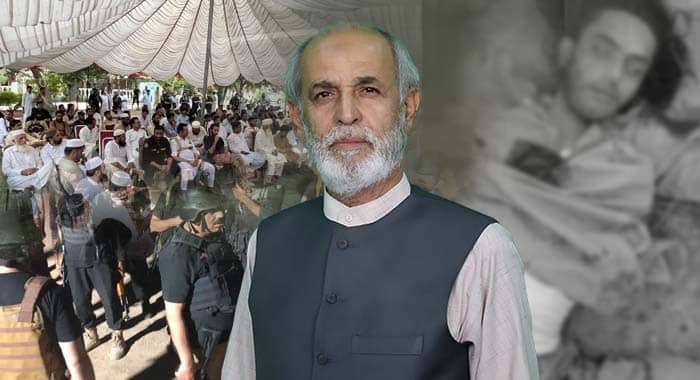
Shamim Shahid
Pakistan’s fight against terrorism has never been merely a battle between the state and armed groups. It is a struggle for the future of communities that have endured years of fear, loss and uncertainty. From the deeply affected villages of Khyber Pakhtunkhwa to the increasingly challenging security environment in Balochistan, the country has paid a heavy price. Yet, amid these difficulties, there are also signs of something equally important: resilience, institutional coordination and a determination not to allow terrorism to dictate Pakistan’s future.
Recent developments in Laki Marwat, particularly in Shah Hassan Khel, offer an important example of how determined security action can protect communities. At the same time, the government’s engagement with the Aman Committee raises important questions about the difficult but necessary process of maintaining peace in areas that have suffered from violence. Meanwhile, reports emerging from Ziarat in Balochistan demonstrate why vigilance cannot be relaxed.
Taken together, these developments tell a broader story not simply of terrorism, but of Pakistan’s continuing effort to move from the shadow of violence toward a stronger and safer future. The reported intelligence-based operation in Shah Hassan Khel, Laki Marwat, deserves attention because of the extraordinary history of the area. According to security sources and the discussion with senior journalist Shamim Shahid, two alleged foreign-sponsored terrorists, identified as Junaid and Mohsin, were pursued during an intelligence-based operation and killed. The operation was reportedly conducted jointly by the police and security forces.
Initial information also linked the two men to the alleged kidnapping of a Federal Constabulary personnel from Abdul Khel. If these allegations are confirmed, their elimination represents an important security development. However, the significance of the operation becomes much clearer when the history of Shah Hassan Khel is understood, because this is far from an ordinary village.
Shah Hassan Khel has experienced some of the most devastating consequences of terrorism. According to the account discussed, a football match in the area was once targeted by explosions, resulting in the deaths of around 140 people. Another suicide attack later claimed an additional 40 to 50 lives. For a village, such losses are almost impossible to comprehend.
Behind every number was a human being: a father, son, brother, friend, student, worker or breadwinner. The consequences did not end when the attacks were over; they continued inside homes and across generations. According to the discussion, a report received around a year ago suggested that there was hardly a house in Shah Hassan Khel that had not lost one or two people to terrorism. Some families were reportedly left with only women and children, while many of the community’s breadwinners were killed.
This is the true impact of terrorism. It does not simply attack buildings or public places; it attacks the economic stability of families, the confidence of communities and the psychological security of an entire generation. That is why an operation preventing another potential attack in such a village carries significance far beyond the two individuals reportedly killed.
Counterterrorism is often measured by dramatic events: the number of militants arrested, hideouts destroyed or terrorists killed. Yet the most important victory is sometimes invisible because it is the attack that never happens. If intelligence led police and security forces to the alleged militants before they could launch another attack, then the real beneficiaries are the people who went home safely that day. Children continued playing, families remained together and workers returned home without becoming victims of another tragedy.
This is the importance of intelligence-based operations. The fight against terrorism cannot depend solely on responding after an explosion has taken place. It must involve identifying threats, disrupting networks and preventing militants from reaching their intended targets.
The reported operation in Shah Hassan Khel demonstrates the importance of precisely this approach. It also highlights the value of coordination between police and security forces. Counterterrorism is most effective when institutions combine their respective strengths, share intelligence and act before threats become disasters. For communities such as Shah Hassan Khel, prevention is not an abstract security concept; it is a matter of survival.
While security operations are essential, lasting peace cannot be built through force alone. This brings us to another important development discussed in the interview: the government’s agreement with the Aman Committee. The issue is complicated because, as Shamim Shahid explained, there are different types of Aman Committees. One category consists of former militants who surrendered and subsequently became part of peace-related structures. Another refers to police or government-supported peace committees.
This distinction is important because their backgrounds, responsibilities and relationships with the state are not necessarily identical. The controversy surrounding the Aman Committee intensified after allegations that some members were refusing to follow government instructions and that violence had escalated following the killing of a police officer.
The government subsequently reached an agreement with the committee. At its core, however, the agreement should be judged by one simple standard: does it make ordinary people safer? That must remain the central question.
Peace agreements can be valuable instruments when they reduce violence, create communication channels and prevent communities from sliding further into conflict. But agreements also require discipline. A peace agreement cannot become a license for lawlessness, nor can it succeed if different sides interpret its terms differently.
The future of the agreement will depend on implementation. If members of the Aman Committee violate its terms, there must be consequences. If government officials or police violate agreed obligations, the same principle of accountability should apply. This is not about weakening the state. Quite the opposite: a strong state is one that can establish rules and enforce them fairly. The government must ensure that peace committees operate within a clearly defined legal and administrative framework. They should support peace, not become parallel centres of authority. At the same time, communities willing to support the state and oppose terrorism should not be left exposed. Pakistan’s history demonstrates why.
As Shamim Shahid pointed out, the establishment of peace committees dates back to around 2005–06, when local members stepped forward to support the government and security forces. These people took an extremely difficult position by standing against terrorism in their own communities. Many peace committee members and commanders were subsequently targeted. Those who wanted peace, opposed terrorism and supported the state became targets themselves. This history deserves greater recognition because the people who stand against terrorism at the local level often face risks that are not visible from distant offices.
They know the terrain, the communities and the networks around them. Their decision to support peace can make them vulnerable to retaliation. Therefore, Pakistan’s approach to peace committees must learn from the past.
Local communities can be valuable partners in counterterrorism, but they require clear rules, state protection and institutional support. The state should never ask citizens to stand against terrorism and then leave them alone to face the consequences.
If Laki Marwat offers an example of proactive security action, the situation in Ziarat is a reminder that the threat remains fluid. Reports emerged of an attack on a customs office in Ziarat. At the time of the discussion, no official statement had reportedly confirmed casualties, although media reports from the area indicated that an incident had taken place.
The development is concerning because Ziarat has already experienced security challenges. According to the discussion, police have also been targeted in the area, with around 35 to 40 police officers reportedly martyred in previous incidents.
Such losses demonstrate the courage and sacrifice of Pakistan’s law-enforcement personnel. Police officers are often the first line of defence. They are not operating from the safety of distant command centres; they are present on roads, in towns, at checkpoints and in communities. When terrorists target police, they are attempting to weaken the state’s ability to protect citizens. That is why attacks against police officers must be understood as attacks against public security itself.
Ziarat also presents a geographical challenge. The area includes mountainous terrain, with Khawarij identified in the discussion as an area where terrorist sites have reportedly existed. Mountainous and difficult terrain can provide militants with opportunities to hide, move and establish temporary bases. Such environments make surveillance and counterterrorism operations more complicated. This does not mean that geography should become an excuse for insecurity. It means that Pakistan’s security strategy must adapt to geography. Different areas require different approaches. Intelligence networks, police capabilities, surveillance, local cooperation and security-force operations must all work together.
The discussion also referred to information concerning the possible involvement or presence of Daesh and the Tehreek-e-Taliban Pakistan (TTP) in the broader security environment. The emergence or activity of multiple militant networks is particularly concerning because terrorist threats can evolve quickly. Pakistan has learned through painful experience that militant groups can exploit local grievances, difficult terrain and security gaps.
But Pakistan has also demonstrated repeatedly that it possesses the capability and determination to confront these threats. The crucial requirement is sustained vigilance. Terrorism cannot be allowed to return simply because one operation has succeeded or one agreement has temporarily reduced tensions. Security is a continuous process.
Perhaps the most important lesson from Laki Marwat is not about terrorism alone; it is about resilience. Shah Hassan Khel suffered extraordinary losses, yet it continued to exist. Families rebuilt their lives, communities continued functioning and people continued to hope. That resilience is one of Pakistan’s greatest strengths.
Terrorism seeks to create fear and convince people that the state is incapable of protecting them. Every time a community refuses to surrender to fear, that objective fails. Every police officer who continues to serve after losing colleagues sends a message. Every family that rebuilds after tragedy sends a message. Every citizen who chooses peace over violence sends a message. Every successful operation that prevents another attack also sends a message that terrorist groups cannot operate with impunity.
Pakistan has reached many moments in its history when it appeared that terrorism was being pushed back. The challenge has always been ensuring that temporary successes become permanent gains. The developments in Laki Marwat, the government’s engagement with the Aman Committee and the security concerns in Ziarat should therefore be viewed as interconnected pieces of a much larger national challenge.
The answer cannot be either force or dialogue alone. Pakistan needs both effective security operations and responsible political and administrative engagement. Where terrorists threaten citizens, the state must act decisively. Where communities are willing to support peace, the state must engage them responsibly. Where agreements are reached, they must be enforced. Where violations occur, accountability must follow. And where new terrorist networks attempt to establish themselves, they must be stopped before they become deeply rooted.
The story of Pakistan’s fight against terrorism is often told through tragedy. It should also be told through resilience, sacrifice and determination. Laki Marwat has suffered enormously, yet its people continue to stand. Pakistan’s police and security forces have lost thousands of brave personnel over the years, yet they continue to defend the country. Communities that have experienced terrorism have repeatedly rejected the idea that violence should determine their future.
This is why the reported operation in Shah Hassan Khel matters. It is not simply about two alleged terrorists; it is about whether a community that has already suffered enough can finally begin to breathe more freely. The Aman Committee agreement matters for the same reason. It is not merely a political arrangement; it is a test of whether local peace can be maintained through responsibility, law and accountability.
Ziarat matters because it reminds the country that success requires constant vigilance. Pakistan cannot afford complacency, but neither can it afford despair. The country has the institutions, experience, courage and public resilience necessary to confront the remaining threats. What is required now is consistency: a security policy that does not change with every crisis, institutions that cooperate rather than compete, and a clear commitment to protecting citizens above all else.
The road from terrorism to lasting peace will not be short, but it is possible. The sacrifices of Shah Hassan Khel, the courage of Pakistan’s police and security forces, and the resilience of communities across the country should not be remembered only as chapters of suffering. They should become the foundation for a stronger national resolve.
Pakistan’s future should not be defined by the violence it has endured. It should be defined by how successfully it rises above it. The real turning point will come when every terrorist understands that Pakistan will not retreat, every community knows that the state stands with it, and every citizen can look toward the future without the fear that once dominated everyday life.
That future is not guaranteed, but it is worth fighting for—and Pakistan has already shown that it has the courage to do so.