
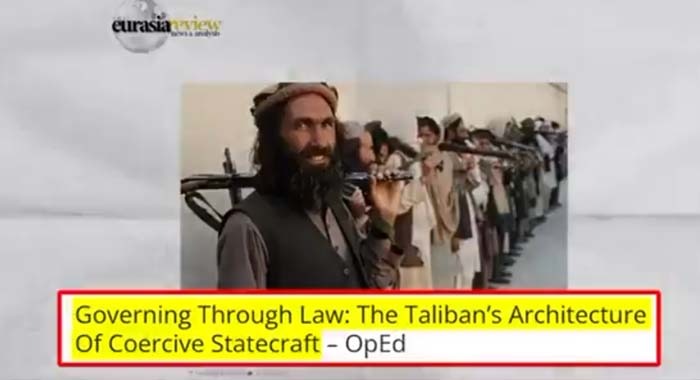
The Afghan Taliban have introduced a new criminal code that international observers and legal experts describe as a mechanism for entrenching authoritarian rule under the appearance of legality, further deepening concerns over human rights, social justice, and public safety in Afghanistan.
According to an analysis published by the international journal Eurasia, the newly imposed criminal code represents a strategic shift by the Taliban regime toward formalized coercion, transforming ideological control into state-enforced law. Rather than establishing an impartial justice system, the code is widely viewed as a framework designed to institutionalize fear, suppress dissent, and consolidate power.
Experts cited by Eurasia warn that the regulations effectively legalize class-based justice, granting privileges and protections to select groups aligned with the regime while exposing ordinary citizens to arbitrary punishment. The report notes that religious and political diversity have been criminalized, with dissenting beliefs and nonconforming interpretations of faith treated as offenses under Taliban rule.
Particularly alarming are provisions that severely restrict women’s autonomy, limiting their legal agency and personal freedoms. International observers caution that the new code normalizes and indirectly legitimizes domestic violence, stripping women of meaningful legal recourse and reinforcing systemic gender-based oppression.
Human rights specialists emphasize that the criminal code is not a neutral legal instrument but a state strategy built on coercion, aimed at enforcing ideological obedience rather than justice. By codifying repression, the Taliban are seeking to transform fear into governance, replacing rule of law with rule by intimidation.
Global analysts further warn that the regulations pose serious risks to the safety and dignity of ordinary Afghans, particularly women, religious minorities, and politically unaffiliated citizens. The code is said to violate fundamental principles of international human rights law, undermine basic religious freedoms, and erode core ethical values by promoting discrimination and social inequality.
The report underscores that the Taliban’s actions reflect a broader pattern, ranging from the patronage of extremist groups to the systematic dismantling of legal protections, exposing the regime’s increasingly authoritarian character. Observers caution that without sustained international attention and accountability mechanisms, the new criminal code could further entrench repression and normalize abuses across Afghan society.
International human rights advocates are urging the global community to closely scrutinize the Taliban’s legal framework, warning that recognition or normalization of such policies risks legitimizing a system built on fear, exclusion, and injustice, rather than law, morality, or public consent.



