
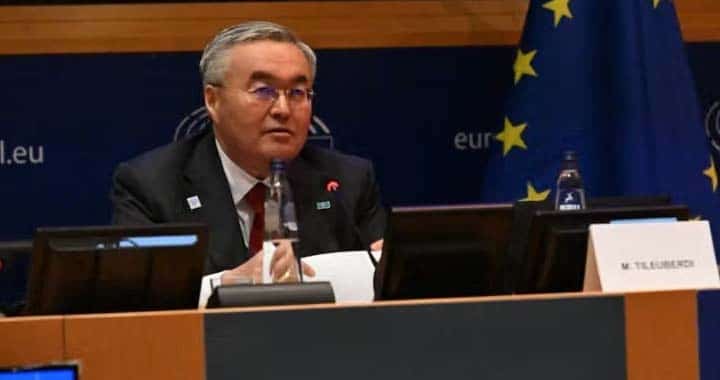
Kazakhstan has raised serious concerns over the growing security implications of developments in Afghanistan, warning that terrorist and extremist networks, cross-border illicit trafficking and the spread of radical ideologies continue to pose significant threats to Central Asian security and regional stability.
Speaking at the third Schuman Security and Defence Forum in Brussels on 18 November, Kazakhstan’s Foreign Minister Mukhtar Tileuberdi called for a coordinated international response to address the expanding spectrum of security challenges linked to Afghanistan and their potential spillover effects across the region.
Addressing the evolving relationship between armed conflict, terrorism and regional instability, Tileuberdi stressed that terrorist networks and extremist activities transcend national borders, making international cooperation, timely intelligence-sharing and stronger counter-radicalisation measures essential.
He warned that the interconnected nature of these threats demands a collective response, with countries working together to prevent extremist networks from exploiting regional vulnerabilities and undermining security.
The Kazakh foreign minister also highlighted the importance of addressing the spread of radical ideologies, particularly through digital platforms, and strengthening mechanisms to prevent radicalisation and violent extremism.
Emphasising the need for a comprehensive approach, Tileuberdi underscored that regional security cannot be safeguarded through isolated national efforts.
He called for enhanced international coordination, improved information-sharing, stronger preventive mechanisms and closer institutional cooperation to counter cross-border security threats.
His remarks reflect Kazakhstan’s growing concern that instability and extremist activities originating from Afghanistan could have consequences well beyond its immediate neighbourhood.
Despite the security concerns, Kazakhstan reiterated its support for pragmatic engagement with Afghanistan, emphasising the importance of expanding humanitarian assistance and economic cooperation.
Tileuberdi identified education, healthcare, transport connectivity and institutional capacity-building as key priorities for supporting Afghanistan’s long-term stability and development.
He also proposed greater utilisation of the United Nations Regional Centre for the Sustainable Development Goals for Central Asia and Afghanistan, based in Almaty, as a platform for strengthening international cooperation.
Particular emphasis was placed on expanding educational opportunities for Afghan women through partnerships with international organisations and donor countries.
In a significant policy message, Tileuberdi stressed that sustainable security cannot be achieved through military and law-enforcement measures alone.
He argued that lasting stability requires a broader strategy combining political engagement, humanitarian assistance, economic development and stronger social institutions.
His position highlights the importance of addressing the underlying conditions that contribute to extremism, instability and cross-border insecurity.
Kazakhstan’s warning at the Brussels forum adds to international concerns over the regional implications of Afghanistan’s security situation. The continued threat posed by extremist networks, illicit trafficking and radical ideologies makes sustained regional cooperation increasingly important.
For Central Asian countries, preventing the spillover of instability from Afghanistan remains a critical security priority, requiring coordinated international engagement and effective mechanisms to address both immediate threats and their underlying causes.



