
Five years after the Taliban takeover of Kabul on 15 August 2021, Pakistan has expressed grave concern over the continued deterioration of the security situation in Afghanistan and the growing threat posed by Khawarij elements operating from Afghan territory.
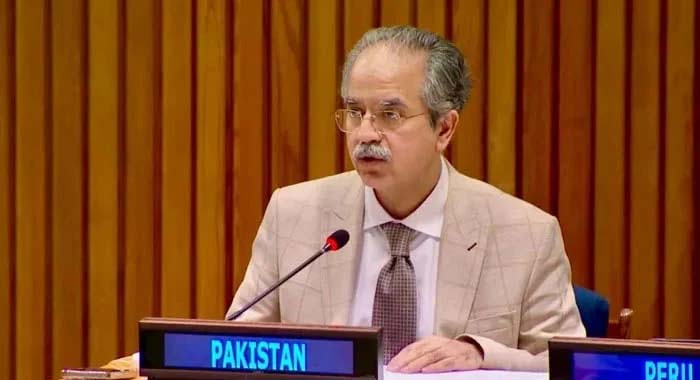
Speaking in an interview marking the fifth anniversary of the Taliban’s return to power, Pakistan’s Ambassador to the United Nations, Asim Iftikhar Ahmad, underscored that Islamabad’s fundamental position toward Afghanistan and the Afghan people remains unchanged. He emphasized that Pakistan and Afghanistan are next-door neighbours with deep-rooted and longstanding historical, cultural, religious, and people-to-people ties.
Ambassador Ahmad made clear that Pakistan’s concerns are directed neither at the Afghan people nor at Afghanistan as a country. Rather, Pakistan’s principal concern is the continued use of Afghan territory as a safe haven for elements involved in violence and destabilization against Pakistan and other countries.
“The trends are posing grave concern,” Ambassador Ahmad observed, referring to findings contained in reports of the United Nations sanctions monitoring mechanisms and the UN Secretary-General concerning Afghanistan’s continued role as a safe haven for a number of terrorist groups.
Ambassador Ahmad recalled that the international community’s expectations following the 2020 Doha process and the Taliban’s subsequent assumption of power were centered around three fundamental benchmarks.
These included the establishment of an inclusive and representative system of governance, respect for human rights, particularly the rights of women and girls, and a clear and credible assurance that Afghan territory would not be used to plan, finance, facilitate, or launch terrorist activities against any other country.
Pakistan, he noted, did not adopt a wait-and-see approach following the Taliban takeover. Recognizing the humanitarian and economic challenges confronting Afghanistan, Islamabad actively worked to mobilize international support for the Afghan people.
Within months of the takeover, Pakistan convened an extraordinary session of the Organization of Islamic Cooperation (OIC) Council of Foreign Ministers in Islamabad in December 2021, seeking greater international attention and assistance for Afghanistan’s humanitarian recovery, economic stability, and long-term development.
Five years later, however, Ambassador Ahmad said that the overall trajectory has been one of regression rather than meaningful progress on the three core benchmarks.
He pointed to continuing restrictions on girls’ education and women’s participation in employment and public life as evidence of the deterioration on the human-rights front. At the same time, Afghanistan’s governing structure has remained exclusionary, with limited evidence of the broad-based and inclusive political framework that had been expected by the international community.
Ambassador Ahmad stressed that it is on the counterterrorism benchmark that Pakistan has paid the heaviest price.
According to figures cited by the Ambassador, Pakistan recorded more than 5,200 terrorism-related incidents in 2025, resulting in more than 1,300 deaths. He acknowledged that these figures encompass categories broader than independently verified attacks specifically traced to Afghan territory.
For comparison, the Global Terrorism Index recorded 1,045 incidents and 1,139 terrorism-related deaths in Pakistan during 2025.
The security situation has remained deeply concerning in 2026. Ambassador Ahmad stated that the pattern had not subsided during the first six months of the year and had, in fact, intensified, with more than 3,000 attacks and upwards of 830 Pakistani deaths reported during that period.
He emphasized that behind these figures are Pakistani civilians, security personnel, and families who continue to bear the human cost of instability and violence.
Pakistan, he stressed, has itself experienced the consequences of decades of instability in Afghanistan more directly than almost any other country. The country has hosted and supported millions of Afghans over successive decades while simultaneously confronting the security consequences of prolonged conflict across its western border.
Ambassador Ahmad identified Tehreek-e-Taliban Pakistan (TTP), the Balochistan Liberation Army (BLA), and the Majeed Brigade, alongside the regional affiliate of Daesh, as major security concerns.
He stated that Pakistan has increasingly observed the first three groups acting as proxies for adversarial interests in the region, contributing to efforts aimed at destabilizing Pakistan and undermining regional peace and stability.
Particular concern was expressed over the continued presence and activities of the TTP, which Pakistan maintains has been operating from safe havens across the border.
Asked whether the Taliban authorities are simply unable to control the TTP or are deliberately providing it space to operate, Ambassador Ahmad stated that, in Pakistan’s assessment, available evidence points beyond a mere lack of capability or political will.
He referred to information contained in UN monitoring reports as well as Pakistan’s own intelligence assessments and alleged that the Taliban authorities are actively providing support and space to the TTP, including safe havens, weapons and ammunition, financing, planning assistance, and facilitation for cross-border infiltration.
He further expressed concern over the availability of advanced weaponry left behind in Afghanistan following the withdrawal of international forces, noting that such weapons can further enhance the capabilities of Khawarij elements.
Pakistan has consistently maintained that the responsibility for preventing the use of Afghan territory against neighbouring countries rests primarily with the authorities controlling that territory.
Ambassador Ahmad therefore called for concrete, credible, and verifiable measures by the Taliban authorities to ensure that Afghan soil is not used for activities directed against Pakistan or any other state.
Among the possible measures discussed was the issuance of a formal religious edict, or fatwa, by senior Taliban religious authorities against groups such as the TTP, accompanied by practical steps to dismantle their infrastructure, deny them safe havens, cut off their financing, and prevent cross-border infiltration.
Pakistan has emphasized that declarations alone are insufficient. What is required, Islamabad maintains, is measurable action that can be independently assessed and verified.
Ambassador Ahmad acknowledged the efforts undertaken by several regional countries to facilitate dialogue between Pakistan and Afghanistan.
He identified Saudi Arabia, Türkiye, China, and Qatar as common friends of Islamabad and Kabul that have sought to encourage dialogue and mediation. These countries have played important roles in facilitating contacts between the two sides, including efforts surrounding ceasefire arrangements and subsequent talks.
Despite these diplomatic efforts, however, Pakistan maintains that the necessary assurances and concrete commitments concerning the Khawarij threat have not been adequately forthcoming from the Taliban authorities.
Islamabad has repeatedly emphasized that regional peace cannot be achieved through diplomatic statements alone. Sustainable stability requires verifiable commitments, responsible conduct, and effective action against elements using Afghan territory for violence and destabilization.
Ambassador Ahmad also urged the Taliban leadership to undertake serious introspection regarding Afghanistan’s continuing international isolation.
He noted that Afghanistan continues to face significant economic and diplomatic challenges, including frozen assets, restrictions affecting Taliban leaders, limited international recognition, and uncertainty surrounding the country’s prospects for development and investment.
Pakistan believes that the Taliban authorities have the ability to alter this trajectory by taking credible steps on counterterrorism, governance, human rights, and regional security.
The international community, Ambassador Ahmad observed, provided considerable “time and space” to the Taliban following the 2021 takeover, including through the United Nations’ engagement framework. Pakistan’s concern is that this period of engagement has not produced sufficient reciprocal progress on the commitments expected from Kabul.
Pakistan has called for a more focused and sustained international approach toward the counterterrorism dimension of the Afghanistan issue.
While existing UN Security Council measures concerning the Taliban include restrictions such as asset freezes and travel-related sanctions, Ambassador Ahmad argued that greater attention is required to address the continued presence and activities of Khawarij groups on Afghan soil.
Pakistan’s position is that international engagement should remain constructive but must also be results-oriented and linked to concrete outcomes.
Where engagement produces no meaningful progress, the international community should consider appropriate diplomatic and political measures to ensure that commitments regarding counterterrorism are translated into action.
Pakistan also reiterated its longstanding position concerning the rights of women and girls in Afghanistan.
Ambassador Ahmad recalled that Pakistan, together with countries including Indonesia and Saudi Arabia, had engaged with the Taliban leadership on issues such as girls’ education and women’s participation in society.
The message conveyed during these engagements was that restrictions preventing women and girls from accessing education and participating fully in society are not consistent with the principles and traditions of Islam, according to Pakistan’s assessment.
Islamabad has maintained that the international community’s concern is not directed against Afghanistan’s Islamic identity or its choice of an Islamic system of governance. Rather, the concern is with policies that discriminate against women, girls, minorities, or other sections of society.
Pakistan believes that these issues can and should be addressed through decisions taken by the Afghan authorities themselves.
Pakistan has consistently stated that it seeks a peaceful, stable, sovereign, prosperous, and inclusive Afghanistan that lives in peace with its neighbours.
Islamabad’s concerns arise from the direct security consequences of instability in Afghanistan and the continued presence of Khawarij elements capable of launching attacks against Pakistan.
Pakistan has paid a heavy price in human lives and national resources in its efforts to secure its approximately 2,600-kilometre-long border with Afghanistan and to protect its citizens from cross-border threats.
The Government of Pakistan reiterates that its dispute is not with the Afghan people. Pakistan remains committed to maintaining its historic bonds with the people of Afghanistan and to supporting efforts aimed at peace, stability, humanitarian relief, economic development, and regional connectivity.
At the same time, Pakistan will continue to defend its sovereignty, territorial integrity, and national security against threats emanating from across its borders.
Pakistan therefore calls upon the authorities in Kabul to take immediate, concrete, and verifiable measures to prevent the use of Afghan territory by Khawarij groups and other elements seeking to undermine peace and stability in the region.
The Taliban authorities must demonstrate through action not merely assurances that Afghan soil will not be permitted to serve as a safe haven, training ground, financing hub, or launching pad for attacks against Pakistan or any other country.
Pakistan remains ready to pursue dialogue and diplomatic engagement with all relevant stakeholders in the interest of regional peace. However, meaningful dialogue must be accompanied by credible commitments, measurable implementation, and verifiable results.
The international community, for its part, must remain engaged with Afghanistan while ensuring that such engagement contributes to tangible progress on counterterrorism, inclusive governance, human rights, and regional stability.
Pakistan believes that lasting peace in Afghanistan and the wider region is possible, but it requires responsible choices, mutual respect, and a genuine commitment to preventing the country from once again becoming a sanctuary for groups seeking to spread violence and instability beyond its borders.
Pakistan’s message remains unequivocal: peace in the region requires peace in Afghanistan, and peace in Afghanistan cannot be achieved while Khawarij elements are allowed to operate from its soil with impunity.



