
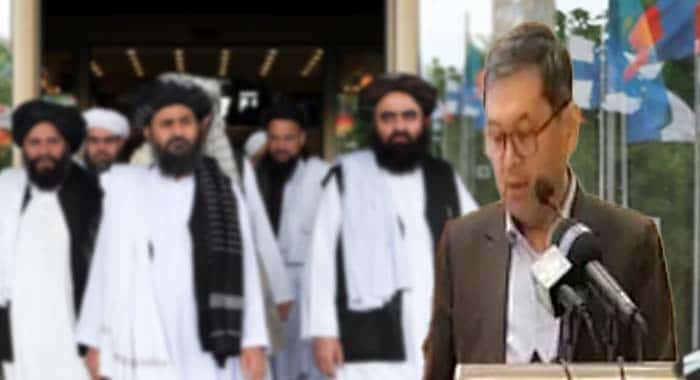
More than five years after the Taliban seized control of Afghanistan, the group has captured the institutions and resources of the Afghan state but failed to transform itself into a government representing the country’s people, Afghanistan’s representative Tahir Zaheer said at a seminar in Islamabad.
Speaking at a seminar titled “Afghan Predicament and the Trajectory to Peace,” Zaheer said the Taliban were using state power and resources not to govern Afghanistan for its people but to suppress and keep them subdued.
He called for Afghanistan’s stakeholders to decisively support the Afghan people’s freedom and the fight against terrorism, warning that the consequences of Taliban rule extend far beyond Afghanistan.
“The Taliban are not only our enemies but also enemies of regional and, ultimately, global peace, stability and development,” Zaheer said.
His remarks come amid growing international concern over the presence of multiple terrorist organizations in Afghanistan and the extent to which the country’s post-2021 security environment has allowed extremist networks to survive, reorganize and operate across borders.
United Nations assessments have identified more than 20 international and regional terrorist organizations operating in Afghanistan, including the banned Tehreek-e-Taliban Pakistan (TTP), Al-Qaeda, Islamic State Khorasan (ISKP), the Eastern Turkistan Islamic Movement, the Islamic Movement of Uzbekistan and Jamaat Ansarullah.
While the Taliban have conducted operations against ISKP, UN monitoring has found that other groups have generally sought to maintain relations with the Taliban. The TTP, in particular, has been accorded greater freedom and support, contributing to increased attacks against Pakistan. The UN has also reported that Al-Qaeda continues to enjoy Taliban patronage and provides training and advice to other terrorist organizations, principally the TTP.
For Pakistan, the consequences have become increasingly direct. TTP fighters have maintained sanctuaries and freedom of movement in Afghan provinces along the Pakistani border, from where the group has conducted increasingly complex attacks inside Pakistan.
The issue has consequently evolved from a question of Afghan internal security into a cross-border threat involving terrorism, militant infiltration and repeated tensions between Kabul and Islamabad.
Pakistan has repeatedly raised the presence of terrorist safe havens with the Taliban authorities and has accused Kabul of allowing Afghan territory to be used for attacks against Pakistan. Islamabad’s position has been that peace between the two countries cannot be sustained while terrorist organizations continue to operate from Afghan soil.
The threat, however, is not limited to Pakistan.
Afghanistan’s northern provinces have become a growing concern for Tajikistan, Uzbekistan and Turkmenistan. UN assessments have warned of the regional and international threat posed by ISKP, which has expanded its propaganda in Central Asian languages and sought to recruit nationals from countries including Tajikistan and Uzbekistan.
Jamaat Ansarullah, a Tajik extremist organization, also remains active in Afghanistan. The presence of such groups near the Central Asian frontier creates the possibility of recruitment, training, financing and operational networks extending beyond Afghanistan.
For Tajikistan in particular, the combination of a long Afghan border and the presence of Tajik extremists on the Afghan side represents a persistent security challenge. Uzbekistan and Turkmenistan face similar concerns over the possibility of extremist networks exploiting Afghanistan’s northern frontier and regional trade and transport routes.
The danger is therefore not simply that terrorism exists inside Afghanistan. It is that Afghanistan can provide an environment in which terrorist organizations with different regional agendas coexist, cooperate, recruit and develop capabilities that can eventually be projected beyond the country’s borders.
The Taliban’s ideological model adds another dimension to the threat.
Since returning to power, the group has imposed sweeping restrictions on women and girls, curtailed political and civic freedoms and pursued an exclusionary system of governance. The result is an Afghan political order in which state power remains concentrated in the hands of the Taliban while large sections of society, particularly women and girls, remain excluded from public life.
This combination of ideological rule, exclusion and the continued presence of terrorist organizations has created concerns over the broader phenomenon of Talibanization: the possibility that the Taliban’s model of governance and religious extremism could influence movements and communities outside Afghanistan.
The threat becomes still more complicated when terrorist organizations receive external political, financial, logistical or territorial support. The use of armed groups as instruments of state competition has long been alleged across the region, with governments accusing rival states of facilitating or patronizing militant organizations to pursue strategic objectives.
Such allegations vary from case to case and remain contested by the states accused. But the wider pattern is clear: where terrorism is treated as an instrument of strategic policy rather than solely as a security threat, extremist organizations gain opportunities to survive, regenerate and expand.
Afghanistan’s experience demonstrates the danger of such an ecosystem.
The Taliban’s seizure of state power did not eliminate terrorism from Afghanistan. Instead, different terrorist organizations have continued to operate under the new order, while some have developed relationships with Taliban authorities and others, particularly ISKP, have sought to challenge the Taliban themselves.
For Pakistan, Tajikistan and other neighboring countries, the consequences include cross-border terrorism, militant infiltration, radicalization, illicit arms and drug trafficking, and pressure on border communities.
For Central Asia, the concern is that Afghan-based extremist organizations could increasingly recruit citizens from the region and establish sleeper networks. For the wider international community, the continued presence of Al-Qaeda and ISKP carries the additional risk that Afghan-based networks could eventually develop or support operations beyond the immediate region.
The Afghan predicament, therefore, is no longer simply about who controls Kabul. It is about what kind of state is being built there, what happens to the Afghan people under that system, and whether the security environment created by Taliban rule allows terrorism and extremist ideology to move outward into neighboring countries and beyond.
Zaheer’s call for international stakeholders to support the Afghan people and the fight against terrorism reflects that broader challenge: achieving peace in Afghanistan requires addressing both the political exclusion imposed on Afghans and the terrorist networks operating within the country’s borders.



