
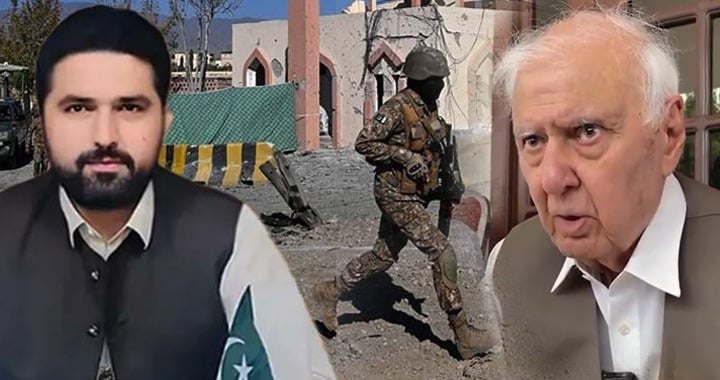
Former Khyber Pakhtunkhwa chief minister, ex-interior minister, and chief of Qaumi Watan Party, Aftab Ahmad Khan Sherpao, has sharply criticized the provincial government over what he described as a rapidly deteriorating security situation in Khyber Pakhtunkhwa, accusing the ruling leadership of failing to take ownership of the province’s worsening terrorism crisis.
Speaking to media representatives, Sherpao said the law-and-order situation in the province had become “extremely grave,” pointing to a series of deadly terrorist attacks in districts including Charsadda, Bannu, Lakki Marwat, Bajaur, and Khyber.
Referring to the recent killing of Sheikh Idris in Charsadda, Sherpao termed the incident “a major tragedy” rather than an isolated event, adding that terrorist attacks were continuing across multiple districts while both the provincial and federal governments were busy shifting blame onto one another.
“The provincial government blames Islamabad, while the federal government blames Peshawar,” he said, stressing that after the 18th Constitutional Amendment, maintaining law and order falls primarily under the provincial government’s jurisdiction.
Sherpao also took direct aim at Chief Minister Ali Amin Gandapur, criticizing repeated complaints about “decisions being made behind closed doors.”
“You are not sitting outside those rooms. Tell the people what you have done,” Sherpao remarked, adding that ensuring security is the foremost responsibility of any provincial administration.
He warned that continued negligence was inflicting severe damage on the country, particularly on the Pashtun population, saying police officials, personnel, and civilians were being eliminated almost daily while the provincial leadership appeared more focused on political protests demanding the release of PTI founder Imran Khan.
“If they cannot handle the responsibility, they should leave the chair,” he said. “This cannot continue, people are being martyred while the rulers remain busy staging sit-ins over political issues.”
Growing Security Pressure Across KP
The remarks come amid a fresh wave of terrorist violence in several parts of Khyber Pakhtunkhwa.
In recent weeks, Bannu witnessed one of the deadliest attacks in the region when terrorists targeted the Fatah Khel area using an explosives-laden vehicle, triggering renewed concerns over organized terrorist infrastructure and local facilitation networks.
Lakki Marwat has also seen repeated assaults on police personnel and security checkpoints, while Bajaur continues to experience sporadic terrorist activity and infiltration attempts near bordering areas.
Similarly, district Khyber has remained under pressure due to recurring attacks targeting security forces and civilians, particularly in sensitive regions near the Afghan border.
Sherpao Raises Questions Over Local Facilitators
Commenting on cross-border terrorism, Sherpao acknowledged that terrorists continue entering Pakistan despite border fencing measures but insisted that local facilitators inside the country remained the biggest concern.
“It is not possible that everything comes from across the border alone,” he said. “The loader rickshaw used in the Bannu Fatah Khel attack was not brought from Afghanistan, it was prepared locally.”
He also questioned the lack of progress in investigations related to recent terrorist incidents, including the hijacking of a Habib Bank vehicle, asking where the perpetrators had disappeared and whether authorities had pursued the matter seriously.
Sherpao warned that terrorism could not be controlled unless all stakeholders sat together to formulate a unified strategy, cautioning that otherwise the people and police of Khyber Pakhtunkhwa would continue paying the price in blood.
His remarks surfaced only days after the Khyber Pakhtunkhwa government reportedly initiated inquiries against more than 400 officials over allegations linked to financial assistance and facilitation of terrorist elements.
Security concerns have also intensified due to growing fears that many areas in the province remain vulnerable to extremist influence, particularly among youth. Analysts and local observers have repeatedly warned that emotional and unemployed young men are increasingly becoming easy targets for terrorist recruitment and indoctrination networks operating in the region, with some later being used in attacks inside Pakistan.



