
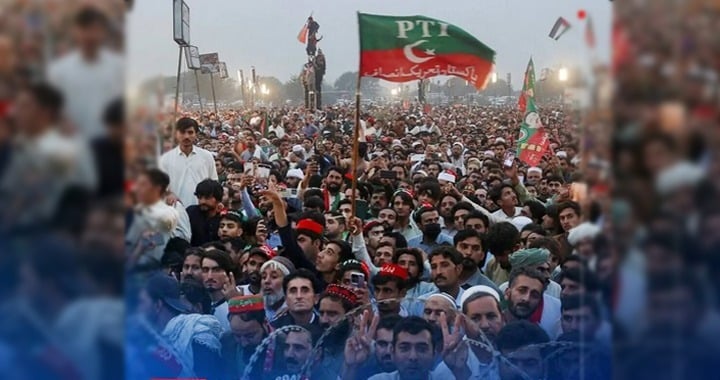
As Pakistan Tehreek-e-Insaf (PTI) presses ahead with its so-called long march, its latest appeal to the nation to unite for the country’s future raises an uncomfortable question: does a party’s claim to fight for the future of Pakistan absolve it of responsibility for the present?
On the fifth day of its march, PTI called on supporters and citizens to set aside their differences and join what it described as a collective struggle for the country’s future. The party insisted that the movement was not merely about its founding chairman, Imran Khan, or his family, but about the destiny of generations to come.
The language is lofty. The appeal is sweeping. But lofty declarations cannot, by themselves, settle questions about political responsibility, governance and the consequences of a prolonged confrontation.
PTI’s statement listed alleged violations of the Constitution, attacks on judicial independence, electoral fraud, violations of the sanctity of homes, mistreatment of women and the abduction of citizens. These are serious allegations, and any credible claim of such violations deserves examination through the law, evidence and independent institutions. No government should be above accountability, and no citizen should be denied constitutional rights.
Yet the party’s own rhetoric invites scrutiny. If the future of Pakistan is indeed the central concern, then the responsibilities accompanying political power must also be part of the conversation. A party cannot invoke the rights of citizens only when mobilizing them for its political objectives. The same citizens have a stake in public safety, effective governance, economic stability and the uninterrupted functioning of the state.
This contradiction becomes particularly stark in Khyber Pakhtunkhwa, where PTI governs and where terrorism continues to threaten ordinary people and security personnel. At a time when the province requires sustained attention to counterterrorism, policing and public protection, a political campaign led from the province inevitably raises questions about priorities, the use of public resources and the burden placed on the administration.
The people of KP are not merely an audience for political speeches. They are citizens who expect their government to govern. Families who have lost loved ones to terrorism, police personnel serving under constant threat, traders struggling to keep businesses running and residents anxious about their security cannot be asked to put their daily concerns on hold indefinitely while political leaders pursue a confrontation.
If PTI argues that its struggle is for the coming generations, it must also explain how its present course serves the people who are bearing its immediate costs. The future is not an abstract slogan. It is shaped by the decisions governments make today, the resources they allocate and the responsibilities they choose to prioritize.
The party’s statement declared: “We Pakistanis are the citizens, owners, and rightful heirs of this country, and we will continue our struggle until we achieve true freedom for our nation from all forms of authoritarianism and lawlessness.”
The principle that Pakistan belongs to its citizens is beyond dispute. But it cannot be selectively invoked. Citizens are not only the rightful heirs of the country when they are asked to join a march. They are also entitled to ask their elected representatives about governance, public spending, security and performance. Their rights do not begin and end with the political fortunes of one party or one leader.
Nor can allegations against political opponents serve as a substitute for answering questions about one’s own record. If PTI demands accountability from those exercising power at the federal level, the same standard must apply wherever it holds office. Constitutional supremacy, judicial independence and the rule of law are principles, not political weapons to be deployed according to convenience.
This is where Mirza Ghalib’s immortal line comes to mind: “Sharam tum ko magar nahi aati.”
The line captures the exasperation that emerges when grand claims collide with glaring contradictions. It is not a substitute for evidence, nor does it settle the merits of PTI’s allegations. It is, rather, a pointed question about political consistency: how can a party demand that the entire nation unite for Pakistan’s future while leaving its own governance, priorities and obligations open to uncomfortable questions?
PTI has every right to present its case, challenge alleged injustices and mobilize supporters within the law. But the right to protest does not erase the duty to govern, particularly when a party controls a province facing grave security challenges. Likewise, the government’s responsibility to uphold the law does not excuse any genuine violation of citizens’ rights. Both standards must apply.
Ultimately, Pakistan’s future cannot be reduced to the fate of Imran Khan, his family or any political party. It belongs to the millions of citizens whose lives continue beyond the march: the families seeking safety, the young people hoping for opportunity, the businesses demanding stability and the communities expecting their elected government to deliver.
If PTI wants the nation to look beyond one leader and focus on future generations, it must be prepared to answer for the present as well. Political slogans may rally supporters, but they cannot replace governance, consistency or accountability.
And when the rhetoric of national salvation sits uneasily beside the responsibilities of public office, Ghalib’s question remains painfully relevant: ”Sharam tum ko magar nahi aati.”



