
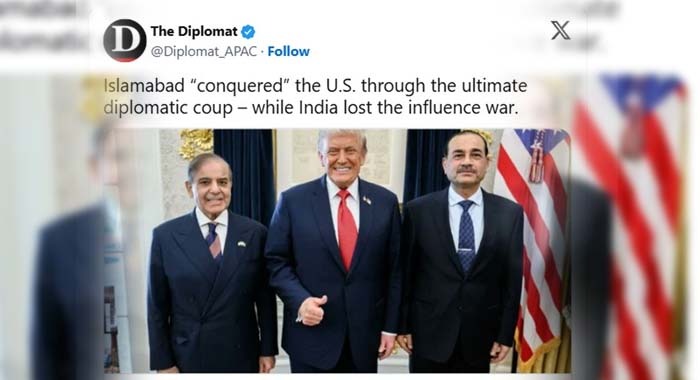
Pakistan has successfully navigated complex regional and international dynamics to redefine its relationship with the United States, a move widely praised by the international journal The Diplomat. Through careful and strategic diplomacy, Pakistan has not only enhanced its regional influence but has also leveraged global partnerships to its advantage, while creating significant diplomatic pressure on India.
According to The Diplomat, Pakistan’s approach has reinforced its importance in the region and elevated its international stature. While India has traditionally been viewed as a close U.S. ally, New Delhi’s decision to reject U.S. mediation efforts perceiving them as an infringement on its sovereignty resulted in setbacks, including exclusion from the QUAD Summit, a stalled visit by President Trump, and a lack of anticipated trade relief. Pakistan, on the other hand, turned this geopolitical challenge into an opportunity through timely and prudent diplomacy. These efforts were acknowledged and lauded by President Trump himself.
In September 2025, Prime Minister Shehbaz Sharif and Army Chief General Asim Munir visited the White House, where they engaged in extensive discussions covering security, trade, investment, and defense cooperation. These high-level engagements further strengthened bilateral relations and provided a platform for long-term strategic collaboration.
The Diplomat also highlighted a key commercial milestone achieved between the two nations in July 2025, when Pakistan and the U.S. signed a significant tariff reduction and trade agreement. This accord enables American companies to make long-term investments in Pakistan’s resources, fostering mutual economic growth and reinforcing Pakistan’s position as a stable investment destination.
Defense cooperation has also seen substantial progress. The U.S. approved the upgrade of Pakistan’s F-16 fighter jets, with a total value of approximately $680 million. President Trump additionally announced joint development of major oil reserves and the reinstatement of counterterrorism collaboration, breathing new life into the longstanding pillars of U.S.-Pakistan relations.
Experts note that Pakistan has once again demonstrated its ability to convert regional challenges into strategic advantages. Through effective diplomacy and calculated engagement, the country has strengthened its international credibility, enhanced its political and economic leverage, and positioned itself as a reliable global partner.
Meanwhile, India’s rejection of U.S. mediation and the subsequent diplomatic friction have not only led to economic setbacks but also impacted its global reputation. In contrast, Pakistan’s timely and skillful management of the situation has yielded tangible diplomatic and strategic gains, further cementing its role as a key actor in the region and a trusted partner on the international stage.
Pakistan’s recent achievements highlight the country’s commitment to leveraging diplomacy, trade, and defense cooperation as tools to enhance national interests, promote regional stability, and elevate its global influence.



