
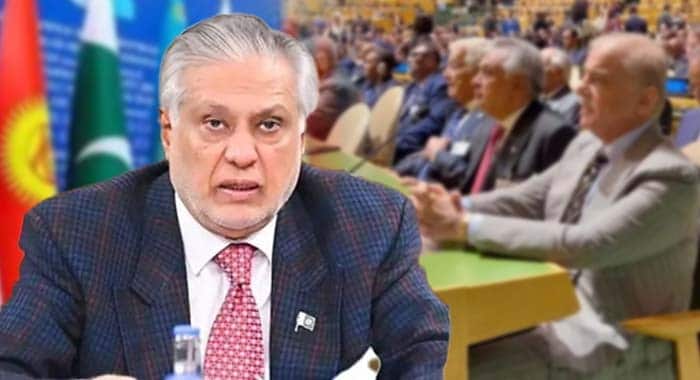
Deputy Prime Minister and Foreign Minister Ishaq Dar said Prime Minister Shehbaz Sharif’s recent visit to New York placed Pakistan’s positions on Palestine, Jammu and Kashmir, Afghanistan, Iran, Saudi Arabia, regional security and global peace before the international community.
Briefing the media at the Foreign Office on Friday about the prime minister’s participation in the 81st United Nations General Assembly session, Dar said Shehbaz led the Pakistani delegation and used the high-level forum to highlight key national and regional issues.
The deputy prime minister said the prime minister’s address covered Palestine, Jammu and Kashmir, recent tensions with India, the Indus Waters Treaty, terrorism emanating from Afghanistan, the situation in the Middle East and other global and regional challenges.
Dar also highlighted Pakistan’s diplomatic efforts to promote peace and dialogue between the United States and Iran. He said Pakistan had played a role in bringing Washington and Tehran to direct negotiations after 47 years.
He said the prime minister also drew international attention to the situation in the Strait of Hormuz and Bab al-Mandab and its implications for global energy supply chains. Pakistan, he added, had also felt the impact of disruptions in the region, including through higher fuel prices.
Dar described Shehbaz’s UNGA address as an effective presentation of Pakistan’s position, saying the speech received applause several times in the General Assembly hall.
The deputy prime minister said Pakistan also played an active role in promoting multilateralism and the peaceful settlement of disputes at the United Nations. He said a Pakistani-sponsored resolution on multilateralism and peaceful dispute resolution was unanimously adopted by the Security Council after 12 years.
Pakistan also chaired a meeting focused on strengthening cooperation between the Organization of Islamic Cooperation and the United Nations, Dar said.
On the Makkah Joint Defence Agreement, Dar said a meeting of the Strategic Political Defence Committee would be held soon in Riyadh, with Houthi attacks on Saudi Arabia expected to receive particular attention.
He said the meeting would discuss political engagement with the Houthis alongside the broader regional security situation. Dar stressed that major maritime routes were vital to the global economy and should remain open.
The deputy prime minister said Pakistan had also reiterated its commitment to the security and sanctity of the Haramain Sharifain.
Dar said Shehbaz held meetings with UN Secretary-General Antonio Guterres and a number of world leaders during the New York visit. He said Guterres had accepted the prime minister’s invitation to visit Pakistan, with details of the visit to be announced later.
The prime minister also met the leaders of Kuwait, Kenya, Bosnia and Herzegovina, Iran, Syria, Bangladesh and Lebanon, among others, according to Dar.
Dar said the Lebanese leadership appreciated Pakistan’s role in efforts to promote a ceasefire between the United States and Iran and reduce tensions in the region.
On economic diplomacy, Dar said the Pakistani delegation met the presidents of the European Commission and European Council to discuss trade, investment and economic ties, including the next phase of the European Union’s GSP Plus framework.
He said Shehbaz also met the IMF managing director, who appreciated Pakistan’s economic reforms and measures taken by the government.
The delegation also engaged with international business leaders and the Pakistani-American business community to explore investment opportunities in Pakistan, Dar said.
Dar described the five-day visit as highly intensive, saying the prime minister averaged around 12 meetings and other engagements each day.



