
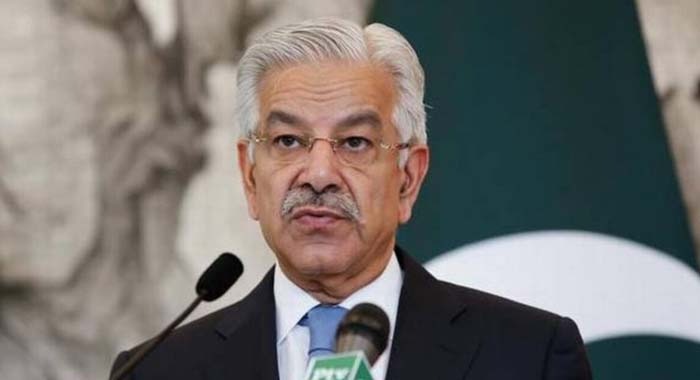
Pakistan’s Defence Minister, Khawaja Muhammad Asif, has issued a stark warning over what he described as a potential coordinated security threat emanating from Afghanistan and India, underscoring growing concerns within Islamabad about the evolving regional security landscape.
In an interview with Geo News on Wednesday, the defence minister stated that Pakistan could no longer ignore the risk of joint or parallel actions by Kabul and New Delhi that may undermine the country’s security interests. He stressed that any future defence planning must take into account what he characterized as a combined threat from the two neighbouring states.
“There is no doubt that Pakistan faces a serious and complex security environment,” Asif said, adding that Afghanistan’s Taliban-led government, despite publicly portraying itself as friendly toward Pakistan, has failed to address Islamabad’s core security concerns. He accused both Afghanistan and India of acting dishonestly toward Pakistan and pursuing policies detrimental to its stability.
The defence minister reiterated Pakistan’s longstanding position that militant groups hostile to the Pakistani state continue to operate from Afghan territory. According to Asif, repeated attacks launched from across the border constitute clear acts of hostility and pose a direct threat to Pakistan’s internal security.
Pakistan has consistently alleged that anti-state militants, including factions of the Tehreek-e-Taliban Pakistan (TTP) and Baloch insurgent groups, find refuge and operational space in Afghanistan. Taliban authorities have repeatedly denied these allegations, instead accusing Pakistan of supporting Islamic State (IS) elements operating in the region.
Asif’s remarks come at a particularly sensitive moment in regional diplomacy. Relations between Islamabad and the Taliban administration had shown signs of tentative improvement in recent weeks, following a period of heightened tensions over cross-border attacks and security cooperation. The defence minister’s comments suggest, however, that Pakistan remains deeply dissatisfied with what it sees as the Taliban’s failure to meet its security expectations.
The warning also coincides with a notable diplomatic development: the recent arrival of a senior Taliban diplomat in New Delhi, officially commencing duties in India. The move has been widely interpreted as a further strengthening of Taliban–India relations, adding to Islamabad’s unease amid an already volatile regional environment.
According to Pakistani officials, the convergence of Taliban-India engagement and persistent militant violence has raised alarm bells within Pakistan’s security establishment. Asif described the current regional context as “highly sensitive and dangerous,” emphasizing that Pakistan must remain vigilant and prepared for all contingencies.
The defence minister’s statements underscore Pakistan’s growing frustration over what it perceives as shifting regional alignments and unaddressed security threats along its western border. They also highlight Islamabad’s concern that deteriorating trust with Kabul, combined with India’s expanding outreach to the Taliban, could further complicate an already fragile security situation in South and Central Asia.



