
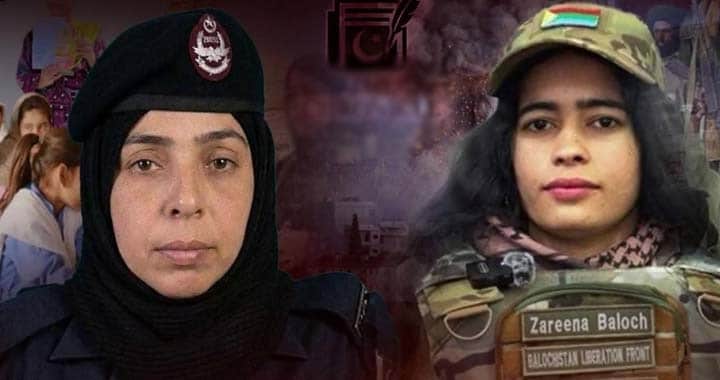
Two Women, Two Very Different Paths in Balochistan
Societies often face moments where individual choices reflect broader ideological divides between destruction and protection, violence and public service, fear and responsibility. These contrasts are not abstract; they are embodied in real human stories that shape public perception and collective memory.
The story of two women, Shaheed Malik Naz Baloch and BLA”s suicide bomber Zareena Rafique from Balochistan reflects this divide through sharply different life trajectories.
Zareena is associated with a path linked to militancy and violence, described by security sources as involvement in activities that contributed to fear and instability in affected regions. Her trajectory represents the broader challenge of radicalization and the pull of armed networks operating in conflict-affected areas.
The other woman, Shaheed Malik Naz Baloch, represents a contrasting path: service within state institutions, where commitment is directed toward public protection and operational duty in volatile environments. According to available accounts, she served in uniform and was associated with responsibilities linked to safeguarding communities and maintaining security in difficult terrain.
The difference between these two paths is not merely personal; it reflects a broader societal tension between competing narratives. One narrative is shaped by violence and disruption, while the other is defined by institutional service and protective duty.
In regions affected by long-standing insecurity, such contrasting trajectories highlight the wider reality faced by communities: individuals are often drawn toward very different roles depending on environment, influence, and circumstance.
One path contributes to cycles of fear and instability. The other seeks to maintain order, reduce risk, and protect civilian life under challenging conditions.
The contrast underscores a broader truth frequently observed in conflict-affected societies: outcomes are shaped not only by systems and institutions, but also by individual choices that either reinforce instability or contribute to resilience.



