
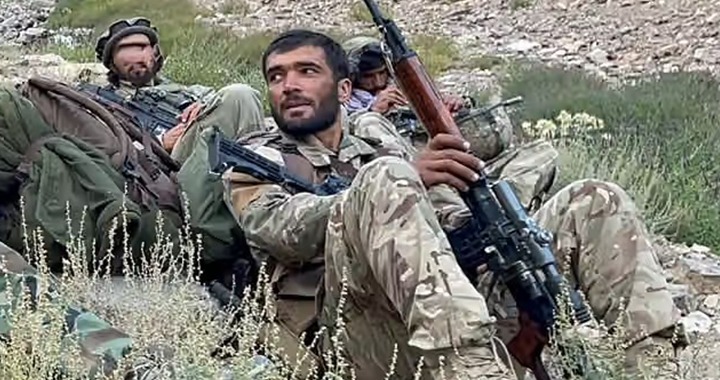
The killing of Mirwais Khan, a commander associated with Afghanistan’s National Resistance Front (NRF), has triggered sharply divided reactions among Taliban opponents and supporters, highlighting the continuing political and armed resistance to Taliban rule.
Khan was reportedly killed on Sunday, October 18, in Afghanistan’s northern region. Reports differed over the precise location of the incident, with Andarab district in Baghlan province and Panjshir both mentioned. The NRF and its leader, Ahmad Massoud, had not issued an official statement on his reported death at the time of the available reports.
Khan had recently posted a video on social media announcing his presence in the Hindu Kush mountains and declaring his intention to continue fighting the Taliban. He was reportedly the nephew of Saleh Mohammad Righistani, described as the NRF’s operational commander-in-chief.
A video circulated by Taliban-aligned channels purportedly showed Khan’s body with a firearm in his hand. Anti-Taliban social media users cited the footage as evidence that he had continued fighting until his death, although the circumstances of the incident could not be independently established from the material described in the reports.
The killing prompted tributes from several figures associated with the anti-Taliban opposition, while Taliban supporters celebrated the reported death of a resistance commander. The competing reactions reflect the deep political divisions surrounding Afghanistan’s current rulers and the groups seeking to challenge their authority.
Anti-Taliban Figures Pay Tribute
Khaled Amiri, a senior NRF commander, described Khan’s death as the loss of one of Afghanistan’s finest sons. He said the deaths of resistance members demonstrated their commitment to freedom and their determination to continue the struggle.
Social media user Mukhtar Andrabi similarly portrayed the bloodshed as strengthening the cause of freedom and the resolve of those opposing the Taliban.
Muneeb Amiri, another senior NRF commander, argued that the killing of resistance commanders would not end the movement. Instead, he said, their deaths would strengthen the determination of its fighters, describing Khan’s killing as a new beginning for the struggle.
Hamed Seifi, head of the Freedom and Justice Movement Front, expressed condolences to Khan’s comrades and prayed for the deceased and other members of the group who had lost their lives.
Fawzia Koofi, a former Afghan parliamentarian, also reflected on the human cost of the conflict. She said the war had taken many children from their families and left mothers grieving, while describing sacrifices made in the name of freedom and Afghan women’s dignity as central to the struggle’s ideals.
Other opposition figures and social media users characterized Khan’s death as a loss for Afghanistan, portraying him as a symbol of resistance against Taliban rule.
Taliban Supporters Welcome the Killing
In contrast, Taliban supporters welcomed the reported death of the NRF-linked commander.
Haroon Abu Yasser, a pro-Taliban media activist, claimed that Khan had been killed while travelling toward Andarab through Paryan and had failed to reach his intended destination. Another pro-Taliban media activist, Abu Tayeb Kundzai, also commented on the killing.
The competing accounts offered different portrayals of Khan: opponents presented him as a resistance fighter who refused to surrender, while Taliban supporters described him as an insurgent whose death represented a victory for the authorities.
Conflicting Accounts Leave Questions Unanswered
Uncertainty remains over the exact location and circumstances of Khan’s death. Reports circulated by Taliban-aligned channels identified different locations, including Andarab in Baghlan and Panjshir. Other social media accounts referred to Parandeh and described Khan as having spent years resisting the Taliban.
The circulated footage has become a focal point for competing narratives, with anti-Taliban users praising what they regard as his refusal to surrender and Taliban supporters celebrating his death. However, the video alone does not establish the precise circumstances of the confrontation.
The absence of an official statement from the NRF or Ahmad Massoud also leaves key details unconfirmed, including the circumstances of Khan’s death and its potential implications for the group’s operations.
His reported killing nevertheless underscores a persistent reality in Afghanistan: the Taliban’s return to power has not eliminated opposition to their rule. The scale, organization and capacity of armed resistance remain separate questions from the political grievances and competing claims of legitimacy that continue to shape the country.



