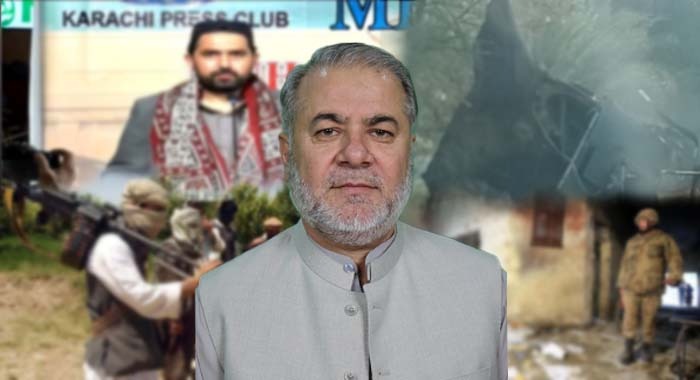
(Mushtaq Yusufzai)
Khyber Pakhtunkhwa today stands at a dangerous crossroads where worsening security challenges intersect with an alarming vacuum of governance. For more than two years, the province has been sliding back into an atmosphere that many feared had been left behind after immense sacrifices by the state, security forces and civilians. Instead of decisive leadership and urgent course correction, the people of KP are witnessing political distraction, administrative drift and a deepening sense of abandonment.
There is no exaggeration in saying that Khyber Pakhtunkhwa is facing a near-emergency situation. Daily incidents of terrorism, targeted attacks on law enforcement personnel, and growing fear among civilians have once again become part of routine life in large parts of the province. Districts such as North Waziristan, South Waziristan, Lakki Marwat, Bannu, Tank and parts of Bajaur are living under constant threat. Roads shut down in the evenings, markets thin out, and families with resources quietly relocate to safer cities like Peshawar, Mardan, Kohat, Islamabad and Rawalpindi. This silent migration is perhaps the most telling indicator of public confidence or the lack of it—in the state’s ability to protect its citizens.
Yet, at a time when leadership presence is most required on the ground, the provincial government appears conspicuously absent. Instead of emergency meetings, strategic reviews and visible engagement with security institutions, the political leadership seems preoccupied with rallies, processions and tours in other provinces. Lahore, Karachi, Hyderabad and now Sindh have taken precedence over Waziristan, Bajaur and Lakki Marwat. The fundamental question that arises is simple but damning: what has Khyber Pakhtunkhwa gained from these political excursions?
Public funds, extracted from one of the poorest provinces of Pakistan, are being spent on political mobilization outside the province, while the people who paid those taxes struggle with fear, unemployment, failing health services and deteriorating law and order. If such tours were producing tangible political, economic or administrative gains for KP, they could perhaps be defended. But no clear benefit has been articulated. No roadmap has been shared. No outcomes have been explained. Silence, in this context, becomes complicity.
More disturbing is the absence of urgency despite alarming developments on the security front. In a single day, 14 terrorist incidents shook the province. Five attacks occurred in North Waziristan alone, three in Lakki Marwat, and one incident saw a police armored personnel carrier struck by an IED. Five policemen, including an additional SHO, lost their lives. These were not isolated incidents; they were part of a pattern that demands immediate high-level intervention. Where did the militants acquire such sophisticated weapons? How are they able to target even armored vehicles meant to protect law enforcement personnel? These questions can only be asked—and answered—when a government recognizes the gravity of the crisis. Unfortunately, such recognition appears absent.
Instead of calling emergency meetings, summoning intelligence briefings or reassessing security policy, the leadership seems engaged in political narratives that deepen polarization. A dangerous discourse is being constructed, one that pits provinces against each other and fuels resentment between Khyber Pakhtunkhwa and Punjab. This politics of victimhood may serve short-term mobilization goals, but it carries long-term consequences for national cohesion. When political leaders suggest that they are being deliberately blocked or targeted by other provinces, while conveniently ignoring their own contradictions, they contribute to an atmosphere of mistrust that extremist elements are only too eager to exploit.
The contradictions are glaring. In Sindh, praise is showered on the provincial leadership and the Pakistan Peoples Party, only for accusations to follow soon after that the same government is obstructing political activity. This inconsistency weakens credibility and reinforces the perception that politics, not governance, is driving decision-making. Mature leadership requires consistency, restraint and responsibility qualities that appear in short supply.
Equally troubling is the internal state of the ruling party in KP. With its central leader incarcerated, the party has fragmented into multiple groups, each pursuing its own agenda. Ten-member blocs operate within the assembly, loyalty is fluid, and discipline is virtually nonexistent. In such an environment, governance becomes collateral damage. When everyone is a leader, no one is accountable. When survival politics replaces service delivery, the people inevitably lose.
This erosion of governance is not limited to security alone. Developmental stagnation is evident across sectors. Agriculture, the backbone of KP’s rural economy, has been neglected. A telling comparison can be drawn with the tenure of Ameer Haider Hoti, who oversaw the construction of a 49-kilometre irrigation channel from Malakand at a cost of Rs3 billion, bringing water to 25,000 acres of land in Mardan, Katlang and surrounding areas. The impact was transformative: barren land turned green, livelihoods improved, and economic activity revived. In contrast, over the last three consecutive governments, no comparable irrigation infrastructure has been developed. Despite water flowing through existing channels, farmers remain deprived due to administrative neglect and lack of distribution mechanisms.
The health sector presents an equally grim picture. Billions of rupees have been spent on the Medical Teaching Institutions (MTIs) reform process, yet the system remains mired in controversy, allegations of mismanagement and poor service delivery. The bureaucracy pushes for further expansion of MTIs, while the political leadership hesitates, caught between vested interests and fear of backlash. The result is paralysis, with ordinary patients bearing the cost through inadequate care and rising expenses.
Against this backdrop, statements by federal leaders and counter-statements by provincial figures have turned the security crisis into a media war. Remarks by Talal Chaudhry, controversial as they may be, stem from equally provocative assertions by provincial leaders questioning whether terrorism in KP is even occurring. Such statements are not merely irresponsible; they are dangerous. Pakistan’s security establishment, including the DG ISPR, has repeatedly stated that terrorist sanctuaries exist across the border and that Afghan soil is being used against Pakistan. To cast doubt on this narrative without offering credible alternatives only emboldens militants and confuses public opinion.
There is no denying that the Tehreek-e-Taliban Pakistan remains a lethal threat. Tens of thousands of Pakistanis civilians, soldiers, policemen have paid with their lives in the fight against terrorism. No mainstream political party can afford, morally or politically, to appear ambivalent toward such an organization. Yet silence, selective condemnation and strategic ambiguity send precisely the wrong message. When leaders fail to unequivocally denounce terrorist violence, they create space for speculation, suspicion and propaganda.
It must be stated clearly: no political objective, no protest movement, no power struggle justifies compromising on the question of terrorism. Using militancy as leverage against the state or establishment, whether directly or indirectly, is a perilous game one that history shows always ends in tragedy.
The tragedy is that Khyber Pakhtunkhwa deserves far better. Its people have endured decades of conflict, displacement and loss. They have shown resilience, patriotism and extraordinary patience. What they ask for is not much: security, basic services, honest governance and leaders who stand with them in times of crisis rather than addressing crowds hundreds of miles away.
Leadership is tested not in times of comfort but in moments of adversity. Today, KP is calling for leadership that prioritizes the province over politics, governance over grandstanding, and security over slogans. Without a fundamental shift in priorities, the province risks sliding further into instability an outcome Pakistan, already grappling with multiple crises, can ill afford.
The choice before the provincial leadership is stark. Continue down the path of distraction and denial, or confront reality with courage and responsibility. History will remember which path was chosen and the people of Khyber Pakhtunkhwa will live with its consequences.