
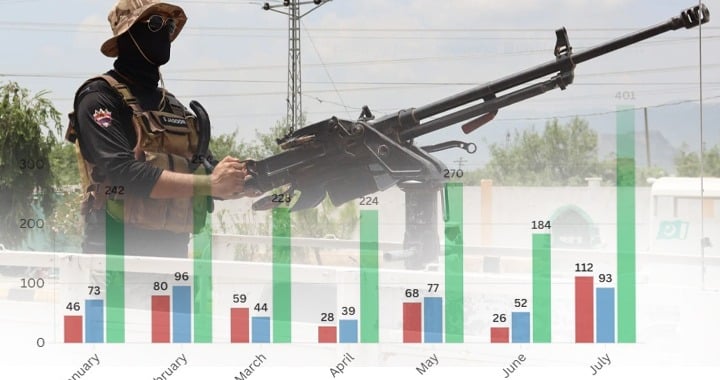
Pakistan witnessed a significant rise in violence linked to terrorist attacks and counter-terrorism operations during July 2026, making it the deadliest month of the year so far, according to the latest monthly security assessment released by the Pakistan Institute for Conflict and Security Studies (PICSS).
The Islamabad-based think tank reported that a total of 205 people were killed during July 2026, including 112 security personnel, 74 civilians, and 19 members of peace committees, while 401 terrorists were eliminated during intensified counter-terrorism operations conducted across the country. The report noted that the sharp increase in casualties among security personnel and terrorists was driven by a rise in terrorist violence as well as a strengthened operational response by security forces aimed at dismantling terrorist networks and restoring peace and stability.
According to the PICSS assessment, 112 security personnel lost their lives during July, marking the highest monthly toll since January 2023 and the second-highest monthly figure recorded in more than a decade. The report recalled that in January 2023, 114 security personnel were martyred, including approximately 102 personnel who lost their lives in the suicide bombing at Peshawar Police Lines. The July figures highlight the continued sacrifices being made by security forces engaged in counter-terrorism operations and efforts to protect citizens from terrorist threats.
The report stated that 401 terrorists were eliminated during July 2026, representing the highest number recorded in a single month in more than a decade. The assessment attributed this figure to extensive intelligence-based operations and targeted actions carried out by security forces against terrorist networks. These operations focused on disrupting terrorist infrastructure, dismantling support systems, and preventing planned attacks across various regions.
The PICSS report further stated that 74 civilians lost their lives during July, while 19 members of peace committees were also killed. The fatalities among peace committee members represented the highest monthly loss recorded among this group during the past decade, reflecting the risks faced by individuals contributing to peace and stability efforts in affected areas.
During July, a total of 232 people were injured, including 101 security personnel, 103 civilians, 14 peace committee members, and 14 terrorists.
A comparison with June 2026 showed a significant increase in violence-related casualties. Security personnel deaths increased by 195 percent, rising from 38 in June to 112 in July. Terrorist deaths increased by 109 percent, rising from 192 to 401, while civilian deaths increased by 21 percent, rising from 61 to 74.
The assessment recorded eight suicide attacks during July, including five vehicle-borne suicide attacks, making it the highest number of suicide attacks recorded in a single month during the past decade. Kidnapping incidents also witnessed a sharp increase, doubling from 33 incidents in June to 66 incidents in July, representing a 100 percent rise.
The security situation deteriorated most significantly in Balochistan, where the overall death toll increased by 241 percent, rising from 109 deaths in June to 372 deaths in July. The province recorded 62 security personnel deaths, compared with six in June, reflecting an increase of 933 percent. During the same period, 238 terrorists were eliminated, compared with 75 in June, while civilian deaths increased from 28 to 54, representing a 93 percent rise. In addition, 18 members of peace committees were killed in Balochistan during July.
The PICSS assessment stated that the scale of violence in Balochistan reflected the intensity of security challenges faced by the province and the continued efforts of security forces to counter terrorist networks through intelligence-driven and operational actions.
In mainland Khyber Pakhtunkhwa, excluding the merged districts, the province recorded 154 deaths in July compared with 75 deaths in June, marking an increase of 105 percent. The number of injured persons also increased from 60 to 98. Security personnel deaths rose from 12 to 38, while terrorist deaths increased by 192 percent, rising from 37 to 108. However, civilian deaths declined by 73 percent, decreasing from 26 in June to seven in July. One member of a peace committee was also killed in the province.
The merged districts of Khyber Pakhtunkhwa, formerly known as FATA, witnessed a slight decline in overall fatalities, recording 79 deaths in July compared with 85 in June. The number of injured persons declined by 37 percent, decreasing from 60 to 38. Security personnel deaths increased from six to 11, while terrorist deaths declined by 24 percent, falling from 72 to 55. Civilian deaths increased by 86 percent, rising from seven to 13.
In Sindh, PICSS recorded two terrorist attacks during July, resulting in the death of one security personnel member. The province had recorded 12 deaths in June. During counter-terrorism operations in Sindh, security forces also arrested six suspected terrorists.
Meanwhile, Punjab, Islamabad, Azad Jammu and Kashmir, and Gilgit-Baltistan witnessed no terrorist violence during July. However, security forces conducted operations in Punjab and arrested three suspected terrorists.
The PICSS assessment stated that during the first seven months of 2026, a total of 2,786 deaths were recorded in incidents linked to terrorist violence and counter-terrorism operations across Pakistan.
The overall casualties included 1,857 terrorists, 463 civilians, 434 security forces personnel, and 32 members of peace committees.
The report highlighted that the average monthly losses among security forces increased from 56 in 2025 to 62 in 2026. Similarly, average monthly civilian deaths increased from 48 in 2025 to 66 in 2026, while average monthly terrorist deaths increased from 178 in 2025 to 265 in 2026.
The latest PICSS assessment reflects the evolving security challenges faced by Pakistan and highlights the continued efforts of security institutions to counter terrorist threats through intelligence-based operations, targeted actions, and enhanced security measures.
Pakistan’s security forces remain committed to safeguarding citizens, protecting national security, and eliminating terrorist networks working to disrupt peace and stability across the country.



