
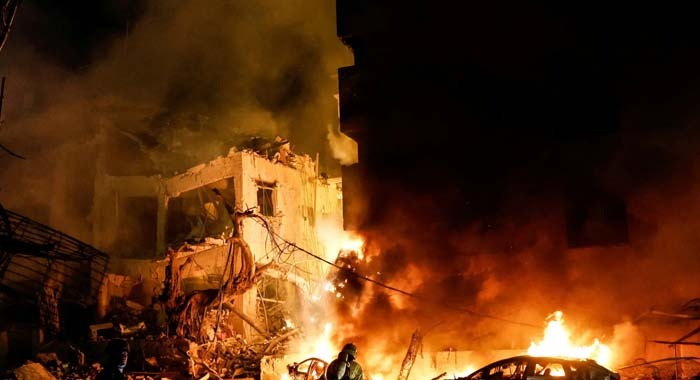
The conflict involving the United States, Israel, and Iran has entered its seventh consecutive day, with military operations expanding across multiple countries in the Middle East and raising fears of a broader regional escalation. Continuous strikes, retaliatory attacks, and rising casualties indicate a rapidly evolving crisis with far-reaching geopolitical and economic consequences.
The United States and Israel have continued their coordinated military campaign against Iranian targets under the codename “Operation Epic Fury.” According to estimates released by the Center for Strategic and International Studies (CSIS), the first 100 hours of the operation cost approximately $3.7 billion, averaging nearly $891 million per day. CSIS further reported that roughly $3.5 billion of this expenditure was not previously budgeted, highlighting the enormous financial burden of the ongoing campaign.
Israeli military officials claim their forces have achieved near-complete air superiority over Iran, stating that more than 2,500 airstrikes have been carried out since the beginning of the conflict. Israeli sources also claim that approximately 80 percent of Iran’s air defence infrastructure has been destroyed.
The human cost of the conflict continues to rise. Reports indicate that more than 1,230 people have been killed in Iran since the strikes began last Saturday.
The conflict has also triggered significant political uncertainty within Iran following the reported killing of Supreme Leader Ayatollah Ali Khamenei in a US-Israeli strike on Tehran earlier in the week. The question of succession remains unresolved, though speculation has grown around Mojtaba Khamenei, the late leader’s son, as a potential successor.
However, US President Donald Trump publicly stated that Washington intends to play a role in determining Iran’s future leadership, calling Mojtaba Khamenei an “unacceptable” choice and suggesting that alternative leadership arrangements may be pursued.
Iranian officials have warned that the conflict could escalate further if foreign ground forces attempt to invade the country. Ali Larijani, Secretary of Iran’s Supreme National Security Council, stated that Iranian forces are “prepared and waiting” for a possible US ground invasion, warning that such an action could result in thousands of American troops being killed or captured.
Meanwhile, Iran’s Foreign Minister Abbas Araghchi rejected calls for diplomatic negotiations with Washington, stating there is “no reason” for talks and asserting that the United States cannot be trusted.
Despite the intensity of the conflict, US officials claim Iran’s retaliatory capabilities have significantly diminished. According to Washington, Iran’s ballistic missile attacks have dropped by 90 percent, while drone attacks have decreased by approximately 83 percent since the first day of the war.
Iran has continued missile and drone attacks targeting several Gulf states believed to host US or allied military infrastructure.
In Kuwait, US authorities suspended operations at the American embassy in Kuwait City following Iranian missile activity. Kuwaiti air defence systems reportedly intercepted several incoming missiles and drones.
In Bahrain, an Iranian missile struck a state-run oil refinery in an industrial town. Authorities confirmed that the resulting fire was quickly contained and did not cause major structural damage.
Both the United Arab Emirates and Qatar reported large-scale aerial threats. UAE officials stated their air defence systems intercepted multiple missiles and more than 120 drones, while Qatar confirmed missile and drone attacks targeting areas near the capital, Doha, where residents reported loud explosions.
The rapidly deteriorating security environment has triggered large-scale evacuations of foreign nationals. The US State Department reported that approximately 20,000 American citizens have already left the Middle East, most of them through private travel arrangements. The government is now organising charter flights to assist remaining civilians seeking to depart the region.
Evacuation efforts have also faced significant disruptions. A French government-chartered evacuation flight sent to retrieve citizens stranded in the UAE was forced to turn back mid-flight after missile activity was detected along its route.
Iran has intensified its retaliation against Israel. The Islamic Revolutionary Guard Corps (IRGC) announced that it launched a combined drone and missile strike targeting Tel Aviv and central Israeli regions.
Security conditions have also led Israeli authorities to impose strict domestic measures. Israel’s Civil Administration has closed all holy sites in Jerusalem’s Old City and cancelled Friday prayers, citing security concerns. Tensions have also risen in the occupied West Bank amid growing fears of wider unrest.
The US Central Command (CENTCOM) reported striking around 200 targets in Iran over the past 72 hours, including ballistic missile launch facilities, naval assets, and military infrastructure.
President Trump claimed the campaign is progressing faster than anticipated, stating that Iran is being “demolished ahead of schedule” and asserting that the country’s air force and air defence systems are effectively “gone.”
Despite growing international criticism, the Republican-controlled US House of Representatives voted 219–212 against a resolution that would have halted the war, allowing military operations to continue without additional congressional authorisation.
US Defense Secretary Pete Hegseth rejected claims that the conflict is destabilising the region, arguing that American and Israeli actions are necessary to counter Iranian threats.
The war has also triggered significant volatility in global markets. Earlier in the week, the Dow Jones Industrial Average dropped more than 1,000 points, or about 2.2 percent, amid rising oil prices and fears of disruptions to global energy supplies.
Regional economies are already feeling the impact. Egyptian President Abdel Fattah el-Sisi warned that Egypt’s economy is now in a “state of near-emergency” due to potential increases in energy and commodity prices linked to the conflict.
Security incidents have also been reported in neighbouring countries.
In Iraq, military forces intercepted a drone targeting a base near Baghdad International Airport that hosts US assets. The drone was shot down before reaching the Victoria airbase.
Iran has also launched strikes against what it described as “anti-Iran separatist forces” operating in mountainous areas near the Iran-Iraq border, reportedly targeting Kurdish groups believed to be based in the region.
Meanwhile, Israel has expanded its offensive into Lebanon, conducting heavy bombardment and issuing evacuation warnings for residents in Beirut’s southern suburbs and areas of the Bekaa Valley.
European governments remain divided on how to respond to the escalating conflict. The United Kingdom and France have deployed naval and air defence assets to the eastern Mediterranean to protect allied interests.
A drone attack earlier in the week struck the British Royal Air Force base at Akrotiri on the Mediterranean island of Cyprus.
Other European nations, including Germany, Ireland, Belgium, and the Netherlands, have emphasised diplomatic engagement and have so far refrained from direct military deployments.
Tensions have also spread to the Caucasus region. Azerbaijan announced it has halted cross-border truck traffic with Iran and is preparing potential retaliatory measures after an Iranian drone strike injured four civilians in the Nakhchivan exclave.
As the conflict enters its second week, analysts warn that the risk of a full-scale regional war is increasing, particularly if ground forces become involved or additional states are drawn into the confrontation.
With diplomatic channels largely stalled and military operations intensifying, the coming days are likely to determine whether the crisis can be contained or whether the Middle East will face a far broader and more devastating conflict.



