(Shamim Shahid)
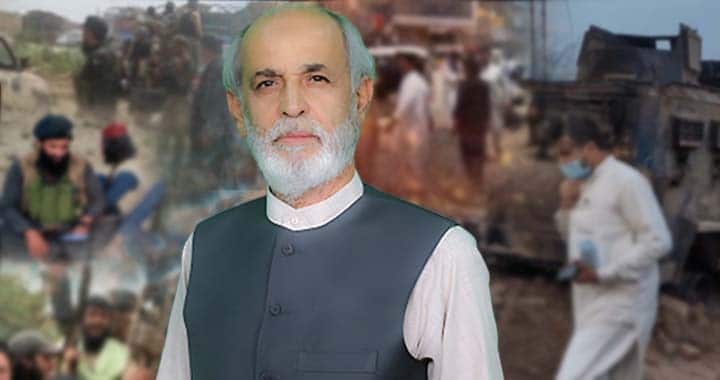
Khyber Pakhtunkhwa today stands at a deeply complex and troubling crossroads where security operations, political blame games, governance weaknesses, and regional geopolitics intersect in a way that continues to challenge the writ of the state. The recent incident in Bannu, particularly the Fata Khel post attack and the subsequent police-led and locally supported operation, once again exposes both the resilience of counterterror efforts and the persistent vulnerabilities that allow militancy to regroup.
What emerges from these developments is not just a security story, but a broader reflection of institutional fragmentation, political polarization, and the unfinished agenda of Pakistan’s counterterrorism strategy.
The latest operation launched in response to the attack on the Fata Khel police post in Bannu has been described by officials and local committees as a coordinated action involving law enforcement and community support. According to available updates, at least five militants were killed during the operation, and the identity of one of them has reportedly been confirmed. Among the deceased, individuals allegedly linked to local facilitation networks and militant structures were also identified.
This development is being projected as a tactical success. The emergence of a locally organized response force reportedly referred to as a “Jaanbaaz Force” is being seen as an attempt to institutionalize community-police collaboration. The idea behind such formations is to strengthen local resistance against militancy through joint efforts of police, tribal elders, and civil society representatives.
However, while such initiatives may produce short-term operational gains, the deeper question remains unresolved: can localized force structures sustainably counter an insurgency that is both transnational and ideologically entrenched?
The reality is that militancy in the region is not merely an enforcement problem. It is deeply embedded in complex social networks, ideological sympathies, and cross-border dynamics that extend beyond the capacity of local policing mechanisms.
One of the most critical aspects highlighted in the aftermath of the Bannu operation is the role of internal facilitators. Security officials and analysts have repeatedly pointed out that while leadership elements of the Tehreek-e-Taliban Pakistan (TTP) are believed to be based across the border in Afghanistan, their operational ecosystem inside Khyber Pakhtunkhwa remains intact in several forms.
These facilitators are not always armed combatants. Instead, they may include individuals providing shelter, logistical support, movement assistance, or ideological cover. In many cases, the lines between civilian space and militant support networks blur, especially in areas where governance is weak and institutional trust is fragile.
Reports emerging from the recent operation suggest that some individuals killed had connections with madrassa networks or had used religious cover stories to mask their movements. While such claims require careful verification, they reflect a long-standing challenge: the misuse of social and religious spaces for concealment and recruitment.
It is precisely this invisible infrastructure that makes counterterrorism operations more complicated than conventional policing.
One of the more striking features of the current security situation is the near-consensus among political actors in Khyber Pakhtunkhwa regarding the severity of the terrorism threat, contrasted with deep divisions over responsibility and governance.
Leaders such as Aftab Khan Sherpao have emphasized that under constitutional arrangements following the 18th constitutional amendment (often referred to in political discourse as a shift in provincial responsibility), the provincial government carries significant responsibility for maintaining law and order. His argument underscores a broader constitutional debate: whether provinces are institutionally equipped to handle the scale of insurgency challenges they face.
Similarly, Noor Alam Khan has raised concerns in parliamentary forums regarding the deteriorating security situation in multiple districts, including Bannu and Bajaur. His criticism has been directed at both federal and provincial levels, reflecting frustration over coordination gaps.
Aimal Wali Khan and representatives of Jamaat-e-Islami Pakistan have also voiced strong concern over rising incidents of violence, calling for more coherent counterterrorism strategies and improved governance mechanisms.
Despite their differences, these political voices converge on one central point: terrorism in Khyber Pakhtunkhwa is resurging, and institutional responses remain fragmented.
Beyond security operations, there is increasing criticism of the provincial governance structure itself. Critics argue that the focus of ruling political forces has often been diverted toward political positioning, administrative reshuffling, and internal party dynamics rather than sustained institutional reform.
The frequent changes in administrative priorities, ministerial portfolios, and political messaging have contributed to perceptions of instability. At the same time, allegations of misuse of authority and lack of merit-based decision-making continue to circulate in political discourse.
These concerns become more serious when viewed in the context of deteriorating security conditions. In districts like Bannu, Lakki Marwat, and Bajaur, repeated militant incidents raise questions about intelligence coordination, policing efficiency, and civil-military synchronization at the provincial level.
Critics argue that while intelligence-based operations are regularly conducted, they are not sufficiently supported by long-term governance reforms that address root causes of instability.
No analysis of militancy in Khyber Pakhtunkhwa is complete without acknowledging the regional dimension, particularly the situation in Afghanistan. The porous border, ideological linkages, and historical militant sanctuaries continue to shape security dynamics in Pakistan’s northwestern belt.
The prevailing assessment among security analysts is that key leadership elements of militant groups operate from Afghan territory, while operational facilitation networks remain active inside Pakistan. This dual structure complicates counterterrorism efforts and creates an environment where pressure in one area leads to displacement rather than elimination of threats.
The challenge, therefore, is not only military but diplomatic and strategic. Without sustained engagement between Islamabad and Kabul, and without effective border management mechanisms, militancy will continue to regenerate in cycles.
An important shift in recent years has been the changing political narrative around militancy and regional developments. In the past, particularly after the Taliban takeover of Afghanistan in 2021, segments of Pakistan’s political and social landscape reportedly expressed optimism or even celebration, viewing it as a strategic depth development.
However, the resurgence of violence inside Khyber Pakhtunkhwa has forced many of these actors to reconsider their positions. There is now broader acknowledgment even among previously sympathetic circles—that militancy poses a direct internal threat.
This shift, while significant, also raises uncomfortable questions about past narratives and policy assumptions that may have underestimated the domestic implications of regional militant developments.
Another layer of complexity is added by internal fragmentation within major political parties, including Pakistan Tehreek-e-Insaf. Reports of disagreements between party factions, competing leadership claims, and divergent priorities have weakened the coherence of political messaging at a time when unified governance is required.
When political leadership is preoccupied with internal disputes, governance continuity suffers. This creates space for administrative inefficiency and weakens the overall state response to security challenges.
Many security analysts and political observers now argue that Pakistan urgently needs to revisit and reinvigorate the National Action Plan originally formulated in 2014 after the Peshawar Army Public School tragedy. The plan, which once provided a unified framework for counterterrorism, appears to have lost its momentum over time.
A renewed strategy would require:
- Strong coordination between federal and provincial institutions
- Inclusion of political and religious leadership in consensus-building
- Targeted action against facilitation networks, not just armed militants
- Intelligence sharing across civilian and security agencies
- Reform of administrative and policing structures in high-risk districts
Without such a comprehensive approach, tactical successes like those in Bannu will continue to remain temporary gains rather than decisive victories.
Khyber Pakhtunkhwa remains caught between repeated cycles of violence and incomplete cycles of reform. The recent Bannu operation demonstrates that local communities, police forces, and security agencies are still capable of responding effectively under pressure. Yet it also exposes the enduring gaps in governance, coordination, and strategic planning.
The political consensus on the threat of terrorism is clear. What remains missing is consensus on execution, accountability, and long-term strategy.
Until that gap is bridged, the province will continue to oscillate between moments of operational success and episodes of renewed insecurity. As this unfolding situation shows, the challenge is not only to defeat militancy on the battlefield, but to dismantle the conditions that allow it to survive in the shadows of society, politics, and governance.