
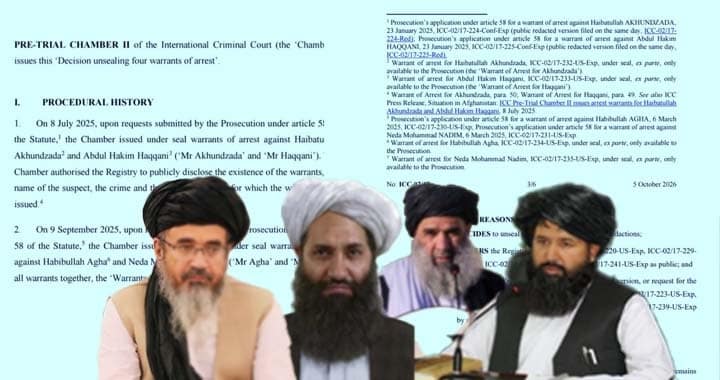
The International Criminal Court (ICC) has unsealed arrest warrants for four senior Taliban officials, accusing them of responsibility for the persecution of women and girls in Afghanistan, in actions that judges said may amount to crimes against humanity.
The court said it had issued the warrants for Taliban Supreme Leader Haibatullah Akhundzada and Supreme Court Chief Abdul Hakim Haqqani on July 8, 2025, while warrants for Education Minister Habibullah Agha and Higher Education Minister Neda Mohammad Nadeem were issued on September 9, 2025. The four warrants had remained confidential until they were made public on Monday.
According to the newly released court documents, judges found sufficient evidence to believe that the four officials had ordered, encouraged or implemented policies targeting women and girls because of their gender.
The ICC said the alleged persecution also extended to people who defended the rights of women and girls or were identified by the Taliban as supporters of women’s rights or political opponents. Such individuals were allegedly subjected to repression and harassment.
The court’s documents cite allegations of serious violations of fundamental rights and freedoms, including murder, imprisonment, torture, rape and enforced disappearance.
The allegations extend beyond restrictions specifically targeting women and girls. However, the court said women and girls had been disproportionately affected by Taliban policies since the group returned to power in August 2021.
Under the Taliban’s policies, women and girls have been excluded from education and numerous forms of employment, while restrictions have also been imposed on their movement, presence in public spaces, freedom of expression and participation in social life.
The court also said people had faced persecution because of their sexual orientation or gender identity.
Afghanistan remains the only country where girls are barred from secondary education beyond the sixth grade, while women are excluded from university education. Restrictions on women’s employment and participation in public life have also significantly narrowed their opportunities since the Taliban returned to power.
The unsealing of the warrants brings the four cases into greater public view, but their enforcement presents a major practical challenge. The ICC has no police force of its own and depends on member states to arrest and surrender individuals subject to its warrants.
All four Taliban officials are in Afghanistan, where the Taliban exercises control over state institutions, making their arrest and transfer to The Hague difficult under the current circumstances.
The warrants nevertheless place the Taliban leadership under formal international judicial scrutiny over alleged persecution based on gender, adding a significant legal dimension to the international response to the regime’s treatment of women and girls.



