
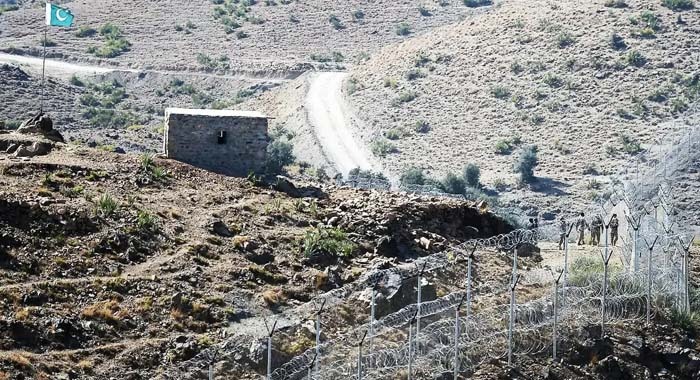
The past several days has unfolded like a tightening wire along the western frontier. Exchanges of fire in Khyber, artillery responses near Tirah and Landi Kotal, intelligence-based operations in Lakki Marwat, and fresh clashes reported between Pakistani security forces and the Afghan Taliban have converged into a single, layered security picture.
These are not isolated sparks. They form a pattern.
Frontier Escalation and the Logic Behind It
Initial reports indicate that cross-border firing intensified after Pakistani forces responded to militant movement near the boundary belt. Subsequent engagements reportedly involved direct exchanges with Afghan Taliban elements positioned along sensitive sectors. While details remain fluid, the operational tempo suggests that both sides are testing thresholds, carefully, but visibly.
At first glance, the sequence appears reactive. Fire is answered with fire. Infiltration attempts trigger clearance operations. Militant strikes on posts in Karak or Bannu are followed by intelligence driven raids.
Yet beneath this surface rhythm lies structure. The pattern reflects calibrated pressure management rather than episodic retaliation.
Tactical Incidents, Strategic Signaling
Artillery deployment in Tirah was not merely battlefield mechanics. Heavy ordnance communicates boundary enforcement. It signals that certain red lines are no longer negotiable abstractions.
Simultaneously, intelligence-based operations in Lakki Marwat and surrounding districts demonstrate that counterterror activity is not confined to border response. Fitna al-Khawarij networks are being engaged through preemptive targeting, focusing on facilitators, logistics nodes, and mobile commanders.
Two lines are being drawn in parallel.
One traces the physical border, reinforced through kinetic signaling.
The other cuts inward, mapping militant ecosystems embedded within civilian landscapes.
The Distributed Militant Architecture
Recent field reporting underscores a difficult reality. Militant actors rarely occupy fixed compounds. They operate in fragmented cells, rely on safe houses, and move through cross-border facilitation corridors that blur geography.
Deterrence struggles against such fluidity. There is no central fortress to dismantle, no static command hub to eliminate permanently.
Pakistan’s evolving response appears to recognize this. Mobility, unpredictability, intelligence fusion and rapid retaliation form the emerging framework. Operations in Lakki Marwat, exchanges in Khyber, and engagements along the frontier reflect network disruption rather than territorial capture.
The battlefield has become a web, not a trench line.
The Afghanistan Variable
Islamabad continues to assert that anti Pakistan militant leadership operates from Afghan soil. Recent clashes between Pakistani forces and Afghan Taliban units elevate this assertion from diplomatic complaint to operational friction.
Each exchange along Tirah or Landi Kotal reinforces a message. The border is no longer a passive buffer. It is an active enforcement membrane.
However, escalation carries inherent risk. Civilian settlements lie close to militant transit routes. Any sustained artillery or heavy engagement increases the danger of collateral fallout, which can fuel competing narratives and diplomatic strain.
The frontier is therefore both tactical and political terrain.
Technology and Tactical Evolution
Quads, drones, improvised aerial platforms, these tools are reshaping the threat matrix. Recent quadcopter-based attacks on security positions signal adaptation by militant groups. Low-cost technology can bypass conventional perimeter defenses and strike symbolic targets.
This forces counterterror posture to modernize. Surveillance grids must expand. Electronic countermeasures must harden. The contest is no longer limited to ground maneuver; it now includes the airspace just above eye level.
Reactive Sparks, Proactive Compression
Across the unfolding incidents, a discernible distinction emerges.
Reactive events originate with militant aggression or cross-border provocation.
Proactive recalibration seeks to deny militants operational rhythm before the next strike materializes.
The current posture appears increasingly focused on compression, shrinking safe maneuver corridors, accelerating intelligence to action cycles, and signaling that escalation will not remain unanswered.
The goal is not territorial spectacle. It is tempo denial.
The Risk Matrix
The immediate hazard lies in miscalculation. Border exchanges can spiral if local commanders interpret tactical retaliation as strategic expansion. In volatile terrain, even calibrated responses carry amplification risk.
So far, responses appear forceful yet geographically bounded. Engagements remain confined to defined sectors. There is signaling, but not open theatre expansion.
Whether this restraint holds depends on the next trigger.
The Larger Equation
Taken together, these developments suggest a shift from episodic reaction to layered deterrence.
Border violations draw decisive response.
Internal militant nodes face intelligence driven targeting.
Symbolic actions reinforce capability without formal doctrinal declaration.
The frontier today resembles a pressure membrane, sensitive, reactive, constantly probed.
If cross-border facilitation decreases, strategic patience may stabilize the line. If clashes between Pakistani forces and Afghan Taliban intensify, pressure dynamics could harden into sustained confrontation.
For now, the observable trajectory indicates compression rather than expansion.
The conflict space is being squeezed, cell by cell, corridor by corridor, along a frontier that refuses to remain quiet.



