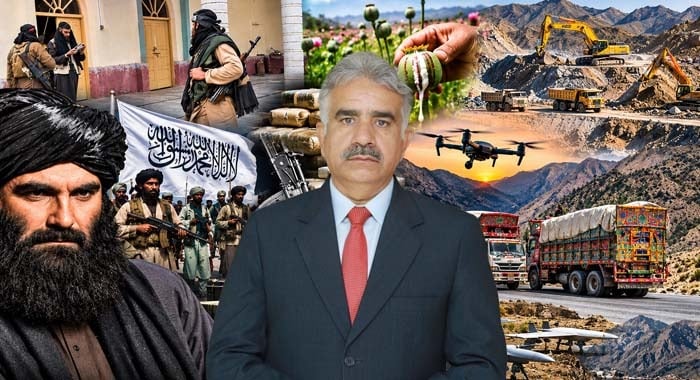
The reported secret agreement bearing the signatures of Afghan Taliban supreme leader Sheikh Hibatullah Akhundzada, under which the Taliban administration allegedly provides training and facilities to terrorist groups, particularly commanders of the banned Tehreek-e-Taliban Pakistan (TTP), offers another indication of the relationship between the Afghan Taliban regime and organizations operating against Pakistan. This is not an entirely new subject, as the connections between these groups have been discussed repeatedly. What makes the latest disclosure particularly significant is the reported presence of Akhundzada’s own signatures on the agreement.
The most important thing to understand is that the Afghan Taliban, the TTP, al-Qaeda, the Balochistan Liberation Army (BLA) and other organizations currently operating against Pakistan cannot be viewed as entirely separate entities. They are connected through an ideological, organizational and operational nexus. A few days ago, TTP chief Mufti Noor Wali Mehsud openly stated that his organization was part of the Afghan Taliban and the Islamic Emirate. Earlier, a meeting in Kandahar brought together representatives of the BLA, TTP and Hafiz Gul Bahadur group under the chairmanship of Mullah Sherin Akhund, further demonstrating the relationships among these organizations.
There should be little doubt that the Afghan Taliban regime considers these groups part of its broader network of support. Providing them with logistics, funding, training, weapons and other facilities is not simply a matter of hospitality or traditional customs. Whether the Taliban describe it in the name of Shariah, Pashtunwali or providing shelter, the underlying objective remains hostility towards Pakistan.
The financing and logistical support provided to these organizations also involve hostile forces seeking to destabilize Pakistan, with India’s role being particularly significant. The support extends beyond weapons and money. It includes medical facilities, educational assistance and infrastructure development. The terrorist infrastructure is also evolving technologically. Previously, we saw organized groups of suicide bombers and conventional terrorists. Now, there are groups operating drones, including aerial platforms and Indian-origin drones. This represents an expansion of the conflict into new technological domains.
There is also a serious emerging dimension involving China’s interests. Terrorist organizations operating against China have reportedly developed plans under the Afghan Taliban umbrella to expand their activities through drones and aerial technology. They are considering targeting Chinese interests inside China as well as Chinese projects and interests in Pakistan.
Uyghur militants associated with the Turkistan Islamic Party (TIP), including Abdul Haq Turkistani and Imran Turkistani, are part of this emerging concern. Their involvement in a drone-based strategy targeting Chinese interests in Balochistan and Khyber Pakhtunkhwa could further expand the regional security threat. What is happening is no longer confined to Pakistan’s internal security. Afghanistan is increasingly becoming a potential launching ground for a wider proxy conflict.
The Afghan Taliban also appear to be using Daesh, particularly the Islamic State Khorasan Province (ISKP), as a political and strategic card against Pakistan, accusing Islamabad of patronizing the organization. However, questions about the origins and expansion of ISKP in Afghanistan cannot simply be dismissed. Reports and accounts concerning the movement of its members, including those who had previously operated in Syria, deserve serious consideration. Even the Afghan Taliban’s willingness to offer the United States access to Afghanistan in exchange for assistance in mineral exploration and development illustrates how the regime is prepared to engage different international actors according to its interests.
Afghanistan is once again moving towards becoming a proxy battlefield, and the responsibility for this dangerous direction rests substantially with the Afghan Taliban’s policies.
The warnings emerging from within Afghanistan are equally important. Abdul Rasul Sayyaf, an influential former Mujahideen commander, has openly warned Hibatullah Akhundzada and his administration about the dangers of their current policies. He has pointed out that Afghans are starving, businesses are struggling, crops have been destroyed, employment opportunities are disappearing and border trade has been disrupted. His message is straightforward: the Taliban must engage Pakistan and resolve outstanding issues before the situation becomes even more difficult. He has also warned that if the Afghan population rises against the administration, the opportunity for dialogue may disappear.
The resistance emerging in different parts of Afghanistan is another indication of the pressure building on the Taliban. Reports of former National Resistance Front (NRF) members, Taliban commanders and TTP-linked figures moving between different factions reflect the increasingly complicated internal landscape. Resistance in Badakhshan has also created serious problems for the Taliban, including pressure along routes connecting Afghanistan with Tajikistan and the Central Asian republics.
The Taliban frequently refer to their improving relations with Russia, but geography cannot be ignored. How will trade with Russia and Central Asia develop if important border routes remain disrupted? Afghan traders themselves are increasingly demanding that the Taliban accept Pakistan’s concerns and resolve the border dispute.
It is important to distinguish between the Afghan people and the Taliban administration. Ordinary Pakistanis have no hostility towards ordinary Afghans, nor does Pakistan have an enmity with the Afghan population. Our traditions, culture and religion are shared. For generations, people on both sides of the border travelled, traded and maintained family relationships with one another, often without the restrictions now imposed on cross-border movement. These relations can be restored.
However, there is a fundamental difference between maintaining relations with the Afghan people and accepting the patronage of terrorist organizations operating against Pakistan. If the Taliban provide terrorists with shelter, funding, training and logistical support, normal relations cannot proceed as though nothing has happened.
The Taliban administration must also understand its political position. It was given temporary responsibility for governing Afghanistan with the expectation that it would establish an inclusive government representing different communities and minorities. Instead, it has adopted a model in which terrorist organizations and their activities are increasingly being used as instruments of leverage, economic advantage and political blackmail. Terrorism has effectively become an ATM card through which the regime seeks resources, influence and concessions.
Terror Financing and the Criminal Economy
Terror financing is another critical dimension of this nexus. As Khyber Pakhtunkhwa Governor Faisal Karim Kundi recently pointed out, several sources of illegal financing are connected with activities extending into Afghanistan. The most important include drug trafficking, human trafficking, human smuggling, illegal mining and other criminal networks.
Drug mafias and smugglers provide financial resources to terrorist organizations. Human trafficking and smuggling generate additional income, while illegal mining has become another major source of revenue. Consider the situation in areas where gold is extracted. Police personnel face attacks when they attempt to intervene, whereas certain groups and individuals continue their activities without facing similar resistance. The reason is that they pay extortion money and shares to those controlling the area.
There have been estimates suggesting that gold worth approximately Rs2 billion, potentially around 90 kilograms, is extracted daily in some of these operations. These figures may vary, but the fundamental question remains: if such quantities of gold are being extracted outside the legal system, where does the gold go, who purchases it and through which channels is it transported? Much of this illegal trade moves through Afghanistan and eventually reaches other destinations, including India. Such networks cannot operate on this scale without protection and connections.
We have witnessed similar patterns in Pakistan’s criminal economy. Kidnappings for ransom, vehicle thefts and bank robberies have generated substantial amounts of illegal wealth. Where does that money go? How are stolen vehicles and large sums of cash moved across the border? These criminal networks have connections on the other side, where money can be converted into dollars or gold and transferred through established channels. In return, the networks operating against Pakistan receive resources and support. This entire arrangement damages Pakistan’s economy while financing terrorism.
The connection between the Afghan Taliban, the TTP and other terrorist organizations is therefore not restricted to ideological sympathy. It is supported by a broader criminal economy involving drugs, smuggling, extortion, illegal mining and external financing.
The drug situation in Afghanistan also deserves attention. Referring to United Nations Office on Drugs and Crime (UNODC) reporting, I have pointed to the substantial increase in drug-related activity and the reported rise in opium prices. The figures cited include a fourfold increase in opium prices and a 333 percent increase in the production of certain drugs. The Taliban announced a ban on opium cultivation in 2022, yet the developments reported for 2025 and 2026 raise serious questions about the actual state of enforcement and the economy emerging under their administration.
We must ask what kind of economic system is sustaining the Afghan Taliban regime. Drug trafficking, smuggling, the promotion of terrorism, financial support from hostile agencies and assistance from international actors all form part of the wider picture. There are also questions about covert financial assistance by the United States and its allies under the arrangements associated with the Doha Agreement. These matters deserve scrutiny rather than being ignored.
The international community must move beyond statements of concern. Pakistan has repeatedly raised the issue of terrorist sanctuaries in Afghanistan, and the evidence of cross-border terrorist activity has become increasingly difficult to dismiss. At the recent Economic Cooperation Organization summit, Central Asian republics, Iran and other regional stakeholders were present, yet the Afghan Taliban administration remained outside the process. Pakistan has made its position clear. Foreign Minister Ishaq Dar has repeatedly indicated that Islamabad is prepared to negotiate and resolve outstanding matters.
If the Taliban administration fails to understand the seriousness of the situation and refuses to correct its policies, Afghanistan itself will face increasingly severe consequences. The coming six months could prove particularly difficult if the present course continues.
Khyber Pakhtunkhwa’s Counterterrorism Challenge
Turning to Khyber Pakhtunkhwa, security operations are continuing across several divisions, including Bannu, Dera Ismail Khan, Landi Kotal and Kurram. The overall situation requires a comprehensive approach because the terrorist threat has become deeply embedded in certain localities.
Except for an incident in Kohat, several recent developments have demonstrated the importance of intelligence-based operations. However, one of the major challenges is the presence of sympathizers and facilitators within local populations. Terrorists have managed to penetrate communities and strengthen their networks, partly because of the concessions and relief they received during previous administrative arrangements. These networks have subsequently become more difficult to dismantle.
The situation is particularly concerning in the 12 southern districts, including Bannu, Lakki Marwat, Dera Ismail Khan, Tank and Karak. Other tribal districts also require sustained attention. The elimination of ten terrorists in North Waziristan during a recent operation demonstrates that intelligence-based action is producing results, but the wider challenge remains.
There is an important difference between the current approach and large-scale kinetic operations involving the displacement of local populations. The present strategy does not seek mass displacement. Instead, security forces are increasingly relying on intelligence, surveillance, modern equipment and targeted operations to restrict terrorists’ freedom of movement and prevent them from operating within populated areas.
This is the right direction, provided the strategy is implemented effectively. Modern surveillance equipment, drones and improved intelligence capabilities can significantly strengthen counterterrorism operations. The new roadmap has already produced visible developments in this regard.
The initial plan included a 100-day framework for strengthening the police. Subsequently, the police structure was reorganized, a separate Inspector General was appointed to command the force, and additional measures were introduced to strengthen police stations and counterterrorism capabilities. An increase of approximately Rs70 billion has also been made for the police and Counter Terrorism Department, alongside the provision of drone technology.
These developments are important because the nature of the threat has changed. We cannot continue fighting a technologically evolving terrorist network through conventional methods alone. Police personnel travelling in vehicles or armored vehicles through mountainous terrain remain vulnerable to ambushes. In many locations, roads run below surrounding mountain positions, giving terrorists a geographical advantage.
We have surveillance equipment, aerial capabilities and gunship helicopters. The question is when and how these resources should be employed. Intelligence must identify potential threats before personnel move into vulnerable locations. Operational planning must account for the terrain, possible ambush points and the availability of aerial support. Even police stations and checkposts should be established at strategically advantageous locations, including elevated positions where appropriate.
There must also be a serious reassessment of the deployment of the Frontier Constabulary. Pakistan already has a substantial force with experience in maintaining security between tribal and settled areas. Historically, the Frontier Constabulary played an important role in maintaining the buffer between these regions. Rather than repeatedly creating new specialized structures, the state should consider relocating and strengthening its presence in designated districts.
The Frontier Constabulary should have properly established bases, police stations and operational headquarters in areas where its deployment can support local policing and counterterrorism efforts. The objective should be to build a coordinated security structure rather than relying on isolated forces and temporary arrangements.
Local Communities Must Become Part of the Security Framework
Another essential component of the new roadmap is the involvement of local communities. The state cannot defeat terrorism through security operations alone while leaving the population economically vulnerable and disconnected from the security framework.
Tribal elders, local maliks and community representatives must be actively engaged. The state should create employment opportunities and give local people a meaningful stake in protecting their areas. If terrorist organizations are offering individuals $500 to work for them, why should the state not offer $700 and provide them with a legitimate livelihood? This is not simply about competing financially with terrorists. It is about ensuring that local people have economic opportunities, dignity and a reason to stand with the state.
The state has the resources and capacity to undertake such measures. What matters is effective implementation. The new roadmap must be implemented in letter and spirit, with particular attention to local government, administrative improvements and better governance.
The local government system needs to be strengthened so that communities have functioning institutions capable of addressing their problems. Tribal elders and local representatives should not merely be invited to meetings; they should be incorporated into a practical mechanism for maintaining peace, identifying threats and supporting development.
If intelligence-based operations, improved police capabilities, modern technology, strategically deployed security forces and meaningful public participation are pursued together, the prospects for success will improve considerably.
Ultimately, the success of this strategy depends on implementation. Pakistan has taken important steps, but announcements and administrative changes alone cannot deliver lasting peace. The state must translate its roadmap into action, strengthen governance and ensure that local communities become active partners in counterterrorism efforts.
Afghanistan’s terrorist networks, their financial support systems and their growing technological capabilities pose a serious regional challenge. Pakistan must therefore continue strengthening its internal security while making it clear that normal relations with Afghanistan depend on an end to the patronage of terrorist organizations.