
Pakistan’s counterterrorism landscape in Khyber Pakhtunkhwa has increasingly been shaped not just by militant capability but by political conduct, and the Tirah Valley episode offers a compact but revealing case study of how governance, security policy, and political survival collide, with measurable costs for the state.
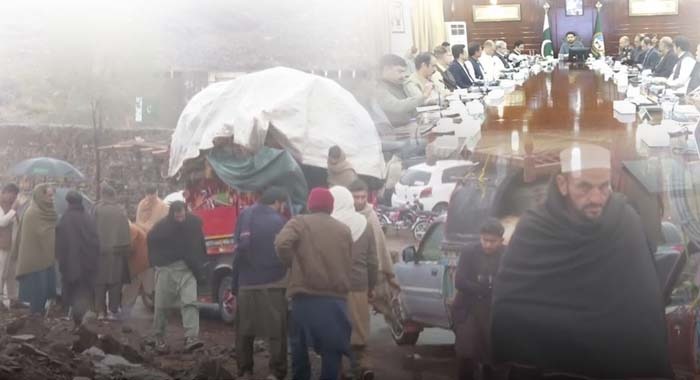
The controversy is anchored in a documented administrative act. On December 26, 2025, the Khyber Pakhtunkhwa Relief, Rehabilitation and Settlement Department formally imposed an emergency in district Khyber under Section 16(A)(1) and (2) of the National Disaster Management Act, 2010. The notification, signed by Secretary Suhail Khan, was issued on the basis of a written report submitted by the Deputy Commissioner of Khyber. That report identified the likelihood of temporary and voluntary displacement from specific areas of Tirah, including Bagh.
The notification was explicit in scope and intent. It recorded that any anticipated movement of population reflected the wishes of local residents, expressed through a representative jirga convened at the district level, and that the decision accounted for seasonal conditions, logistical constraints, and ground realities. The purpose of the emergency was defined operationally, to enable advance arrangements for transportation, food supply, temporary shelter, registration points, and other humanitarian assistance.
Under the notification, the Provincial Disaster Management Authority and the district administration were authorized to immediately initiate relief activities. All expenditures were to be met from designated relief accounts, with strict maintenance of financial and stock records. The document carried an unambiguous clarification that the emergency was imposed solely for humanitarian preparedness and facilitation. The notification has not been withdrawn, amended, or disputed, and therefore remains the official, legally binding position of the KP government on Tirah Valley.
Within days, that position fractured politically. Chief Minister’s Adviser on Information and Public Relations Shafee Jan addressed a letter to Federal Minister for Information and Broadcasting Attaullah Tarar that effectively disowned the provincial government’s own decision. In the letter, the adviser characterized the relief operation as economically disruptive, alleged that it led to forced displacement, and claimed that evacuation-related actions had been undertaken without consultation with the provincial government or elected leadership.
These assertions stand in direct contradiction to the December 26 notification, which documents provincial authorization, district-level consultation, and community input through a jirga. The adviser’s letter further attempted to shift responsibility for relief, rehabilitation, and compensation onto the federal government by invoking actions taken under federal authority and civil power provisions, while omitting any reference to the provincial government’s formal invocation of emergency powers under the NDMA.
The letter also sought to obscure allegations of corruption linked to funds allocated for locally displaced persons. This omission sits alongside the documented fact that the federal government released Rs 4 billion for the operation, funds that were subsequently alleged to have been diverted by the provincial government toward political activities, including protests, rallies, and demonstrations. As residents of Tirah began demanding relief and compensation, the provincial political narrative shifted further, distancing itself from decisions already recorded in official government documents.
From Administrative Record to Strategic Pattern
This contradiction is not an isolated administrative anomaly. It reflects a recurring PTI governance pattern in Khyber Pakhtunkhwa, exercising state authority when pressure mounts, then politically disowning the consequences of that authority when accountability follows.
The army’s presence in KP illustrates this pattern clearly. It was not imposed unilaterally by the federation. It followed a formal request by the KP government itself under Article 245 of the Constitution, made at a time when civilian institutions were overwhelmed by sustained terror attacks. That constitutional request acknowledged the collapse of civilian capacity. Subsequent political portrayals of military involvement as intrusive or externally driven contradict the province’s own actions and the constitutional record.
The Tirah relief notification follows the same trajectory. Legal frameworks were invoked, institutional mechanisms activated, and administrative authority exercised. When political cost emerged, the same decision was reframed as imposed, mishandled, or externally driven. This dual-track governance, administrative clarity paired with political ambiguity, carries direct security consequences.
Tirah Valley lies within a sensitive belt affected by militant regrouping, cross-border movement, and the convergence of criminal and terror networks. In such environments, unity of narrative and clarity of authority are stabilizing tools. Mixed signals from civilian leadership weaken institutional coherence, erode civilian confidence, and create operational ambiguity that hostile actors exploit.
The contrast with Balochistan under the National Action Plan sharpens the analysis. While Balochistan pursued uneven but tangible implementation and began extracting measurable security gains, Khyber Pakhtunkhwa remained mired in protest politics, selective enforcement, and administrative retreat. The gap was not legal or constitutional. It was political choice.
Overlaying the Tirah episode is PTI’s overriding political priority. Governance decisions, humanitarian relief, and counterterror coordination have consistently been subordinated to a singular objective, the release of Imran Khan. In this framework, national unity, security coordination, and civilian protection become secondary, negotiable considerations.
The Tirah Valley controversy, therefore, is not simply about a notification and a contradictory letter. It is a case study in how fragmented governance, opportunistic politics, and selective accountability can transform a humanitarian measure into a strategic liability. In a terror-affected province, such contradictions do not remain rhetorical, they shape outcomes on the ground, and those outcomes are paid for by civilians, institutions, and the state itself.



