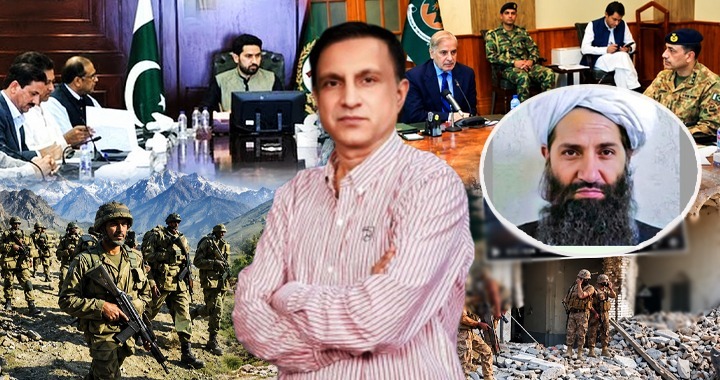
It is deeply unfortunate that the Khyber Pakhtunkhwa government does not appear to be taking the deteriorating security situation in the province seriously. Terrorist incidents have been occurring for a long time, and the situation is getting worse, yet the provincial government continues to demonstrate a non-serious attitude toward peace and security.
The government’s attention to this issue appears to be virtually nonexistent. People are being martyred, security forces personnel are being martyred, and police officers are losing their lives, but the provincial government does not seem to treat this as a matter requiring urgent and sustained attention.
The situation demands regular meetings of the Apex Committee. Such meetings should be held every month to review the security environment, identify emerging threats, determine where terrorist groups are operating and discuss what measures are needed to counter them.
But look at the government’s attitude. How many Apex Committee meetings have actually been held?
Sohail Afridi assumed office as chief minister on October 15, 2025. Since then, there have been only one or two meetings, as far as I can recall, and those were largely introductory in nature. The last meeting was held in February 2026. No meeting has been held since then.
This gives the impression that the provincial government does not consider terrorism a matter requiring serious attention. It does not appear to be making a sustained effort to address the security crisis.
The Provincial Government Cannot Escape Its Security Responsibilities
The responsibility for maintaining law and order rests with the provincial government. It is responsible for the security of the province, and it has the police force and the administrative machinery needed to take action and defend the population.
Consider the situation in Peshawar. A group associated with Jamaat-ul-Ahrar arrived in the city, and there were reports of an explosives-laden vehicle and suicide bombers. The threat continued from one day to the next.
The Counter Terrorism Department subsequently conducted a raid, during which a young security personnel was martyred. Footage of the incident also emerged.
The following day, another alert warned that a suspicious vehicle had entered Peshawar and that an attack could take place anywhere. Authorities had also been warning about a possible attack on the Civil Secretariat since the previous day.
The threat persisted, and people were evacuated from the area.
These developments show the seriousness of the security situation. Terrorists are targeting people, and the provincial government needs to demonstrate that it understands the gravity of the threat.
Look at what happened in Kohat in recent days. Around 25 people were martyred, including security forces personnel and police officers. In Kurram, our personnel were also martyred.
In such circumstances, where is the government’s vision? Where is its strategy? Why is it not sitting down with the relevant institutions to discuss the situation and formulate a coordinated response?
The security establishment and the army are institutions of Pakistan. They are not India’s army. Political differences should not prevent the provincial government from engaging with them.
The government should call the relevant officials, sit with them and discuss the challenges facing the province. Whatever political differences exist should be set aside when the lives of people and the security of the province are at stake.
Silence Over the Martyrs Raises Serious Questions
One of the most troubling aspects of the situation is the provincial government’s response when security personnel are martyred.
Even when soldiers lose their lives in terrorist attacks, the government does not always issue a condemnation statement. It does not consistently acknowledge the sacrifices made by those protecting the province.
There is another issue that I find particularly unfortunate.
When a civilian is martyred, the chief minister sometimes visits the victim’s family or attends the funeral. But when a member of the security forces is martyred, the chief minister does not appear to make the same effort to visit the family or attend the funeral.
Attending a funeral is not merely a formal gesture. It gives courage to the bereaved family and demonstrates that the sacrifices of those who protect the country are recognized.
Visiting the families of martyred personnel is an important responsibility. These families have lost their loved ones while performing their duties, and they deserve the government’s attention and support.
Instead, the chief minister and other political leaders often appear occupied with political activities, whether in Lahore, Karachi or elsewhere.
Sometimes, visits to the homes of martyrs take place only after 24 or 48 hours. This raises questions about the government’s priorities and the seriousness with which it treats the sacrifices of security personnel.
Fear, Political Alignment or a Policy of Negotiations?
When a government does not condemn terrorist attacks, avoids security meetings and appears reluctant to take action, several questions arise.
One possibility is that the government is afraid.
Perhaps its leaders believe that if they condemn an attack, order a counterterrorism operation or participate in a security meeting, terrorist groups will target them.
That is one possible explanation.
Another possibility is that the government is maintaining some form of understanding or accommodation with these groups, allowing them to operate without confronting them effectively. When a government consistently refrains from taking action against a particular group, people may begin to suspect that there are contacts or an understanding between them.
A third explanation is that this reflects the government’s political position and its preference for negotiations over security operations.
There is a history behind this position.
When Imran Khan was in power, he even proposed opening an office for the Taliban in Peshawar. His government was prepared to pursue negotiations with them to that extent.
The political leadership’s reluctance to confront terrorist groups may also be rooted in fear of retaliation. Terrorists have targeted political parties across the country. Religious parties have been attacked, and even Jamiat Ulema-e-Islam has suffered terrorist attacks.
Political leaders may fear that if they openly condemn terrorist groups or support security operations, they could become targets themselves.
But the question remains: can fear justify silence when people are being killed?
The political position of seeking negotiations with terrorist groups, opposing operations and attempting to persuade them to abandon violence has repeatedly failed to produce lasting peace.
The government appears to believe that it can avoid confrontation by continuing to negotiate, even when terrorist groups continue to attack security forces and civilians.
But these groups have targeted mosques, Imambargahs, schools and other public places. They have killed soldiers, police officers and ordinary citizens.
After all this, what exactly is left to negotiate?
The History of Failed Agreements Cannot Be Ignored
We have discussed the issue of jirgas and negotiations many times, but it is important to recall the history.
How many jirgas did former KP chief minister Ali Amin Gandapur convene? Sohail Afridi also began pursuing jirga-based efforts after assuming office.
But we must remember what happened when the Taliban established themselves in Tirah and Bajaur. There were numerous rounds of negotiations with them.
Despite those efforts, the security situation continued to deteriorate.
The problem is not that negotiations were never attempted. The problem is that repeated negotiations and agreements failed to produce lasting peace.
At the same time, international concern about terrorism emanating from Afghanistan has also grown.
The intelligence chief of Turkey and senior Qatari officials have visited Kabul to discuss the situation. These countries are concerned about terrorist groups operating from Afghan territory.
The threat is not limited to Pakistan. Terrorist organizations from different parts of the world are operating in Afghanistan, and groups such as Daesh and Al-Qaeda are also strengthening their presence.
During these diplomatic efforts, foreign officials were reportedly told that they would have to meet Taliban supreme leader Mullah Hibatullah Akhundzada to resolve the issue.
They agreed to travel to Kandahar for the meeting, but he reportedly refused to receive them.
If even international officials seeking dialogue cannot secure a meeting with the Taliban leadership, what does that say about the prospects for negotiations?
Pakistan has already conducted numerous rounds of talks with the TTP, and those efforts have failed.
The insistence that negotiations alone can resolve the problem ignores the experience of the past.
I believe the time for relying on negotiations as the principal solution has passed. The situation now demands effective action against terrorist groups.
Why Security Operations Became Necessary
Whenever a major security operation is launched, people are displaced from their homes. Leaving one’s house, abandoning belongings and moving to another place is extremely difficult.
These are painful decisions, and no government should take them lightly.
But we must also consider the argument that previous operations failed to produce lasting results.
If we are going to assess the effectiveness of security operations, we must also examine the outcomes of negotiations and agreements.
How many rounds of talks have taken place? How many agreements have been signed? How many jirgas have been convened?
From the Shakai Agreement to the Swat Agreement, the state has entered into numerous arrangements with these groups.
What was the result?
I would ask Sohail Afridi: how did we restore the writ of the state in Swat?
The 2008-09 Swat agreement failed, and an operation became necessary. Negotiations had taken place, and an agreement had been reached, but the Taliban violated it. That is why the state had to launch an operation.
Operations were also conducted across South Waziristan and other parts of the former Federally Administered Tribal Areas because agreements had failed to prevent violence and restore the state’s authority.
The Shakai Agreement is a clear example.
One of its conditions was that foreign fighters would not be allowed to remain in the area. But that commitment was violated, and more foreign fighters were brought in.
The government asked the Taliban to remove those individuals or hand them over to the authorities. They refused.
There were also commitments concerning weapons and attacks on security forces. Those commitments were not honored either.
The Taliban agreed not to attack security forces and not to participate in terrorist activities. Yet attacks resumed within a month of the agreement.
This was not an isolated incident. Similar violations occurred under other agreements as well.
Instead of expelling foreign terrorists, these groups provided them with refuge and protection. They used and trained them.
In such circumstances, how can a government continue to rely on agreements that repeatedly fail?
The issue is not whether negotiations should ever be attempted. The issue is whether they can work when the other side refuses to honor its commitments.
The TTP’s Demand for Safe Havens Is at the Heart of the Crisis
The central problem is that terrorist groups want safe havens and areas where they can operate freely, particularly in the tribal districts.
They want space in which they can maintain their networks, receive funding, recruit personnel and carry out activities without interference.
The TTP and the Afghan Taliban have not accepted the fundamental conditions necessary for lasting peace: that Afghan territory should not be used against Pakistan and that terrorist groups should not be allowed to operate freely across the border.
This is an ongoing crisis.
The question I would put to the PTI leadership is simple: what does the party expect to achieve by continuing to oppose security operations while the TTP seeks to establish a protected space in the region?
The provincial government is enjoying its political position, while terrorist groups continue to carry out attacks.
The perception is that the government wants to avoid confrontation with these groups and that the terrorists are therefore able to operate without targeting the political leadership in the same way they target security forces and ordinary citizens.
This is a serious concern, and the government needs to clarify its position.
Pakistan Has Tried Dialogue With Afghanistan, Too
The Afghan Taliban repeatedly claim that Pakistan is targeting them and refusing to engage in dialogue.
But Pakistan has consistently maintained that it wants to resolve the dispute peacefully and has called for talks to address the security concerns.
The results of these diplomatic efforts, however, have been disappointing.
China has expressed concern over the situation. Turkey has also been frustrated by the lack of progress, particularly after its intelligence chief’s visit to Kabul failed to produce a meeting with the Taliban supreme leader. The United Arab Emirates has also expressed dissatisfaction with the situation.
Pakistan has repeatedly asked the Afghan Taliban to prevent terrorist groups from using Afghan territory to launch attacks against Pakistan.
It has also shared evidence with them, including information about terrorists eliminated during attempts to infiltrate Pakistan and the involvement of Afghan facilitators.
In recent incidents, Afghan nationals have been identified among attackers. An Afghan national was also identified among the attackers involved in the latest incident in Peshawar, while the suicide bomber involved in the Kohat attack was also an Afghan national.
Pakistan has been providing information about these individuals and the networks facilitating their movement.
The question is: what more is Pakistan expected to do?
Some people describe the situation as a conflict between two Muslim brothers. But that description does not change the reality of repeated attacks.
If someone attacks your home, you ask them to stop. You try to explain the consequences. You make repeated efforts to resolve the matter peacefully.
But if the other person remains determined to continue attacking, what options are left?
You try to stop them. You seek help from third parties and other countries. You pursue diplomatic channels and negotiations.
Pakistan has made these efforts, but the attacks have continued.
Under such circumstances, how can Pakistan simply reopen the border and restore normal trade relations without addressing the security threat?
A peaceful and friendly relationship requires mutual respect for each other’s security and sovereignty.
If the Afghan Taliban want Pakistan to remain a friendly and brotherly neighbor, they will have to change their policies and prevent terrorist groups from using Afghan soil against Pakistan.
Without that change, it will be difficult to restore trust, normalize relations and establish lasting peace along the border.