
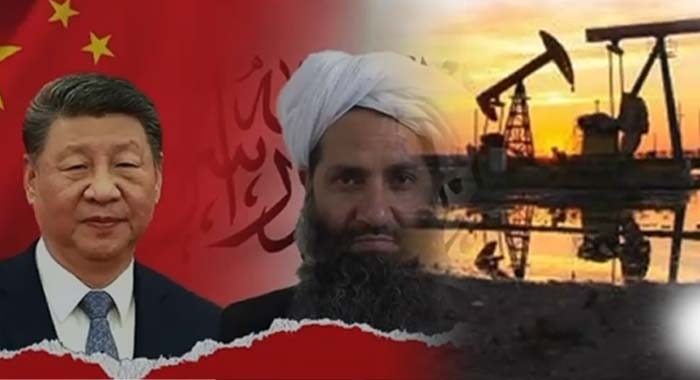
A series of disturbing developments surrounding the Amu Darya oil project has exposed what analysts describe as the Taliban’s predatory and coercive approach to governance, revealing a pattern of extortion, contract violations, armed intimidation and economic sabotage that has further isolated Afghanistan from global investors.
The controversy began with what initially appeared to be a rare economic breakthrough. In January 2023, the Taliban announced a 25-year agreement with Xinjiang Central Asia Petroleum and Gas Co., Ltd (CAPEIC), a major Chinese firm tasked with extracting oil from the Amu Darya basin. The deal included a Chinese commitment to invest USD 150 million in the first year and USD 540 million over the following three years, alongside thousands of employment opportunities for Afghan workers.
Yet within months, the arrangement began to unravel. Taliban commanders reportedly started demanding monthly “security payments” from the Chinese company payments that were never part of the contract and suspended operations when the company declined to comply. By 2024, the Taliban escalated their demands, insisting that their share of the project be doubled from 15 percent to 30 percent. When Chinese officials referred them to the signed agreement, Taliban authorities dismissed the document outright, asserting that they could “change the terms as they wished.”
The situation deteriorated further in 2025. In May, Taliban forces raided the Chinese company’s Kabul office, seizing USD 17 million in cash along with equipment, documents and company assets. On 17 June 2025, more than 200 armed Taliban fighters stormed the Amu Darya extraction site, forcing Chinese engineers out at gunpoint. That same morning in Kabul, twelve Chinese technical experts were detained from their residences, stripped of their passports and confronted with a demand for USD 50 million as a so-called “fine.” Reports also indicate that approximately USD 8 million was forcibly withdrawn from the company’s bank account.
Although eight of the twelve detained Chinese workers were released during a high-level diplomatic visit by China’s foreign minister in August, four remain in Taliban custody. Meanwhile, the Taliban have begun marketing the same oil fields developed entirely through Chinese investment, surveys and equipment to new foreign buyers, effectively attempting to resell stolen infrastructure.
The fallout has been swift and severe. China has suspended all new investments in Afghanistan, while major global corporations have backed away from any engagement with the Afghan market. International financial assessments warn that the last remaining prospects for Afghanistan’s economic revival have been severely damaged. Analysts say the Taliban’s actions have destroyed investor confidence and reinforced perceptions of Afghanistan as an unstable environment governed by coercion rather than law.
Experts conclude that this is not a simple contractual dispute but a clear pattern of looting, armed intimidation and predatory governance. The Amu Darya scandal, they argue, has exposed the Taliban’s true character a regime operating through force, extortion and economic exploitation, pushing Afghanistan deeper into isolation and crisis.



