
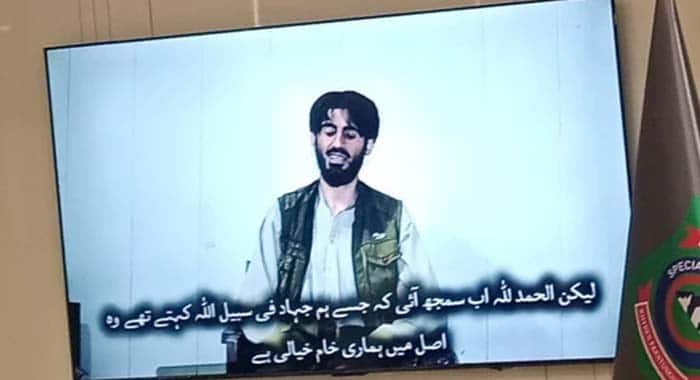
Pakistan’s security agencies have secured a major breakthrough against cross-border terrorism with the arrest of a TTP operative who allegedly entered Pakistan from Afghanistan and was involved in planning terrorist activities including suicide attacks inside Pakistan, exposing the continued use of Afghan territory for attacks inside Pakistan.
Additional Inspector General (AIG) of Designated Districts Ahsan Abbas, accompanied by Regional Development Council Adviser for Information Mahmood Jan Babar, disclosed the arrest during a press conference in Peshawar, detailing the suspect’s links with terrorist networks on both sides of the border and his alleged involvement in recruitment, training and attack planning.
Abbas identified the arrested terrorist as Hikmatullah alias Hamza, son of Noor Muhammad, who was apprehended on November 7 during an intelligence-based operation conducted jointly by law enforcement agencies and security forces.
According to the AIG, Hamza belonged to the Mangrial village of Chamkani area in Afghanistan’s Paktia province. He entered Pakistan through the Tirah route and continued his journey towards Peshawar before security personnel intercepted and arrested him near the provincial capital.
He said the arrest followed an extensive intelligence operation involving human intelligence and various electronic surveillance techniques.
Afghan Territory Used for Terrorist Training and Infiltration
Abbas said Afghan territory continued to be used for terrorist activities against Pakistan despite Islamabad repeatedly presenting evidence of such involvement.
He described Hamza’s arrest as a major breakthrough, saying interrogation had revealed important information about his local facilitators, contacts in Afghanistan, training locations and planning of terrorist activities inside Pakistan.
Investigators also established that the suspect had previously served in the former Afghan National Army before its dissolution.
Following the collapse of the previous Afghan government, Hamza reportedly resumed using his military skills, became associated with different religious seminaries, received further training and established connections with individuals involved in terrorist activities.
Seminary Used to Prepare Suicide Bomber
One of the significant revelations concerned Hamza’s alleged involvement in preparing a suicide bomber at a seminary near Jalalabad in Afghanistan.
According to Abbas, the arrested terrorist had prepared a student named Akrama for a suicide attack at the Khalid bin Walid seminary.
The AIG further disclosed that Hamza maintained links with the banned Hafiz Gul Bahadur Group and had previously served as a personal bodyguard to one of its commanders, Mansoor.
He added that the suspect maintained extensive connections with terrorists and their facilitators inside Pakistan as well as an established network of contacts across the Afghan border.
Interrogation Reveals Cross-Border Terrorist Connections
Abbas said interrogation of the suspect following his November 7 arrest had provided investigators with important leads about the broader terrorist network, including individuals facilitating his activities in Pakistan and Afghanistan.
The information also helped investigators identify locations where he had received training and where plans for terrorist attacks inside Pakistan had been developed.
During the press conference, journalists were also shown a video statement in which Hamza appeared to confess to planning or participating in various terrorist incidents in Pakistan.
The arrest provides another insight into the cross-border networks, recruitment channels and training arrangements allegedly facilitating terrorist activities against Pakistan.
It also reinforces Islamabad’s longstanding concerns that Afghan territory continues to serve as a source of operational support for terrorist groups targeting Pakistan, despite repeated diplomatic engagement and demands for verifiable action against these networks.



