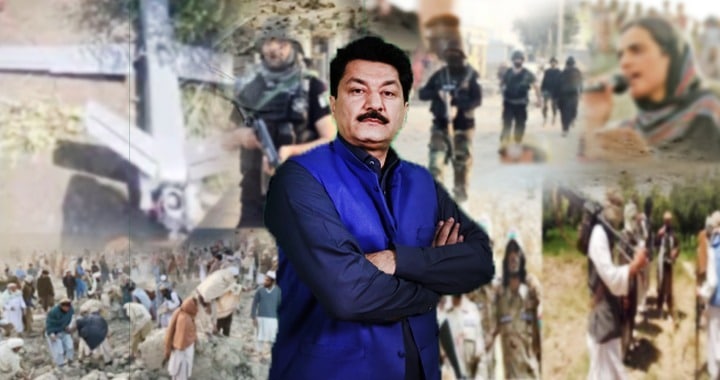
The security situation unfolding in Khyber Pakhtunkhwa, particularly in Hassan Khel, North Waziristan, and adjoining sensitive areas, reflects a pattern that is no longer episodic but continuous. Drone-related incidents, whether attributed to state claims or counter-claims, have shifted the nature of violence into a more complex and technologically enabled form, where civilians are increasingly exposed alongside security personnel. What stands out most is not just the frequency of such incidents, but the widening of their impact on ordinary communities.
The discussion begins with a stark observation: civilians are no longer peripheral casualties in isolated security events. Reports from Hassan Khel and surrounding regions indicate injuries and displacement, with both minor and serious cases requiring medical attention. In some instances, families have been directly affected, including reports of women and children being caught in the aftermath. This shift signals an escalation in operational consequences that demands immediate attention from all stakeholders.
In 2021, Afghan authorities made clear commitments that their territory would not be used for terrorism or any activity that threatens neighboring states. However, the current situation on the ground presents a contradictory picture. The persistence of cross-border security incidents, combined with intelligence-based assessments, continues to raise serious concerns about the operational space available to banned terrorist organizations, including Tehreek-e-Taliban Pakistan and Jamaat-ul-Ahrar.
Drone-related allegations exchanged between Pakistan and Afghan authorities further complicate the narrative. Claims of cross-border strikes and counter-strikes have emerged in parallel, each side presenting its own version of events. Yet beneath these competing narratives lies a more fundamental issue: the increasing normalization of unmanned aerial technology in non-state conflict environments. Drone systems and quadcopters are no longer limited to state militaries; they have become tools in the hands of organized terrorist networks operating in the region.
Pakistan’s military response through targeted strikes in Kunar, Paktika, and Paktia reflects a continuation of its counter-terrorism posture aimed at dismantling infrastructure believed to be used for planning and coordination of attacks. In response, counter-claims of strikes within Pakistani territory highlight the information contest that now runs parallel to physical operations. This dual-layer conflict, kinetic and narrative, has become a defining feature of the current regional security environment.
One of the most significant recent developments reinforcing Pakistan’s long-standing concerns is the Karachi incident, where a captured attacker reportedly stated that he belonged to Jalalabad and had received training in Afghanistan. While such statements require formal verification through investigative processes, they nonetheless align with previously documented patterns of cross-border facilitation. These are not isolated occurrences but part of a broader security challenge that has persisted over time.
The central issue remains the lack of sustained investigative cooperation between the two sides. While there have been occasional instances of engagement on security matters in the broader region, there is still no consistent mechanism for joint investigation, intelligence sharing, or structured counter-terror coordination in cases directly affecting Pakistan. This gap continues to undermine trust and prevents meaningful progress in de-escalating tensions.
At the core of the problem lies the continued presence and operational flexibility of banned terrorist organizations that exploit geographic proximity and porous border dynamics. Groups such as TTP and Jamaat-ul-Ahrar have demonstrated adaptability, shifting locations and methods while maintaining their operational intent. Without addressing this structural mobility, tactical responses alone cannot stabilize the situation.
Another layer of complexity is introduced by the presence of Daesh Khurasan, which operates as a transnational extremist entity with implications extending beyond Pakistan and Afghanistan into Central Asia and beyond. Its ideological rigidity and operational reach have made it a shared security concern for multiple states. Any sustainable counter-terrorism strategy in the region must account for its activities in a coordinated framework rather than fragmented responses.
Alongside these security concerns, a parallel narrative battle continues in the digital space, particularly regarding developments in Balochistan and the arrest of Mahrang Baloch. The discourse surrounding BYC and BLA has been heavily shaped by misinformation and conflation. While BYC is generally presented as a non-armed platform focusing on grievances, BLA is an armed group engaged in violent activity. The merging of these distinct identities in online narratives creates confusion and distorts public understanding.
It is also important to clearly distinguish between political expression and armed violence. Actions involving attacks on infrastructure, disruption of public life, or harm to civilians cannot be categorized as legitimate political struggle. Such activities ultimately undermine the communities they claim to represent and weaken the space for genuine political engagement.
The legal proceedings in Quetta’s anti-terrorism court, including the life imprisonment verdict in the referenced case, followed a prolonged judicial process spanning years. The proceedings included procedural opportunities for defense and appeal. However, the boycott of court proceedings by the accused shaped the final outcome within the legal framework of the judicial system.
Beyond legal and security dimensions, the information environment itself has become a battleground. Fragmented clips, selectively circulated speeches, and decontextualized narratives frequently dominate social media discourse. This creates parallel realities that complicate informed debate and often overshadow verified facts.
On the development front, observations from Gwadar and Turbat in Balochistan reflect visible progress in infrastructure, education, and economic activity. The establishment of universities, colleges, and emerging industrial opportunities indicates a trajectory of development in selected regions. However, the broader challenge remains ensuring that this progress is distributed more evenly across the province, rather than concentrated in specific areas.
Sustainable development requires coordination between provincial governance structures, federal institutions, and security agencies. Without institutional alignment, development initiatives risk being uneven or interrupted. Security and development are not separate domains; they are interdependent components of long-term stability.
In Khyber Pakhtunkhwa, counter-terrorism capacity continues to face structural limitations. The police and Counter Terrorism Department remain at the frontline of response operations, yet they often operate with constraints in equipment, protection, and mobility. The increasing use of drone technology by hostile actors further exposes the need for upgraded counter-drone systems and modern surveillance infrastructure.
Infrastructure deficits within policing systems, including outdated stations, limited armored transport, and insufficient protective resources for field officers, reduce operational effectiveness. In a conflict environment where threats evolve rapidly, institutional adaptation becomes essential rather than optional.
Ultimately, the situation reflects a broader reality: security challenges in the region are evolving faster than the systems designed to counter them. Until coordination improves, investigative cooperation strengthens, and institutional capacity is modernized, instability will continue to adapt and persist.