
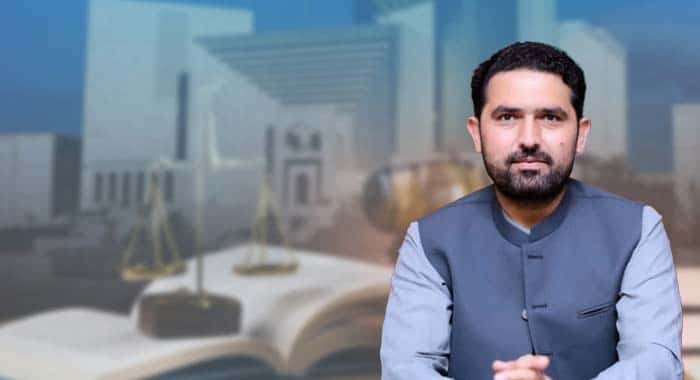
There is something profoundly disturbing about the political priorities being displayed in Khyber Pakhtunkhwa at a time when terrorism is once again threatening the lives, livelihoods and social fabric of more than 40 million people.
The province is not facing an abstract security challenge. Terrorists continue to target communities, intimidate civilians, attack the state and exploit insecurity for their own strategic purposes. Families in affected districts are being forced to live with a question no citizen should have to confront: whether it is safer to remain at home or seek a future somewhere else.
And yet, at precisely this moment, Chief Minister Muhammad Sohail Afridi has spent five days campaigning in Karachi and other parts of Sindh as part of the Pakistan Tehreek-e-Insaf’s mobilization campaign for its September 27 protest.
There is nothing inherently undemocratic about political mobilization. Political parties have the right to organize, campaign and seek public support.
But a chief minister is not merely a party worker with a government office.
He is the chief executive of a province whose people are facing terrorism, unemployment, poverty, displacement and an increasingly difficult struggle to preserve normal life.
That distinction appears to have been lost.
When Terror Is at Home, Where Should the Chief Minister Be?
The contradiction becomes particularly glaring because Afridi comes from Khyber District. He was elected from Khyber-II and became the first chief minister of KP from the former tribal districts.
Khyber is therefore not some distant district whose security situation can be viewed from an Islamabad office or a party headquarters.
It is home.
And while terrorists continue trying to establish their presence, intimidate communities and use civilians as cover, the province’s chief executive has been spending days hundreds of kilometers away campaigning for a political cause centered on the fate of PTI founder Imran Khan.
That is not merely a question of scheduling.
It is a question of priorities.
If terrorism is the foremost threat to KP, then the chief minister’s political energy should be overwhelmingly directed towards defeating that threat, strengthening the police and other law-enforcement institutions, protecting vulnerable communities, restoring confidence in affected districts and creating the economic conditions in which people can build lives without fleeing their homes.
The people of KP do not merely need speeches about development.
They need peace in which development is possible.
They need roads and markets that terrorists cannot intimidate.
They need schools that can function without fear.
They need businesses that can operate without extortion and violence.
They need revenue-generating initiatives capable of reducing poverty and creating employment, particularly in districts where insecurity has destroyed economic activity.
That should be the priority list of any chief minister governing a province under a severe terrorism threat.
Karachi Is a City of Livelihood, Not a Political Escape Route
The choice of Karachi as the centerpiece of this mobilization makes the contrast even more striking.
Karachi has long been a destination for people from Khyber Pakhtunkhwa and the former tribal districts because they are searching for precisely what their own province has struggled to provide consistently: employment, commerce, business opportunities and economic security.
Pashtuns did not travel to Karachi merely to become political foot soldiers.
They went there to live.
They went there to work.
They established businesses, entered transport and construction, built commercial networks and created futures for their families.
For many, Karachi became a second home because economic opportunity demanded it.
The tragedy is that so many people from KP have had to leave their own districts in search of security and livelihoods.
A chief minister confronted with that reality should be asking why people have to leave.
He should be trying to make Khyber Pakhtunkhwa a place where people can remain, work, invest and raise their families in peace.
Instead, five days of political campaigning in Karachi have offered a revealing picture of where political energy is being spent.
Mob Justice Has No Place in a Democracy
Then comes the question at the heart of this entire political mobilization: what exactly is a provincial chief minister supposed to accomplish by campaigning for the release of a political leader whose imprisonment is a matter before the courts?
Imran Khan’s supporters have every right to contest the cases against him through legal and democratic means. They can challenge convictions, file appeals, argue their position in court and campaign politically.
But there is a line that no democratic society should allow political mobilization to cross.
Mob justice has no place in a democracy.
What belongs to the courts must be decided by the courts.
If a court convicted someone, the proper response is an appeal, legal challenge or other remedy provided by law. If the courts ultimately determine that the person is not guilty or that a conviction cannot stand, then the courts can provide the corresponding relief.
A crowd cannot become a court.
A political rally cannot become an appellate bench.
A chief minister cannot transform street mobilization into a substitute for judicial process.
That principle becomes even more important in the case of a person who has repeatedly presented himself as a champion of democracy.
Democracy is not simply the right to gather crowds when a political leader is imprisoned. Democracy also requires respect for institutions, due process and the authority of courts.
If the PTI founder is innocent, let his lawyers prove it before the courts.
If convictions are legally unsustainable, let the courts overturn them.
If he is entitled to relief, let the courts grant it.
That is democracy.
The alternative is not democracy with louder slogans. It is the replacement of institutions with street power.
Even Afridi’s Own Legal Position Now Demands Attention
The irony is sharpened by the fact that the courts are not merely an abstract institution in this political dispute.
On Wednesday, September 9, an anti-terrorism court in Islamabad maintained arrest warrants for KP Chief Minister Sohail Afridi, PTI lawmaker Junaid Akbar and several other accused in a case related to the November 26 protest.
The Anti-Terrorism Court Judge Tahir Abbas Supra rejected exemption applications filed by accused who failed to appear and directed police to submit the challan against Afridi and the other accused as soon as possible. The court also ordered the issuance of arrest warrants for those absent from proceedings.
Police records cited in the proceedings show that multiple FIRs have been registered against Afridi at police stations across Islamabad. The ATC had previously issued his arrest warrants in November in a case involving alleged arson during the November 26 protest. The Islamabad Cyber Crime Wing has also registered two separate cases against him.
The ATC proceedings included steps towards declaring Afridi and other accused proclaimed offenders, while further proceedings were adjourned until September 30.
These proceedings do not establish guilt. That is precisely the point.
The court must decide.
Afridi, like every accused person, is entitled to due process and the opportunity to defend himself. But that same principle must apply to the political cause for which he is campaigning.
If courts are the proper forum for determining his own legal position, they are equally the proper forum for determining the legal fate of the PTI founder.
It is extraordinarily difficult, therefore, to defend the proposition that a chief minister should spend days mobilizing crowds for a prisoner’s political cause while simultaneously facing a legal process of his own.
The Terrorists Have No Such Confusion
Meanwhile, terrorists do not suffer from the luxury of divided priorities.
They know exactly what they want.
They want to weaken the state.
They want to frighten civilians.
They want to undermine confidence in government.
They want to disrupt economic activity.
They want to create an environment in which people abandon their homes, businesses close and public institutions retreat.
They do not need to defeat the state everywhere if they can persuade citizens that the state is either incapable of protecting them or too distracted to care.
Political dysfunction helps them.
A provincial government absorbed in political confrontation while terrorism continues to threaten its population creates precisely the kind of vacuum terrorists seek to exploit.
This does not mean political parties should surrender their rights.
It means a government must understand the difference between a party’s political interests and the public interest it has been elected to serve.
The People of KP Are Not Political Manpower
The people of Khyber Pakhtunkhwa are not merely numbers to be summoned for rallies.
They are citizens.
They are taxpayers, workers, farmers, traders, students, teachers, police officers, soldiers and businesspeople.
Their foremost interest is not whether a political rally becomes larger than the previous one.
Their foremost interest is survival.
Then comes security.
Then peace.
Then education, employment, investment, infrastructure and economic opportunity.
A government that genuinely understands its people should therefore be obsessed with making those things possible.
KP needs revenue-generating initiatives that can reduce poverty instead of leaving young people with migration as their principal economic strategy.
It needs investment in districts that terrorism has economically strangled.
It needs stronger policing and intelligence coordination.
It needs political leadership that treats the fight against terrorists as an existential responsibility rather than one item competing with party politics.
And above all, it needs a chief minister whose most urgent political battlefield is the province he governs.
Khyber Cannot Be an Afterthought
Sohail Afridi’s five-day campaign in Karachi therefore becomes more than another episode in PTI’s political calendar.
It becomes a political statement about priorities.
At a time when terrorists were roaming his home district of Khyber, his most visible political engagement was taking place in Karachi.
At a time when families across KP were seeking security, his political campaign was seeking crowds.
At a time when the province needed economic thinking capable of reducing poverty and creating livelihoods, political energy was being directed towards a battle over the fate of a prisoner.
And at a time when democracy requires institutions to function, the political narrative increasingly risks turning streets into substitutes for courts.
That cannot be allowed to become normal.
The PTI founder’s fate should be decided by the judiciary, through the law and due process. If he is entitled to freedom, the courts can provide it. If his convictions stand, political crowds cannot simply overrule them.
Likewise, the chief minister’s responsibility is not to secure a political outcome for one individual at the expense of the province’s urgent needs.
His responsibility is to secure the province.
To protect its people.
To restore peace.
To create jobs.
To generate revenue.
To reduce poverty.
To make Khyber Pakhtunkhwa a place from which people do not have to escape merely to find safety and a livelihood.
The terrorists understand their priorities.
The people of KP understand theirs.
The question is whether their chief minister does.
For more than 40 million people facing the threat of terrorism, KP cannot afford a chief minister whose political priorities are somewhere else.



