
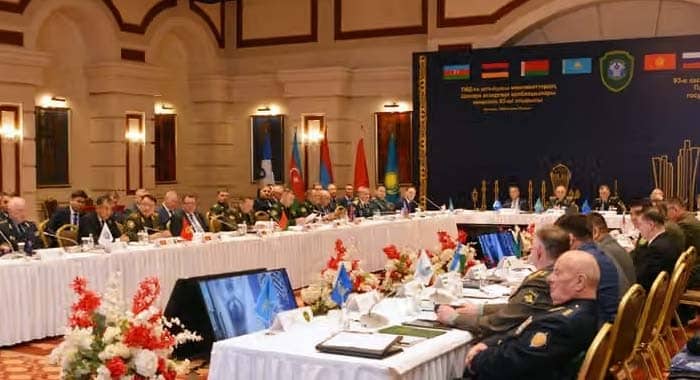
Border security officials from member states of the Commonwealth of Independent States (CIS) have called for stronger protection of external borders, including those adjoining Afghanistan, amid concerns over terrorism, drug trafficking, illegal migration and cross-border organized crime.
The call came during a meeting of the CIS Council of Border Guard Commanders in Astana, Kazakhstan, where representatives discussed measures to improve border surveillance, strengthen cooperation and respond more effectively to security threats.
Improving the exchange of operational intelligence among border security agencies was a key focus. Participants also discussed deploying modern technologies for border control and enhancing coordination between member states during security emergencies.
Alexander Manilov, deputy head of the CIS Council of Border Guard Commanders, emphasized the need for unified efforts, noting that emerging threats require border units to maintain operational readiness and coordinate their responses.
Yerlan Aldzhumanov, deputy chairman of Kazakhstan’s National Security Committee and head of its border guard service, said the council meets twice a year to assess security conditions along the Commonwealth’s external borders and coordinate protective measures.
He highlighted joint border operations spanning areas from Afghanistan’s frontiers to the Commonwealth’s western boundaries, stressing their role in containing cross-border threats and improving coordination among participating states.
The discussions also covered personnel training, military education programs, and scientific and technical cooperation. Aldzhumanov noted that most council resolutions are adopted unanimously, helping member states establish common approaches to border protection.
The meeting comes amid wider regional concerns about security threats originating from Afghanistan. The Collective Security Treaty Organization (CSTO) has expressed concern about risks along the Afghan-Tajik border, prompting renewed attention to the region’s security requirements.
CSTO member states, including Russia, Kazakhstan, Kyrgyzstan and Belarus, have been preparing to provide Tajikistan with weapons and military equipment to strengthen its border defenses against Afghanistan.
Russian Foreign Minister Sergey Lavrov has also warned that the Islamic State Khorasan Province (ISKP) intends to use Afghanistan as a base for expanding terrorist activities into Central Asia and Russia. He has raised concerns about terrorist groups maintaining training facilities in Afghan border areas adjoining Tajikistan and Uzbekistan.
The latest discussions reflect growing concern among regional governments that instability and terrorist networks operating from Afghan territory could pose wider security risks beyond Afghanistan’s borders.



