
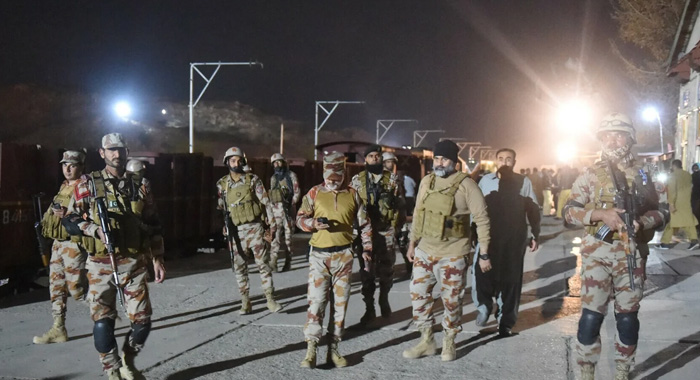
The series of attacks that unfolded across Balochistan in mid-January 2026 were not routine acts of violence. They marked a dangerous evolution in both scale and coordination, signaling a deliberate attempt to destabilize Pakistan through synchronized, high-impact operations.
From Kharan to Quetta, Gwadar to Pasni, what emerged was a pattern not isolated incidents, but a networked strategy designed to overwhelm security forces, create panic, damage financial infrastructure, and trigger hostage crises for maximum leverage.
On January 15, security forces in Kharan acted on intelligence and engaged armed assailants who had targeted a police station, the National Bank of Pakistan, and Habib Bank Limited. Their apparent objective was not merely destruction, but economic sabotage and the creation of hostage situations to extract funds and concessions. The swift response prevented what could have spiraled into a prolonged urban crisis. At least twelve attackers were killed in that engagement alone.
Yet the larger picture is even more alarming. Just days earlier, on January 13, coordinated assaults were launched simultaneously at 12 locations across Balochistan. The level of planning, communication, and timing demonstrated a degree of operational synchronization rarely witnessed in Pakistan’s history. These attacks targeted security installations, markets, banks, and government offices combining suicide bombings, ambush tactics, and direct assaults.
Security sources report that at least 216 armed militants were eliminated during subsequent operations, while provincial leadership confirmed recovery of approximately 180 bodies. The scale of these losses underscores both the magnitude of the attempted offensive and the intensity of the response.
What stands out most is the strategic intent behind these operations. The attackers sought to tie down security forces across vast geography for extended durations, stretching resources and creating psychological pressure. This was not merely about territorial disruption it was about perception, optics, and messaging.
The ambush on a Frontier Corps convoy near Ormara Pasni on January 14, which resulted in eight personnel losing their lives, further demonstrated the sustained nature of the campaign. A subsequent attempted assault on January 17 was foiled due to heightened alertness, with five attackers neutralized.
As the nation absorbed these shocks, tragedy struck again in Islamabad’s Tarlai area on February 6, when a suicide bomber attacked worshippers at Jamia Khadijat-ul-Kubra Imam Bargah during Friday prayers. Thirty-three lives were lost, and over 150 people were injured. The symbolism was chilling violence not just against the state, but against civilians engaged in worship.
These developments raise critical questions about the evolving threat landscape. The sophistication of coordination suggests access to funding, advanced communication tools, and sustained logistical backing. The repeated targeting of economic and civilian centers indicates a strategy aimed at destabilizing both security confidence and social cohesion.
International condemnation, including from the United Nations Security Council, reflects the global recognition of the seriousness of these events. But beyond statements, the attacks force a domestic reckoning: the battlefield is no longer confined to remote terrain. It is urban, synchronized, and psychologically calculated.
At the same time, the response of Pakistan’s security forces highlights another reality. Rapid intelligence-based engagement, immediate combing and clearance operations, and follow-up pursuit operations prevented the attackers from achieving their broader objectives. The high number of militant casualties demonstrates operational preparedness and tactical resilience.
Yet victory in such confrontations is never purely measured in numbers. The loss of security personnel and civilians leaves wounds that statistics cannot quantify. Families bear the burden long after headlines fade.
The January attacks may ultimately be remembered not just for their scale, but for what they revealed: a transition toward coordinated, multi-city destabilization attempts and a state response determined to confront them decisively.
The challenge ahead lies not only in eliminating armed networks, but in dismantling the financial, ideological, and logistical ecosystems that enable such campaigns. Without addressing those deeper layers, the cycle risks repeating itself in new forms.
Pakistan now stands at a critical juncture where vigilance, institutional coordination, and long-term strategic clarity will determine whether such coordinated offensives remain an exception or become a recurring threat.



