
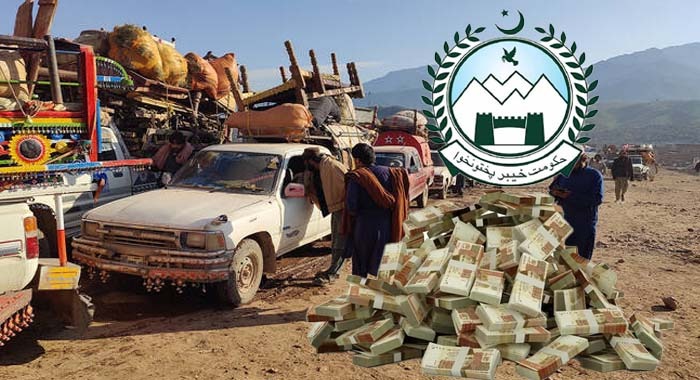
The release of Rs4 billion for Tirah Valley, within less than two days was presented as an emergency intervention, an extraordinary administrative response to extraordinary suffering. Speed was cited as compassion. Urgency was framed as resolve. What followed, however, was not transparency, delivery, or even a paper trail, but silence.
When questioned about where and how this massive sum was spent, the Khyber Pakhtunkhwa government led by Pakistan Tehreek-e-Insaf offered no breakdown, no verifiable projects, no audited trail. Instead, what emerged was a familiar pattern: shifting narratives, unsubstantiated allegations, and a deliberate attempt to redirect public anger away from accountability.
The question is simple, and it refuses to go away. Where did the Rs4 billion go?
Rather than answering it, the provincial leadership and its political ecosystem have chosen confrontation as distraction. Allegations are fired outward, institutions are blamed, and an atmosphere of grievance is carefully cultivated, not to resolve Tirah’s crisis, but to obscure administrative responsibility.
This is not accidental. It is tactical.
When Accountability Becomes the Enemy
The first confirmed explanation lies in political conditioning. PTI’s leadership has long relied on accusation as substitute for evidence. Its founder is on record leveling claims of betrayal and conspiracy against opponents before global audiences, allegations that were never proven but succeeded in poisoning discourse. That method is now institutionalized.
Federal Minister for Information Tarar, speaking on record, previously described the PTI as the political wing of the banned TTP that provided cover and narrative protection to militant elements. In the context of Tirah, that statement acquires renewed relevance. The explanation is more consequential. Accountability is being actively delayed because answers would expose decisions that served interests far removed from Tirah’s displaced population.
By delaying decisive action in Tirah, the provincial government objectively benefited none but militant networks belonging to multiple banned organizations that were cornered in the area. The delay allowed escape routes to reopen. It also enabled the uninterrupted harvesting of opium and cannabis, an industry whose profits are known to be shared with militant groups. Those who were meant to be neutralized slipped across the border and, as one federal minister described it, now sit comfortably in Afghan sanctuaries, grateful to their political enablers.
This is not rhetoric. It is sequence.
The operation was delayed. Militants escaped. The narcotics cycle completed. Funds were released. Questions followed. Silence prevailed.
Manufacturing a Divide
At the same time, a parallel effort has been underway to pit the population against the state, particularly Pashtuns and more specifically the tribes of Tirah. The narrative pushed is deliberate: displacement and hardship are blamed on federal authorities and law enforcement agencies, while the provincial government presents itself as powerless or victimized.
This narrative collapses under scrutiny. It was the provincial government that delayed the operation. It was the provincial government that prioritized political leverage, including demands linked to the release of its imprisoned leader, over state security and civilian safety. Tirah became a bargaining chip.
Attempts to create confrontation between the army and the people have so far failed, but the intent remains visible. This is not merely irresponsible politics. It is governance weaponized against national cohesion.
The Question That Will Not Die
Even PTI’s own workers may not yet be asking the hardest question. But others are. Tribal elders are. Political alliances are. Institutions tasked with safeguarding territorial integrity are.
A representative tribal jirga has been announced to examine alleged misuse of Tirah funds, corruption, and politically motivated distribution. At the same time, a political rally is being branded as a jirga, a move widely criticized as an effort to dilute traditional mechanisms and politicize grievances.
This duality reflects the core problem. One forum seeks answers. The other seeks noise.
After more than a decade in uninterrupted power in Khyber Pakhtunkhwa, an unprecedented tenure in the province’s political history, PTI can no longer blame predecessors. The question is no longer rhetorical.
Where was the Rs4 billion spent?
Why was it released with such urgency?
Why is there no public accounting?
And why does every demand for answers trigger accusations instead of evidence?
These questions must be asked at the start, in the middle, and at the end, because until they are answered, Tirah’s suffering remains a political instrument rather than a governance priority.
Silence is not an oversight. It is the story.



