
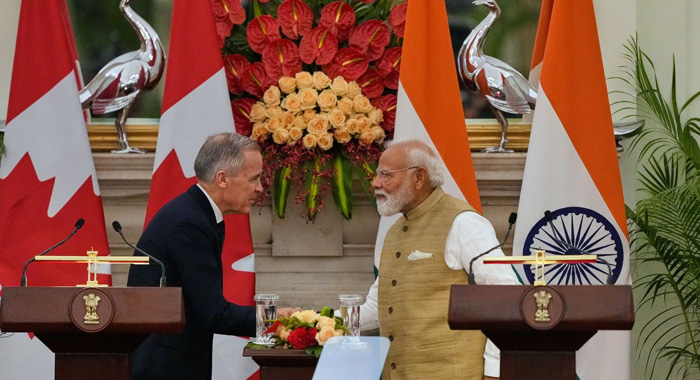
Pakistan on Thursday expressed serious concerns regarding the recently concluded long-term uranium supply agreement between Canada and India, as well as the potential cooperation between the two countries on small modular reactors and advanced nuclear reactor technologies. The Government of Pakistan cautioned that such arrangements risk undermining the global nuclear non-proliferation framework and could have far-reaching strategic implications for regional stability.
Addressing the issue, Foreign Office Spokesperson Tahir Andrabi stated that the agreement represents yet another country-specific exception in the domain of civil nuclear cooperation, raising important questions about the integrity and consistency of international non-proliferation regimes.
“This arrangement represents yet another country-specific exception in the field of civil nuclear cooperation. It is particularly ironic given that India’s 1974 nuclear test, conducted using plutonium produced in a reactor supplied by Canada for peaceful purposes, had led directly to the establishment of the Nuclear Suppliers Group (NSG),” the spokesperson said.
The Foreign Office highlighted that India’s nuclear test in 1974 prompted the international community to establish the NSG to regulate the export of nuclear materials, equipment and technology to prevent their diversion toward military purposes. Against this historical backdrop, Pakistan questioned the rationale behind granting India preferential access to nuclear resources under selective bilateral arrangements.
The spokesperson further pointed out that India has not placed all its civilian nuclear facilities under the safeguards of the International Atomic Energy Agency (IAEA), nor has it made any binding commitment to do so under the present arrangement.
“Several of India’s nuclear facilities remain outside international inspection. It is also unclear what concrete non-proliferation assurances, if any, accompany this agreement,” he noted.
Pakistan also underscored the strategic implications of such cooperation. According to the Foreign Office, assured external uranium supplies could allow India to divert its domestic uranium reserves toward military purposes, potentially enabling the expansion of its fissile material stockpiles and accelerating the growth of its nuclear arsenal.
“This development could deepen existing asymmetries in South Asia’s strategic balance and raise serious concerns regarding long-term regional stability,” the spokesperson added.
Furthermore, Pakistan expressed concern that the agreement could undermine Canada’s commitment to the international non-proliferation regime and its corresponding obligations under global frameworks designed to prevent the spread of nuclear weapons.
Reiterating its long-standing position, Pakistan emphasized that civil nuclear cooperation should be governed by a non-discriminatory, criteria-based framework that applies equally to all states that are not parties to the Nuclear Non-Proliferation Treaty (NPT).
“Selective exceptions diminish the credibility of the global non-proliferation framework and risk further destabilising regional and global peace and security,” the Foreign Office maintained.
In a subsequent statement shared on social media platform X, the spokesperson highlighted additional concerns regarding India’s nuclear posture, noting that India has rejected the Comprehensive Nuclear-Test-Ban Treaty (CTBT), has not provided a binding no-test pledge, does not maintain full IAEA oversight across all facilities, and continues to operate with blurred lines between civilian and military nuclear programs.
“Despite these realities, a supplier state has proceeded with bilateral nuclear commerce arrangements with India, allowing commercial considerations to override the imperatives of non-proliferation and regional stability,” the spokesperson stated.
Meanwhile, in a separate statement, the Ministry of Foreign Affairs informed that the Government of Pakistan has taken proactive measures to facilitate the evacuation and assistance of Pakistani nationals affected by the evolving regional situation, particularly those located in Iran and other countries.
The Ministry’s Crisis Management Unit (CMU) is operating around the clock to monitor developments and provide necessary assistance to Pakistani citizens abroad. On the instructions of the Prime Minister, Pakistan’s diplomatic missions have established special facilitation desks to assist stranded nationals with visa facilitation, logistical support and travel arrangements.
The missions have also launched dedicated mobile applications, registration portals and emergency helplines to enable timely outreach and ensure that Pakistani nationals receive prompt assistance. Officials confirmed that Pakistan’s diplomatic missions are in close coordination with host governments to facilitate necessary consular services.
With the partial restoration of international air connectivity, stranded Pakistanis have begun returning to their destinations through commercial flights. Emergency contact details of the Ministry of Foreign Affairs and Pakistan’s diplomatic missions have been made available on official websites and were previously communicated through a press release issued on 1 March 2026.
In parallel diplomatic developments, Deputy Prime Minister and Foreign Minister Ishaq Dar met with the British High Commissioner to Pakistan, Jane Marriott, at the Ministry of Foreign Affairs in Islamabad on Thursday.
During the meeting, the Foreign Minister appreciated the Commonwealth’s continued engagement with Pakistan but informed the High Commissioner that he would be unable to attend the upcoming Commonwealth Foreign Affairs Ministers Meeting due to the prevailing regional situation.
Discussing broader regional developments, the Foreign Minister emphasized the urgent need for restraint and de-escalation in order to preserve peace and security across the Middle East and the wider region.
Later in the day, Deputy Prime Minister Dar also held a telephonic conversation with Canada’s Minister of Foreign Affairs, Anita Anand. The two leaders discussed bilateral relations and explored opportunities to expand economic cooperation in various sectors, including agriculture, clean energy and critical minerals.
Both sides also reaffirmed their commitment to strengthening people-to-people ties and maintaining sustained high-level engagements to further enhance the positive trajectory of Pakistan–Canada relations.



